
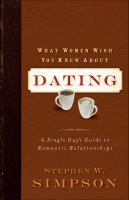
 Some months ago I saw What Women Wish You Knew About Dating: A Single Guy’s Guide to Romantic Relationships by Stephen W. Simpson mentioned on a couple of blogs with, if I remember correctly, the first chapter included on one. Having two sons of dating age and one approaching it in a few years, I thought this might be a good resource, so I wanted to check it out first.
I’m more conflicted about this book than any other in recent memory.
There is a lot I like about it. I agree with a lot of the actual dating advice: getting to know the other person in group situations before asking them out, tips for actually asking them plus suggestions for the first couple of dates, being a man rather than “a guy,” being assertive without being overbearing, taking the lead without being controlling, differences between being authentic (not putting on a false front to impress people) yet not being blunt, working on your life before asking anyone out, signals that she is not interested, understanding that no other person can take God’s place in your life and no one else is responsible for your self-esteem.
But I do have several problems with the book as well.
1. In a discussion of places to meet women and the advantages and disadvantages of each, bars are listed as a possibility. I don’t know why a Christian writer writing to Christians would even list bars and nightclubs: the author does discuss the potential problems of such a setting, and with all the caveats mentioned, any thinking young person would deduce that bars are not really options. To give the author the benefit of the doubt, perhaps that is exactly what he was trying to do: help the reader see the problems without outright saying, “DON’T go to these places,” knowing that that in itself would cause some to seek them out; or perhaps he was thinking of a wider audience who might already have some experience in such places, and he was trying to help them see they were the least attractive options. But I can just picture some people thinking that, because it is listed, and he didn’t say not to consider them, then they’re plausible options: He does say, “This is not to say that bars and nightclubs are evil (though some are close). You can have fun as long as you pay attention to the fun you’re having” (p. 87). As the daughter of an alcoholic and therefore, I am sad to admit, having spent some time in those places growing up, they are really no place for Christians.
2. Drinking alcohol is mentioned here and there as a natural thing that Christians might be doing. If you have a young person old enough to consider dating, you’ve probably already had discussions about your standards on this issue — if not, you should. But with this consideration and the first one, you’d really need to take into account how your young person might respond. (I’m thinking about another post with my own thoughts on this subject, but let me just say for now that though personally I don’t believe in social drinking, I don’t toss a book out just because it might be mentioned, but a book made up of advice for primarily young adults is one where I would be wary of the subject.)
3. I’ve lamented before that reverence seems to be a lost commodity in a lot of Christian literature. Jesus is a “friend who sticks closer than a brother” and was called “a friend of sinners,” but he’s not a buddy. There is a difference. But there is that overly-familiar, irreverent tone towards the Lord in the book, such as “God will never leave you. And He’s a great guy to have around” and our being “lucky to have Him around” (pp. 200-204). I don’t think we have to address Him as “Thou” and speak in King James English to and about him, but to hear the Creator, the Lord of glory being spoken of casually as “a great guy to have around” does just rub me the wrong way.
4. Simpson advocates waiting until the third date to kiss, and that’s with the understanding that the young man has gotten to know the young woman well before he even asked her out: he even advocates it because otherwise “she’ll think you don’t like her” (p. 158). He does advocate waiting until there is some level of commitment and avoiding physical contact on a casual date. Personally I would advocate waiting much longer for that kind of physical contact until there is much more of an understanding and commitment. He also “oks” brief hugs on the first date, but with the increased amount of body contact involved in hugging, I’d hold off on that, too. He also lists “cuddling while sitting up” as an “appropriate physical behavior” for those in “committed relationships” (p. 188). I would be very cautious about that, because, honestly, that’s where a lot of problems start. Parents need to have discussions on this topic with their young people, and seriously dating young people need to discuss it with each other, but one of the things we have told our boys is not to linger with a kiss or hug. Cuddling on the couch while watching a movie is inherently lingering and is especially dangerous if the couple is alone.
Then I have some other areas of disagreement though I wouldn’t call these major problems:
1. The overall tone of the book is more like an older friend or brother coming alongside and giving friendly advice rather than an authority figure giving lists of dos and don’ts, which I think would go over much better with the intended audience. Either the tone or the author’s personal style leans towards a casualness which overall is fine and fitting, (except in reference to God as mentioned above), but here and there it makes me wince, as when, in discussing several Biblical character’s accomplishments, he describes Paul’s trials as going “through a bunch of crap” (p. 37). (I’ve written before how I feel about that word.)
2. He lists as a “myth” the idea that God has one person picked out to be your spouse and that He will guide you to that person. I disagree that that’s a myth — I think God does guide us to the right person — but I do agree probably too many Christians take that to mean there will be some “sign” or that it won’t take personal effort on their part. I think it is like anything else in the Christian life — we don’t always know exactly what is “our part” and “His part,” but they work together: as we walk with Him each day, seeking His direction, He leads and guides, but it doesn’t mean we sit idly by. Dr. Bob Jones, Jr. used to say something like “God will help you with your responsibilities if you ask Him, but He’s not going to do your math homework for you.” He does guide and direct and help, but we have our responsibilities as well, and often He directs through what He guides and helps us to do.
3. For those who believe in courtship over dating, Simpson does not, so if you have strong views you’d want to preview his book before passing it on . I am not one who believes “courtship” is the only option for Christians, nevertheless I do share the concerns some of these folks have. For those who have no idea what I am talking about, there is a growing segment who believes that dating as we know it in this era is wrong for several reasons and that we need to go back to the practice of courtship, where young people don’t date widely and generally, but that a young man comes “calling” on a young lady when he is ready to pursue that relationship through to marriage (unless they discover along the way some reason not to marry), and the girl’s father has to give his permission for this step. There are various levels of belief in regard to courtship, some very rigid and extreme. Perhaps that would be a subject for another post, but the major point I disagreed with Simpson on was a quote from Henry Cloud and John Townsend in Boundaries In Dating that “fear of rejection has spawned the anti-dating movement in the church.” I don’t believe that was the primary factor, if it was a factor at all: rather, I believe it was concern that, 1) the date, form an exclusive relationship with, then break up cycle occurring over and over wasn’t good training for marriage; 2) that these young people who were going together were emotionally married even without being physically and financially married and this wasn’t healthy but rather too intense for this stage of their relationship; 3) that this kind of dating put more temptation and pressure on the young people to get involved physically.
Favorite quotes from the book:
“That’s why this poor girl whom I hardly knew was carrying the weight of my self-worth. It was never hers to bear in the first place” (p. 12, emphasis mine.) (That would solve so many problems if we would realize our self-worth isn’t any one else’s weight to bear.)
“When he’s competing, his goal is to challenge himself instead of humiliating others” (p. 29).
“Confidence is not being cocky and loud. It’s not a personality style. Confidence means trusting that you are God’s unique and important creation” (p. 28).
“You need a reason for getting out of bed in the morning other than finding Miss Right. You need to focus on Mr. Right Now” (p. 36).
“”Being yourself’ isn’t the same as hurling forth every thought without hitting the censor button. It means that you can express yourself while caring enough about someone not to offend them if you can avoid it” (p. 65).
In conclusion, if you have a young adult in your home or under your influence, and you’d like to give them a book about dating, or you are a young person interested in the subject, you would have to evaluate this book (and any other) in light of your beliefs and convictions. I am still undecided about whether to pass it on to my sons or not.
Related posts:
What women want…in a Christian man
 Stray Thoughts
Good analysis, Barbara. I too am the daughter of an alcoholic, and I totally agree with what you’ve said about drinking.
However, Johnny and I married 2 months and 4 days after meeting. We celebrated our 50th anniversary this past July. I know that we are extremely unusual, but God did bring us together; of that I am certain. So waiting more than 3 dates for a kiss would not have worked for us. Different strokes for different folks.
Just goes to show there’s an exception to every rule, Sally! 🙂
Very good review, Barbara, and I’d say I agree with you on practically all of it. Definitely on the casual references to God and the picking up dates in bars – oh my! It was good to read such a thorough review – thanks!
Good review, Barbara.
I am one of those Christians who go to the bar (or bistro) only occasionally with friends, but nightclubs are a definite no-no for me. I think the author has a point when he says, “You can have fun as long as you pay attention to the fun you’re having.” But then again, mature Christians (in age and faith) are better off in this respect than young ones. Anything can happen there.
I’m a social drinker but I don’t get drunk. In fact, I have high tolerance for alcohol which can be a blessing in disguise. I mainly drink wine, though. I’ve tried others including whisky and survived. I think it’s good to drink in the sense to be able to gauge one’s tolerance but to go overboard and become addicted, is something else.
As an Asian, I’m not too keen with physical contact after a short period of knowing a person. Even friendly hugs bother me sometimes. I need to have a lot of personal space. And you’re right, couples alone usually leads to something dangerous no matter how strong they are in claiming to be able to resist, etc. Put alcohol to the equation, nothing matters anymore. The person just gets the ‘boldness’ to anything.
Barb, off-topic: You must post a pic of your boring conference mug(s). You can do this. 🙂
Dating a Christian would be a living hell. The amount of times i’d be told i’m going to hell would be unbearable.
I don’t know why you feel the need to waste your time commenting on a blog and post that you have no interest in, but, be that as it may, I don’t think you have to worry about it because most Christians don’t date non-Christians because we’re instructed not to be “unequally yoked.”
If your sole interaction with Christians is being told that you’re going to hell, I am sorry for that. That’s only half the message — the better half is that Christ loves you and provided the way for you to escape hell and go to heaven by paying for your sins Himself. All He requires is repentance and faith.
Well… I haven’t read this book — BUT… from what you’ve written here – and from reading the description of the book that you link to… the man doesn’t claim – at least on the front cover — and it’s not mentioned in the description – that this is a CHRISTIAN book intended ONLY for young CHRISTIAN men. Soooooo keeping that in mind… it LOOKS like the kind of book that even non-Christian young men might be tempted to pick up and read … and LEARN A LOT! Not only about what young ladies want – but ALSO what God wants — and who God is! This book is the type that rankles you the way The Shack rankled me — but the book has it’s place! If non-Christian young men pick this book up and read it and get to thinking of Jesus as a friend – in THEIR language – then it just may lead to more investigation into God and Christianity in general. And if it does that for even just ONE person… it was worth writing in just the tone it’s written in!
On the other hand – young Christian men who have a good firm background in Christianity, who are well churched and have strong family values are going to whiz right past those things that worry you so much. They already have the “social” background.
This looks like an interesting book. But, I have to make one observation: Why is the author still single? Does he address that irony at all?
Also, as a single, 28 year old, Christian woman, I have to disagree with Melli. In know MAYBE two single Christian men and about 10 wonderful, attractive, godly, single women who want to be married. This disparity in the Church is very sad. I wish more Christian guys would start working on being Mr. Who God Wants Me To Be.
The author isn’t single. He’s married and has two-year-old quadruplets.
Surely i have the right to offer a different opinion? I realise many christians don’t like any challenge to what they see as “truth”, but that’s not me.
In regards to your second point. I do not believe in a God, nor do I believe in Jesus. In fact, I doubt he even existed given the amazing coincidences between his life and the Roman God Mithras’ life. But let’s say he is watching over me. Surely he knows i’m not going to believe in him? He knows all right? How can I be punished for just being myself? Why am I going to be punished for being true to myself? If God punishes those who happen to disagree with everything that is written about him, then that’s perhaps the most evil dictator the World has ever known, and I want nothing to do with him.
You’re certainly entitled to your opinion. It just doesn’t make sense to me to go to a place of someone who believes differently and say, “I don’t believe what you believe and I think what you believe is evil.” That’s more provocative than constructive. You wouldn’t want a Christian to come to your site and do that, would you? Unless you’re just one of those people who just likes debate rather than engage in actual conversation. You don’t appear to be interested in anyone’s opinion but your own.
This isn’t an open forum. It’s a personal blog. There are plenty of places online where you can debate to your heart’s content. I’m not interested.
I like debate. Which is perfectly fine. Of course it’s provocative. How can I offer anything constructive when it comes to faith? Debates have to be provocative. I would love a Christian to come and argue with me on my many anti-religion blogs. My ‘hypocrisy of the Christian right wing’ is just begging to be debated.
I’m interested in all opinions. But i’m the type who will argue my point until exhausted.
You appear to only be interested in people who blindly agree with you, you don’t want to hear any criticism, much like Christianity on the whole.
That’s not true. I am willing to discuss civilly with people who differ from me, but not argue or debate. I’ve had many interactions with people who believe differently than I do. But in this case I see no point in it.
Oh, sorry Barbara. I just assumed he was because of his title. The fact that he is married gives his book even more credence.
I have not yet read this book, however I am looking forward to the read. I am very thankful for Your insight into it and has made me want to read it more.
On the issue of God as a friend, I have always felt that He is one that can take many rolls in our lives. One being our heavenly Father and like my dad leads me in a way that is pleasing to Him(God) and another roll would be that of GOD, the God that made all that we see around us and that which we can’t. Thinking of how big the universe is and how small earth is in comparison and then how small we are to the earth. We are but a mear spec with in a spec with in a spec….Just the thought that God loves us…. WOW!! He could take time out of being God to love a microscopic spec, thats beyond me.. and then God as my close person friend… To a person of this generation a friend at times can be closer then blood family and some one you can always trust, I think(even have not read the book yet) that the Author has hit the nail right on, that is for his target Audience.
Thank you for your insight and I hope what I have said on my thoughts makes some since.
I know its been a while, but as I was reading this book, I just have some quick thoughts regarding some of your concerns:
You said you had two children of dating age, but this book was not written for teenagers – it was written for grown men, and yes, there is a difference in how the two should be dating – the reference to drinking and bars I would say is an obvious sign of that. I would not give this book to my son (if I am blessed to have one) to read this at 15 or 16. If he were single at 24? Yes. Having read this book, when my son was beginning to date as a teenager, I might re-read it and let its basic ideals guide some discussions with him, but I would modify my presentation to fit his age.
As far as the “no social drinking” – I don’t drink either, both my grandparents on one side of the family struggled with drinking badly. But that some fall into sin from an activity does not make the activity sinful. Christ turned water into wine for a wedding – obviously, that is the very definition of social drinking! A social feast and celebration, where you drink in celebration of what God has done! I don’t drink, and it took me about 4 months per drink to find one beer and one one wine I could stand to drink, I did find one of each in case I was ever in a social situation where to refuse a drink would be seen as an insult (not a problem in America, but in many places of the world – Europe, Asia, and South America – this is actually quite common).
Finally, as far as Christ not being our “friend” but not our “buddy” – yes, and no. No, he is not “one of the guys” who will overlook our problems for the sake of having a good time. He is holy. But he is, at the same time, more than willing and capable of being as intimate as a buddy, and can/does enjoy a laugh and having a great time as much as we do. So he’s not what we usually we are used to as a “buddy” – the only way Christ can’t be our buddy is if our idea of buddy is warped (which, in our world, often happens). Buddies shouldn’t be okay with sinful behavior. They often are, but they shouldn’t be. But the familiarity is perfectly acceptable IF, and let me stress the IF, you are walking with him and living a lifestyle of repentance (note that I did not say sinless – that doesn’t happen this side of heaven, but we should be actively fighting sin, not living comfortably with it).
God created human society. Originally it was based on the community God shared with himself in Father, Son, and Spirit. Our has fallen, but every good aspect of our relationships and feelings are rooted in God, and he feels them even stronger than we do. When God wanted to stress in Isaiah how strong his love for us is, he gave the image of the intimate love of mother has for her still nursing infant – and then said his love for us is stronger. He often used marriage – but he has been more faithful in our faithlessness than any human has – the only one who even kind has a fraction of God’s steadfastness in that sense is Hosea. And Christ did indeed describe himself as the friend that sticks closer than a brother – and brothers are VERY frank and intimate.
We often try to understand God by placing ourselves in his shoes, when in reality he already gave us a much better idea by placing himself in our shoes while telling us about himself. When you think about it, God is not just some formal benevolent force. That is not what agape means. Agape is superior to philios, but not because agape has purged itself from the emotional root that philios is tied to, just like God is supernatural doesn’t make him unnatural. God is not bound by nature – he is its Master. But neither is he unnatural, for nature is itself a reflection of his character. In fact, God’s miracles that seem to contradict nature never appeared until nature was cursed and fallen due to man’s sin. Think of the miracles Christ performed. Raising from the dead – death was not a natural outcome for man in the beginning. Removing sicknesses. Sicknesses were not natural in the beginning. When I think about it, the only miracle Christ performed that changed something that was already good was water to wine – and water is a big part of wine, but wine is better – he took something already good and made it better. Christ never really “broke” the laws of nature. Rather, the miracle was that his power over nature were demonstrating his ability to render its cursed state mute, and restored what he touched to its perfect state that he had intended for it originally, as it would have been before the fall.
The same thing is true of Agape. What makes Agape better than Philios is not that it has purged itself from feeling. If that were the case, Agape would be lacking something that is key for the human spirit. In fact, to take the supernatural metaphor to its natural extent, Agape actually feels MORE keenly than Philios. However, Agape is self-sacrificing in a way that Philios is not. What is truly amazing about God’s purity in his love isn’t that he acts holy because he isn’t tainted by the passions we have. Many of our passions were given to us by him, and he possesses them and feels them infinitely stronger than we do. And yet, he never lets them rule him. He rules himself, and remains holy. God never sins in his most extreme emotions. And one of the reasons, if you read Scripture is obvious. He gave us every example of the most passionate loves humans experience, and says he loves us more. But he also says that Trinity – Father, Son, and Spirit – love each other sacrificially and more than they love even us. If God loves us more than we can even imagine loving, how strong must the Persons of the Trinity love each other that God’s love of himself is stronger even than that.
I am not saying God is some over-emotional always on some high feeling character who is teetering from one extreme to another. Calm and Peace are also of God. My point was simply our nature, though fallen, was created in God’s likeness. Many of these passions God gave us and calls good – in which case, they came from him and are of him. And that includes intimate friendships.
God is King and Creator, and he is also Friend and Father. A blessing of time is that we can experience those in their fullness at different times to fully appreciate it. There are times when it would indeed be horribly inappropriate to waltz up to him on his throne and go “WHAT’S UP?!” But it also would be an insult when God has given up so much of himself for a personal relationship to deny him the privilege (it is so because he deems it, not because we are worthy of it) of our intimate friendship, to laugh with us, to cry with us, when it was for being with us eternally that he sacrificed himself. Why do I think this?
Because in the Garden, before he ever gave Man a command, he blessed them. Told them to be fruitful and multiply. And in the evenings he came down and walked with them, sharing in their delight and their company. It was a very intimate friendship. God didn’t just create subjects – he had angels for that. He created – what, at the time, were pure “buddies”.