
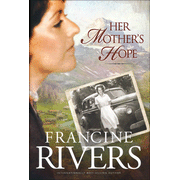
 The first blurb I saw for Her Mother’s Hope by Francine Rivers mentioned mother-daughter conflict, and that in itself didn’t sound like something I would want to read, but Francine writes riveting stories, and I knew there would be much more depth. And indeed, there was.
Marta Schneider is born to an abusive father and a God-fearing mother in Switzerland in the late 1800s. As she grows older, her father takes her out of school at a young age and sends her out to work at various service-related jobs. When she foresees that her life will never change, with her mother’s encouragement, she leaves.
Marta tackles anything that comes into her path with resolve and hard work. She travels various places and learns different skills and languages with a desire to open her own boarding house some day. When she finally realizes her dream, she unexpectedly falls in love with one of her boarders and marries.
When Marta’s daughter, Hildemara, is born early, small, and frail, Marta is determined that she will never end up as her younger sister, Elise, did, who was a fragile soul, beautiful and overprotected, who came to a tragic end. Marta’s efforts to make her daughter tough and strong are often misunderstood. Hildemara feels as if she can never obtain her mother’s approval, so when she can she goes off on her own quest.
You just ache for these two and their misunderstood actions toward each other.
I also enjoyed Marta’s relationship with her quieter husband, the fact that though she drives him crazy sometimes, he loves her and her “fire.” They spar often over — well, over many things, but most often over the need to rest and wait on the Lord versus the need to take matters into their own hands and do something.
The historical backdrop covers two world wars, the plight of immigrants to this country, especially when their old and new countries are at war, and the hard life of a sharecropper.
Francine shares that though the story is fictional, it contains many facts from her own family’s history.
It’s not a short read at 483 pages, but it goes quickly. I enjoyed spending an entire evening with this book, which is rare for me — I usually read in bits.
I don’t feel as if I am doing the book justice, so let me just say I recommend it. I have readers who would want to know these things, so I will just mention that there are a couple of instances of intimacy between Marta and her husband that were more explicit than I wanted to read, but they are very brief.
I am glad I waited to read the book until this time, because the sequel, Her Daughter’s Dream, is due out today — so I don’t have to wait long to find out what happens next!
(This review will be linked to Semicolon‘s Saturday Review of Books.)
 Stray Thoughts
Oh, I”m glad you liked it in the end. And I knew that the sequel was due out this fall but I lost track of it and didn’t realize it came out TODAY! Thanks for the heads up!
Oh, I liked it way before the end! I liked it early on once I started. It was just the concept that didn’t quite grab me when I first heard of it, but I knew in Francine’s hands it would be good.
I loved this story! I didn’t know the sequel was out today! Darn I just spent my quota at the book store on the weekend, if I’d have known… LOL.
I love Francine Rivers’ books. But hadn’t heard of these two. Do you think there will be a third? Or is this a two-part series? I can’t bear not to have the sequel at hand when I’ve started 😉 Thank you for the review and I look forward to finding these books soon.
Hmm… I’m wondering where I read another review of this book. This makes two thumbs up.
I’ve never read any Francine Rivers, but this one sounds like it would be a good place to start.
Good morning, Barbara… interesting. I have to admit I have not read any of Rivers’ books. I tend to like my fiction shorter. But maybe this would be great for a trip…
Pingback: Fall Into Reading 2010 « Stray Thoughts
Pingback: What’s On Your Nightstand: September « Stray Thoughts
Pingback: Book Review: Her Daughter’s Dream « Stray Thoughts
I’ve actually struggled with Francine Rivers lately. I found that Her Mother’s Hope didn’t have very much hope at all. After writing my own review (which you can read at http://www.tracysbooknook.com ) I went out and read about 50 other reviews, and 50 out of 50 loved this book. I guess there’s always one in the crowd who doesn’t fit in – and this time it’s me. 😦
-Tracy
I could not make it past page 28, and even that was about 10 pages after I started searching for a reason why this book may not be as bad as it seems.
The reason: Tacit approval of abuse, choosing sides for the abuser and not the person abused, is characterized as Godly behavior. By the name and back blurb, the mother is regarded as the good person in Marta’s life. Marta is physically abused by her father, unjustly punished, taken out of school, not given her money from her employers…
Her mother, the “good Christian” of the book, does not care about “when you did it not for the least of these, you did it not for [Jesus]”. She does not care that Jesus came to set free the oppressed, that working for justice is the work of God. She does not secretly go to speak to the nicest among Marta’s employers, asking them to give Marta ful-time work and lodging, and to give Marta her own pay instead of giving it to the father (escaping an abusive situation by living elsewhere). The woman never even say: “Sweetheart, I love you. And your father is wrong, he should not do that. I don’t know how to help, but know that this is not what you deserve.”
The religiousity of the mother consist of messages like telling the daughter to forgive, to count her blessings, to not lose hope, but no practical advice. She never directly or through someone else, gives any messages to the very sinful father.
If preaching to the weak to forgive ongoing abuse, without doing anything to lift their burden, is shown as Christian love, the Christianity of the book is not at all compatible with “the righteous are bold as lions.”
It makes me wonder if Rivers have been taught a pink and blue “Christianity” in which “the righteous are bold as lions” is for men, and “the fruit of the spirit is gentleness” is for women. A religion where helping the weak is a lower priority than obeying even abusive authorities if you are a woman.
That’s a lot of assumption for only having read 28 pages. 🙂 Because there is unchallenged abuse in a story doesn’t mean the author approves it. This was based in part on Rivers’ own family story, so perhaps that kind of thing is in her background. In that era women (not just Christians) thought they had to “take” it and had no recourse. It’s been 1,015 years since the setting of this story, and even though some women today stay in abusive relationships, by and large it has been preached and urged that this is wrong and no woman should have to put up with abuse toward herself or her children. There are shelters available now that I doubt they had then. I don’t think at all that Rivers has two standards of Christianity differing for men and women. She’s not promoting abuse or saying it is ok: she’s just telling a story that sadly has happened in too many homes, showing how the daughter overcame her background, and later in the story the trouble her background caused in relating to her own daughter.
I hear you, but where does the 1015 comes from? The book is set in the early 1900s.
Oops – 115 years since 1901, not 1,015.