
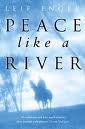
 I had seen many bloggers refer to Peace Like a River by Leif Enger years ago, and I put the title on my TBR list, but only got to it the last couple of weeks: my family wanted ideas for my birthday, and I scanned my list of TBR titles and suggested this one and a couple of others.
The story is told by eleven-year-old Reuben Land, who almost didn’t survive his birth as a severely asthmatic child but was brought back after twelve minutes without breathing by his father calmly saying, “Reuben Land, in the name of the living God I am telling you to breathe.”
Thus begins a series of miracles at the hands of Reuben’s father. After many of them Reuben says, “Make of that what you will.” Honestly, I don’t know what to make of that, and that may be why I hadn’t sought out this title earlier, but figuring out the author’s theology of such isn’t really necessary to enjoying the story. Reuben narrates the book as a witness: “Someone to declare, Here’s what I saw. Here’s how it went. Make of it what you will.”
In Reuben’s eleventh year, his brother Davy kills two bullies, somewhat but not entirely in self-defense, and escapes jail when he seems sure to be convicted (not much of a serious spoiler there as the back of the book refers to Reuben’s “outlaw older brother who has been controversially charged with murder.”) There follows a strange dichotomy of heart for some of the characters and for me as a reader as well: you find yourself hoping Davy is okay, yet knowing that he has to face justice, and grieving that he seems to have no regrets or repentance. After a time Reuben, his nine-year-old sister Swede, and their father go after Davy to try to find him, only to discover after a time that the FBI is following them. Throughout it all the character of each unfolds through the events, especially that of Reuben’s father.
Leif Enger is a wonderful storyteller. The book feels as if you’re sitting across from him in rockers on the front porch, listening to him tell a story. One reviewer’s blurb on the back of the book says “his novel moves in a current that can be poetic and slow or as tumultuous as whitewater rapids,” an apt description. He’s no mean poet as well, as through Swede he shares segments of an epic Western poem (though it didn’t seem like this could come from the hand of a nine-year-old girl, precocious as she was). I also liked that the chapter titles were significant: this was the first book in a long time in which I paid attention to the titles and at the end of each chapter looked back and thought about the title designations. And at the end of the book, when I turned it over and looked again at the front cover, I realized with a start who the shadowy horseback rider was, and nearly came to tears.
Some of Enger’s phrases stood out to me as well: a description of a particular women who “resembled an opportunity missed by Rembrandt”: “Fair is whatever God wants to do”; a reference to something people say “as if they’ve been educated from greeting cards.”
There were humorous parts as well: in one incident when Reuben and another girl end up in the church kitchen during a long service and start to make pancakes, the smell floats up to the sanctuary, influencing one man to “prophesy” about heavenly smells at the Lord’s banquet table.
I probably should say for some readers that though there is a description of a charismatic service, I am not charismatic and not promoting that kind of thing, but I am not going to dissect all of that. One doesn’t have to agree with every little point in a book to benefit from it.
I did enjoy the book and it had me pondering for a while afterward. In a search earlier today I came across this interview which shed more light both on the author and the book. I am definitely planning to put his next one, So Brave, Young, and Handsome on my TBR list.
(This review will also be linked to Semicolon‘s Saturday Review of Books.)

 Stray Thoughts
Great review, Barbara. I enjoyed reading it!
I read this one before I started blogging, but I remember it as an unusual book in a way, one that left an impression. I remember ‘Brave Young and Handsome’ more clearly because I read it as a blogger and reviewed it. 🙂 Very different book, but I thoroughly loved it.
This one stands out in my head as being one of Lisa;s (Lisa Writes…) favs. I read it a few years back and still remember the majority of the storyline – which is saying something because I generally forget story lines. (Hence the blog!) As Janet said, it left an impression.
I forgot he had a second book. Can’t say I’ll run out and look for it but I WILL watch and see what you think of it. I know I’d want to make time to re-read Peace Like a River before I picked up his second book so we have a time problem. But convince me it’s worth it and I will!
Very interesting. I’ve had this on my TBR list for awhile too.
Loved, loved, loved Peace Like a River. I’m reading So Young, Brave, and Handsome now.
I confess that when I saw your link at Semicolon, I thought to myself, “Oh, I hope she liked it!”
Here’s my review of Peace Like a River—> http://www.hopeisthewordblog.com/2008/12/03/book-review-peace-like-a-river-by-leif-enger/
Pingback: What’s On Your Nightstand: September « Stray Thoughts
Pingback: 52 Books to Remove from my TBR List « bekahcubed
I am reading Peace Like a River for my AP English class and found it to be a very interesting book. The book goes far deeper into the aspects of a family than most. Leif Enger goes beyond the surface of how a family functions and realizes that all families are broken and dis-functional in their own way. The important thing to remember, Enger reminds us, is that we need to react to certain trials with confidence and strength to hold the family together. The father in this book demonstrates the kind of strength it takes, one that only comes from God.