
I read Susan Meissner’s Lady in Waiting last year and subsequently wanted to read more of her books. So I recently picked up The Shape of Mercy which was published in 2008, and I remembered several bloggers mentioning it and liking it, so I decided to give it a try.
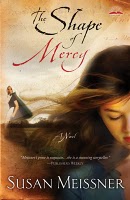 In The Shape of Mercy, Lauren Durough comes from a family of wealth and privilege, but wants to forge her own path, her own destiny. She defies tradition by going to a different college than expected and living in the dorms, and she takes a further step by looking for a job to take care of living expenses rather than depend on her father’s stipend. That leads her to an eighty-three year old well-to-do retired librarian, Abigail, who is looking for someone to transcribe a diary that was written by one of her ancestors, named Mercy, who had been arrested and convicted during the Salem witch trials.
Lauren learns that misjudgment and jumping to conclusions did not die in 1692, but she is especially startled to learn the extent those elements rule her own heart.
Overall I thought this was a marvelous, multi-layered book. Susan brilliantly wove together the diary entries with the contemporary story, and I was drawn in to Lauren’s growth and realizations about herself as well as her curiosity about Abigail’s life. There were times when I didn’t want to put the book down, times I was almost in tears for different characters.
This would be one of those five-star, two thumbs up reviews except for just a couple of things.
Major Spoiler Alert:
It doesn’t bother me so much that one character commits suicide — I think such a thing is always a tragedy, but I can accept it as part of the plot because such does happen in the real world. What does bother me, though, is that is is regarded by the other characters as something heroic, sacrificial, and done out of love when biblically it is never regarded that way. “Thou shalt not kill” certainly applies to one’s own life as well as others. There is a difference between taking a bullet for someone and aiming that bullet at yourself. Suicide is the ultimate taking of your own life into your own hands and the ultimate lack of faith in God to handle one’s life circumstances as He sees fit. There were Bible people who wanted to die, but they left the actual process to the Lord. I don’t want to turn this into a treatise on suicide, but felt I must explain why the response in this book disturbed me.
Secondly, at one point the author refers to “that bit of the divine still smoldering in us.” If she means that we’re made in God’s image and some of that can still be seen even though we’re marred by the fall of man and our own personal sin, I can agree with that. If she means some spark of divinity resides in every human being, I can’t agree with that.
But other than those two elements, I really enjoyed the book and I do plan on reading more of Meissner.
Something neat I just found earlier today is a blog where Meissner continued the stories of some of the characters as blog posts here. I poked around just a bit today and I am looking forward to reading a bit more.
(This review will also be linked to Semicolon‘s Saturday Review of Books.)

 Stray Thoughts
I have the same thought on “what did the author mean when she said…?” related to the bit of the divine. Interesting.
I loved this story. Can’t remember that quote though. I’ll have to reread and see what the context is that she put it in to see what I think. Another great story by her is “White Picket Fences”.
Pingback: What’s On Your Nightstand: September « Stray Thoughts
I’ve read this and really enjoyed it as well. Those two instances you mentioned also made me stop and ponder. On the whole, however, as you said, it is a great multi-layered novel.