
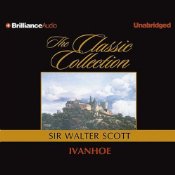
 I listened to Ivanhoe by Sir Walter Scott via audiobook from Audible.com: I got it when they had a $4.97 sale on several of their audiobooks.
The setting is 12th century England just after the Third Crusade. Many knights were headed back to England, King Richard the Lion-Hearted was thought to be a prisoner of the Duke of Austria, England was ruled by Richard’s unscrupulous brother, Prince John. The Normans has conquered the Saxons some years earlier and there was still bad blood between them. Ivanhoe was a knight who had been off to fight the Third Crusade with Richard, and because of his alliance to the Norman Richard, his Saxon father disinherited him.
As the story opens, Ivanhoe is not thought to be back from the Crusades yet. His father, Cedric, wants his ward, Rowena, to marry his close friend, Aethelstane. Those two are the last of the Saxon noble lineage and the last best chance for uniting the Saxons’ power to resist the Norman rule, at least in Cedric’s mind. But Rowena loves Ivanhoe, and of course Cedric will not allow her to marry him.
At a tournament, a two disguised knights figure prominently. You might guess who the one called the Disinherited Knight was. My first guess about the other, the Black Knight (also called the Black Sluggard because he did not fight except to assist the first knight) was wrong, but my second guess was right. A yeoman named Locksley also distinguished himself and annoyed Prince John in the archery segment.
On the way home after the tournament, Cedric’s party, including Rowena, Aethelstane, and a Jew named Isaac and his daughter, Rebecca, were attacked and captured by a group of knights, one of whom was attracted to Rowena and somehow thought capturing her in this way would convince her of the depth of his passion for her. Of course, she refused him, and meanwhile friends of Cedric made plans to storm the castle, joined by Locksley, also known as Robin Hood, and his merry men.
The results of that battle, which lead to another capture and another climax, I’ll leave you to discover if you decide to read the book.
The book started out very slowly at first, but once the action picked up the story held my attention pretty well. There are the classic elements of this type of story: chivalry, quests, castles, knights, good vs. evil. etc. The evil isn’t embodied in any one person or group: the knights, the politicians, and even the priests all have corrupt segments.
Robin Hood was the stuff of folklore long before this, but this book is credited with describing him as we think of him these days.
There are wry comic elements and characters as well. One line about two priests “vituperating each other in bad Latin” cracked me up.
The one jarring element in the book is the extreme prejudice against the Jews. They are constantly called names (“Dog of a Jew!’ “Daughter of an accursed race!” Somehow they missed their description of them in the Bible as God’s chosen people.) One character, on thinking he was about to die along with a Jew in the storming of the castle, thought it would be better to kill the Jew than to die in his company and would have killed him if something else had not interfered. According to Wikipedia, “The book was written and published during a period of increasing struggle for emancipation of the Jews in England, and there are frequent references to injustice against them.” I’m not sure whether Scott was writing to highlight these injustices so as to call attention to them for the purpose of alleviating them, or if he just considered them normal, but they are very disturbing.
By the way, the Wikipedia article does tell pretty much most of the plot of the book, so if you’re wanting to read the book I wouldn’t advise looking there too much til afterward.
Every now and then I get a craving to read something medieval, and this certainly fit the bill. I hadn’t known much about this time period, but after finishing the book I was curious enough to spend some time looking up this era, the Crusades, the Knights Templar, etc.
The audiobook was read by a Michael Page, and he did a marvelous job giving different voices to a wide variety of different characters, from knights and nobles, to women, to snooty priests, to the amusing Robin Hood and Friar Tuck and Jester Wamba, to the old Jew Isaac and his daughter Rebecca.
Overall the time spent listening to Ivanhoe was a very enjoyable experience and made driving time enjoyable rather than boring. You can probably find a copy of the book in your library, and the text is online here and here.
(This review will also be linked to Semicolon‘s Saturday Review of Books.)

 Stray Thoughts
I have only watched the BBC A&E rendition of Ivanhoe. I had secretly wanted him to end up with Rebecca during the presentation.
Thanks for your review. I liked Ivanhoe when I read it some 15 years ago. I was self-guilted into it because I wrote a paper on an “unread” Ivanhoe in college. Got an A, so I thought I would do penance in my later life! I’m thinking an audio re-read might be a good thing.
I’ve never read this one. (Sigh.) But I feel I most definitely ought to.
A classic novel, one of Scott’s best. You should give Rob Roy a look – it’s just as good, if not better. 🙂
Hmmm. . . I *should* read this, but it sounds like it might require more brainpower than I currently possess. Two of my favorite children’s novels set in this period are The Door in the Wall and Adam of the Road, the next time you get a hankerin’ for something Medieval. 😉
I love the classics and haven’t read Ivanhoe. Your review makes me want to read it! Thank you!
Pingback: What’s On Your Nightstand: April 2012 « Stray Thoughts
Pingback: Odds and ends « Stray Thoughts
Pingback: Spring Reading Thing 2012 Wrap-Up « Stray Thoughts
Pingback: Books Read in 2012 « Stray Thoughts