
If people think about humility at all these days, they usually envision self-deprecation, playing down one’s attributes, talents, or accomplishments, or, at the very least, not bragging.
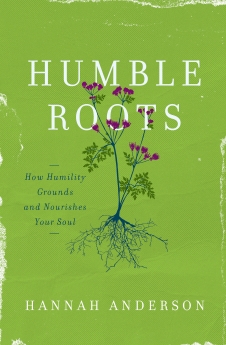
In Humble Roots: How Humility Grounds and Nourishes Your Soul, Hannah Anderson explores humility from a Biblical angle. Instead of viewing humility as a club or prod when we’re feeling too proud, humility frees us and leads us to rest.
I defined humility as a correct sense of self, as understanding where you come from and where you belong in this world (p. 64, Kindle version).
Theologically speaking, humility is a proper understanding of who God is and who we are as a result (p. 102).
I would describe it as a creaturely dependence. We’re “made in His image, but we are made nonetheless (p. 11)—made originally from dirt, to which our bodies return. As Paul reminds Timothy, “we brought nothing into the world, and we cannot take anything out of the world” (1 Timothy 6:7). Everything we are and everything we have comes from God.
The problem is our obsession with ourselves. With our need to fix things, our need to make ourselves better, our need to be approved by God and others, our need to “count for something.”
But this is also why Jesus calls us to come to Him. By coming to Jesus, we remember who we are and who we are not. By coming to Him, we come face to face with God and with ourselves. “It is only in our encounter with a personal God,” writes philosopher Dietrich von Hildebrand, “that we become fully aware of our condition as creatures, and fling from us the last particle of self-glory” (p. 55).
If I can’t handle little things, what can I handle? Failure at small things reminds us of how helpless we are in this great, wide world. When little things spiral out of control, they remind us that even they were never within our control in the first place (p. 26).
Humility, instead of being a negative concept, frees us:
to be the people God created us to be (p. 11).
from the cycle of stress, performance, and competition (p. 12).
from our burdens . . . by calling us to rely less on ourselves and more on Him (p. 32).
to redirect our energies toward God and those whom He has given us to love (p. 3).
from the condemnation of others, . . . from self-condemnation and unnecessary guilt (p. 108).
to hear God’s call and leads you to a place of both rest and flourishing (p. 110).
from the oppression of our emotions, when we finally learn that “God is greater than our heart (p. 114).
from the responsibility of feeling like you have to “do it all.” You are free to do only what you have been made to do (p. 163)
. . . and so much more.
Hannah follows Jesus’ admonition to consider birds and flowers by grounding each chapter in something from the garden or nature. For instance, the chapter “Vine-Ripened” begins with all the work that goes into growing garden tomatoes, then being fooled every year into thinking the ones gassed for redness in stores will be the same. That leads into a discussion of wisdom being rooted not in acquiring facts, but in submitting to the source of wisdom–the fear of the Lord. Then an 1800 court case over whether tomatoes are vegetables or fruit is tied in, along with our relentless desire to be “right.” “Humility simply leaves room that my understanding of a situation could be wrong” (p. 124). We may not have all the facts or may be influenced by culture. Because we’re limited, “my faith cannot rest on my own knowledge . . . or ability to understand . . . humility leaves room for grace” (p. 124). How unlike most social media discussions, where everyone is right in their own eyes. Hannah then refers to an Isaac Watts book which discusses a “dogmatical spirit.” Our wisdom and safety come not from our being right, but from Jesus being right. Then the chapter goes back to the process of creating store-bought tomatoes, compares that with our search for wisdom, and extols the wisdom of waiting: “Humility teaches us to let knowledge ripen on the vine” (p. 129). The chapter is much more beautifully woven together than my cobbled summation here.
Hannah points us to Jesus, “who, though he was in the form of God, did not count equality with God a thing to be grasped, but emptied himself, by taking the form of a servant, being born in the likeness of men. And being found in human form, he humbled himself by becoming obedient to the point of death, even death on a cross (Philippians 2:6-8) and who invites us to “Take my yoke upon you, and learn from me, for I am gentle and lowly in heart, and you will find rest for your souls” (Matthew 11:20).
Besides benefiting from the truths Hannah shares, I marvel at the way she is able to weave together facts from nature, literature, Scripture, and personal example seamlessly into each chapter. I don’t know how she accomplishes this without time to just sit and think, but as a busy pastor’s wife and mom, I’m sure such time is at a premium. I first read one of her books during Advent and have been working my way through her others. She has quickly become one of my favorite authors.
Even though I just finished this book, reading one chapter a week, I am thinking about going through it again. I need to soak in its truths more.
(I often link up with some of these bloggers.)
 Stray Thoughts
And now I want to reread this book…!
I really appreciated Hannah Anderson’s book, Barbara! She had great insights, “Humility is accurately understanding ourselves and our place in the world. Humility is knowing where we came from and who our people are. Humility is understanding that without God, we are nothing.” -https://strengthwithdignity.com/humility-in-leadership
Thanks for the great review! Now I want to get ahold of this book! We’e been talking a little about what humility is and isn’t according to Scripture so this is very timely.
New author to me, and I love the topic. I like your idea of humility freeing us and leading us to rest. That’s so different from the view we get from the world.
This sounds like a great book. I think humility is often under-rated. The most memorable description I’ve heard of it is that it’s not thinking less of yourself; it’s thinking of yourself less.
Your review has intrigued me. I think I will look for this book.
For there is one mediator between God and men, the man Christ Jesus. 1TIMOTHY 2:5 . Now this is the main point of things we are saying. We have such a High Priest, who is seated at the right hand of the throne of the Majesty in the heavens. A Minister of the sanctuary and of the true tabernacle which the Lord erected, and not man. Hebrews 8:1-13, Jeremiah 31:31-34.
more of Him, less of me. therein is the secret to the vibrant Christian life.
Sounds kind a great one for our Book Club!
Blessings, Jennifer
Excellent comments about humility in your review. I want to read this book!
Pingback: June Reflections | Stray Thoughts
I think humility allows us to see ourselves along with others, not separate. Without the separation we will always be more caring of others, as well. Nice post, and thanks for sharing with SSPS #267.
Congratulations, your post will be featured on SSPS, Monday and also on FB Bloggers Share, Care & Inspire as well as Instagram: _esmesalon
Hannah’s book sounds great. This is one I’m going to have to add to my book wish list. This is a great review. Pausing to reflect on this.
Thank you so much for sharing this with Sweet Tea & Friends this month dear friend.
I buy about 5 English books every year. I’ll add this one to my list now. Thank you for this review. It seems like a very good book.
Pingback: The Most Important Way to Change | Stray Thoughts
Pingback: July Reflections | Stray Thoughts
Pingback: August Reflections | Stray Thoughts
Pingback: Books Read in 2023 | Stray Thoughts
Pingback: 2023 Reading Challenge Wrap-Up | Stray Thoughts