
When I was in school, the types of sentences we learned about were declarative, interrogative, imperative, and exclamatory. There were also simple, complex, and compound sentences.
Recently I learned about right-branching sentences.
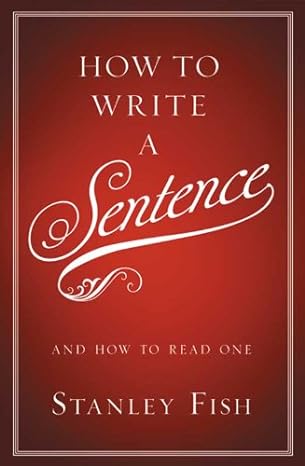
But Stanley Fish doesn’t write about any of these in How to Write a Sentence and How to Read One.
First he spends time explaining what a sentence is: organization of words in logical relationships.
If one understands that a sentence is a structure of logical relationships and that the number of relationships involved is finite, one understands too that there is only one error to worry about, the error of being illogical, and only one rule to follow: make sure that every component of your sentences is related to the other components in a way that is clear and unambiguous (unless ambiguity is what you are aiming at) (p. 20).
He suggests practicing various forms of sentences without regard to content at first to get used to logical progressions and connections. He compares this to learning scales in music.
He expounds on the subordinating, additive, and satiric styles of sentences.
The subordinating style, he says, is technically called hypotaxis. This involves “the art of arranging objects and actions in relationships of causality, temporality, and precedence” (p. 50).
The additive style, also known as parataxis, involves a “coordinate, rather than a subordinate construction” (p. 62).
The first displays “planning, order, and control”; the latter has the effect of “spontaneity, haphazardness, and chance” (p. 61), even though it might be just as carefully planned.
“Satire, the art in which ‘human vice or folly is attacked through irony, derision, or wit'” (p. 89), is a “content category . . . but there’s a lot of formal skill in writing satire” (p. 90).
Fish has a chapter on each of these styles with numerous examples from literature. He also has a chapter on effective first and last sentences, with abundant examples as well. Many of the examples are well-known; some are obscure.
My one quibble with his examples, though, is that many of them are from older writings and are so long, no editor would allow them today. One random example on page 145 (Kindle version) has 76 words and nine clauses. One can say a lot with that much material!
Nevertheless, the point is taken that effective sentences are thoughtfully arranged, not randomly scattered.
Some of my favorite quotes from the book:
Language is not a handmaiden to perception; it is perception; it gives shape to what would otherwise be inert and dead (p. 42).
Content must take center stage, for the expression of content is what writing is for (p. 134).
What you can compose depends on what you’re composed of (p. 138).
Evanescence can be produced by language that in its mundane use sits inert on the page (p. 146).
I think I’ll need to read this book again to benefit from it more. It had the misfortune of being dipped into in bits and pieces among other reads. But I think my brain needs a rest first. I was glad I read this via the Kindle app, where I could tap some of the words I’d never seen before and use the built-in dictionary to find out what they meant.
But I can recommend this book for thoughtful examination of what sentences are and how they can be effectively composed.
 Stray Thoughts
Well this sounds pretty intense! I enjoyed your review though and I can see value in reading such a book, especially as a writer. Your point about his using older writings is interesting. One thing I notice as I write in different ways is that there’s a definitely different way of writing “for the web” — shorter paragraphs, paragraphs separated by a space rather than indenting for a cleaner visual look, etc.
Yes, I’ve read that about writing for the Internet as well–lots of white space, shorter paragraphs and sentences. That’s even filtering into books these days. They encourage sections of bullet points and such so pages don’t look so dense.
This sounds like quite a book! Definitely not light reading. As a reader more than a writer, I still can see the advantage of a good sentence. So sentences I’ve read so either so long or difficult to follow that I forget what I was reading at the beginning of the sentence.
Now this sounds like an interesting book…maybe as a resource book too. I had to chuckle when you mentioned about the one example he gave having 76 words. My thought was about that’s the way the Puritans wrote. And I do love reading the Puritans, but sometimes by the time I get to the end of the sentence, I need to go back and reread the first part of it. 🙂 I would definitely like to get a copy of the book because I know I could learn a lot and improve my writing “skills” as a result of putting it into practice. Thanks for the review, Barbara.
Getting the sample of this one sent to my Kindle! Sounds like an interesting book for us word nerds. 🙂
Sounds like a slow read with much insight. I enjoyed your favorite quotes, especially: “What you can compose depends on what you’re composed of”
SSPS#36
Pingback: January Reflections | Stray Thoughts