
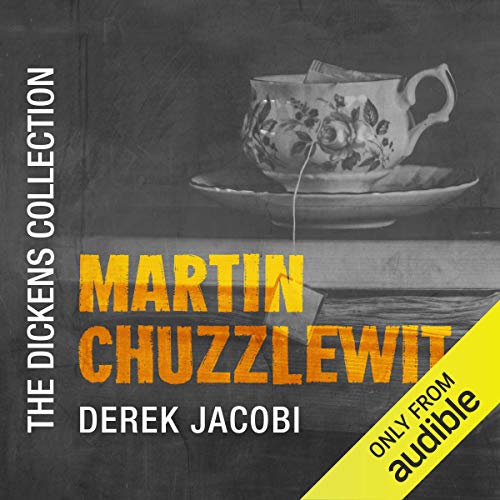
There are two Martin Chuzzlewits in Charles Dickens’ eponymous novel, originally titled The Life and Adventure of Martin Chuzzlewit.
The older Martin feels bitter because his relatives fight over his money. He tries to steer clear of them all, except his grandson with the same name. He has hired a young woman named Mary with no family as his caregiver and companion. He pays her well but promises that he will not put her in his will. He reasons that with no expectations after he is gone, she’ll be motivated to keep him alive.
Problems arise when young Martin, the grandson, falls in love with Mary. Grandfather and grandson have a falling out, resulting in young Martin leaving home and being disinherited.
Martin goes to apprentice with a distant relative, an architect named Seth Pecksmith. Mr. Pecksmith’s other apprentice is a good-natured but naive young man named Tom Pinch.
Old Martin asks Pecksmith to kick young Martin out, so he does, to curry old Martin’s favor. Young Martin decides to go to America to see if he can make a success of himself there.
The main theme of the novel is selfishness in various forms, displayed by two main villains as well as several minor characters. A few of the good characters, by contrast, are kind, considerate, and willing to help others. One character transforms from bad to good. One remains good but learns wisdom through painful circumstances. One who appears good at first is revealed to be bad. And one who is moderately bad becomes evil.
As always, Dickens weaves several minor plots and characters throughout the story, some more interesting than others.
Mr. Pecksmith has two daughters, Mercy and Charity, who do not live up to their names.
Anthony Chuzzlewit, the brother of the older Martin, has a son named Jonas. Jonas is surly and wishes his father would go ahead and die so he can get his inheritance. Anthony takes care of an elderly clerk named Mr. Chuffey.
Mark Tapley works at the local inn and likes to be “jolly,” a word he uses often. Oddly, he wants “credit” for being jolly in circumstances where happiness might be hard to come by. He decides to go to America with young Martin.
Sarah Gamp works at various jobs: midwife, caregiver, and one who helps prepare dead people for their funerals. She drinks alcohol often and takes advantage of the hospitality of those she serves.
John Westlock was a student of Pecksmith’s who does not like him and can’t fathom why his friend, Tom Pinch, likes him so well.
Montague Tigg is a swindler.
Mr. Nadgett is said to be one of the first private detectives in literature.
And those are just the English characters, not to mention the American ones.
Dickens wrote this novel not long after his own visit to America, where he was unimpressed. The American section is heavy with satire. He writes in the preface, “As I had never, in writing fiction, had any disposition to soften what is ridiculous or wrong at home, so I then hoped that the good-humored people of the United States would not be generally disposed to quarrel with me for carrying the same usage abroad. I am happy to believe that my confidence in that great nation was not misplaced.” This book was written in the 1840s, when slavery was still rampant in America. Dickens points out the irony of people bragging about their freedom while keeping so much of the population as slaves. Plus many of the American characters ask Martin what he thinks of their country and then get offended if he mentions its problems. They think they know more about England than he does. The newspapers threaten to ruin anyone who doesn’t do things their way. I wonder think Dickens may have had direct experience with this. He says in his preface:
Even the Press, being human, may be sometimes mistaken or misinformed, and I rather think that I have in one or two rare instances observed its information to be not strictly accurate with reference to myself. Indeed, I have, now and again, been more surprised by printed news that I have read of myself, than by any printed news that I have ever read in my present state of existence.
His portrayal of America won him no friends here and garnered much criticism. Dickens visited America again in 1868 and commented on the many positive changes he saw at that time. He gave a speech saying so and declaring that he would have an addendum added to all future publications of this book saying so as well.
I have to say that this isn’t one of my favorites of Dickens (those would be David Copperfield and A Tale of Two Cities). It took a very long time to get into it. But I knew the bad guys would get their comeuppance and everything would be brought together in the end. By the last part of the book, I was eager to listen to it as much as I could, and I loved how it ended.
The audiobook I listened to was read by Derek Jacobi, who did a marvelous job except when the older Martin and Sarah Gamp got excited–then he was a little hard to understand.
The audiobook also contained an introduction by a William Boyd, which I didn’t listen to until after finishing the book to avoid spoilers. He commented that this book did not sell well, and he felt it was because it was primarily comedic, with the serious and moral bits taking away from the fun parts. I heartily disagree. Most, if not all, of Dickens’ books contain some comedic elements even when dealing with some of the darkest elements of human nature. But I wouldn’t say the main thrust of this book is comedy.
Boyd also commented that young Martin is supposed to be the main character but only appears in about a fifth of the book. By contrast, in Dickens’ other books with a name in the title, like David Copperfield and Oliver Twist, we see much more of the main character throughout the book. He may have a point there, that readers expected Chuzzlewit to be more like those stories.
He also felt that the selfishness theme equaled lust for money. Not necessarily. Many of the selfish characters were after more money or someone else’s money. But Sarah Gamp, for instance, was selfish in other ways. Young Martin himself, even after being cut off from his inheritance, doesn’t seem concerned about money except that he wants to be able to marry and support Mary. His selfishness appears in the way he treats Mark Tapley as a servant.
Both Boyd and Wikipedia say this is a “picaresque” novel which centers on a lovable, appealing rogue. I didn’t really see young Martin that way. He’s not a likeable character at first but has a transforming character arc, so he’s more appealing at the end.
For me, part of my dislike arose from the first chapter detailing Chuzzlewit lineage. It’s tongue in cheek and not meant to be dry, but we don’t really care enough about the Chuzzlewits enough yet to be interested in their family history. Then the story focuses on the Pecksmiths for a long time before the older Chuzzlewit makes an appearance. Mr. Pecksmith was hard to figure out at first, because he’s highly regarded in the town and seems moral and almost too polite. Yet there’s something off about him from the beginning. I don’t usually look up information on a classic before reading it because I want the story to unfold as it would have originally. But I did look up Pecksmith, and then understood where Dickens was going with him.
But, as I said, by the latter half of the novel, I started to enjoy it a great deal. Tom Pinch, especially, is a favorite character.
Have you read Martin Chuzzlewit? What did you think?
 Stray Thoughts
Very interesting review! I had vaguely heard of this book in the past and almost forgot it was written by Dickens. I also have read about Dickens’ thoughts during his visits to America. He wasn’t impressed with us, but we were fascinated by him because of his works. Having been married to a Brit, I could see some of that British candor coming out (mostly from his father). LOL The only thing I’ve read by Dickens is A Christmas Carol. My TBR pile has a couple more of his classics. This probably won’t be one of them!
I’ve never even heard of this! I should read more Dickens, but given your review, it may not include this one. Bummer that he wasn’t more enthralled with America. I’m glad it did pick up as you kept reading. Good review!
I have not read this…as a matter of fact, I fall dreadfully short in the area of “classics”. It does sound interesting, but I don’t know if I could deal with reading halfway through the story and not being totally interested. Thank you for the review though!
I wasn’t exposed to many classics growing up, so I have made it a point to read some every year as an adult. Someone used to host a “Back to the Classics” challenge each year with different categories. It was a fun way to expand my horizons beyond what I would usually read. But they’ve taken a break from blogging.
One of my goals is to read the Dickens’ books that I haven’t read yet, so at least this got me closer to that goal. 🙂
I think I saw a film made in the ’90s and could barely keep up with all the characters, even with typical film reduction of book characters. And there were so few sympathetic ones, it was a hard Dickens to like.
Appreciate your synopsis to remind me even of the plot!
From what I read, Dickens thought this was one of his best. I’d be curious to know why he thought so. I did like Tom Pinch and his sister, Ruth, although they were somewhat too good to be true.
Pingback: September Reflections | Stray Thoughts
When I was on a plane on a recent trip I listened to a short podcast speaking to one of Dickens’ descendants, and it was fascinating. I am intending to search out some of his lesser known Christmas stories in the lead up to Christmas this year. Must get onto that!
Thanks for sharing this review with the Historical Fiction Reading Challenge.