
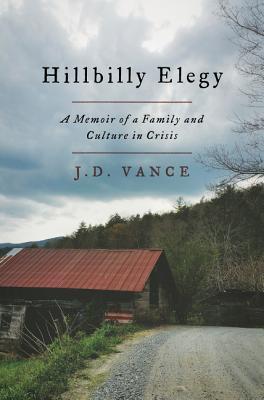
I saw Hillbilly Elegy making the rounds a few years ago and almost read it then, but kept deciding on something else instead. The title stuck with me, the author’s name did not, so it was only recently that I realized the author, J. D. Vance, is the current Republican Vice-Presidential nominee. I decided to finally read this book to learn more about him.
I almost gave up reading it a number of times due to the language. At first, it was easy to compartmentalize that most of vulgarities came from Vance’s grandmother. But later in the book, Vance himself used these same words.
About halfway through, I had just about decided to abandon this book when I read Rebekah Matt’s testimony of how much this book helped her as she grew up in similar circumstances to Vance’s. I decided to keep reading because this story is a real account of what many go through. I’m sure the language goes with the other characteristics Vance described, but I think he could have demonstrated that factor without .giving so many examples.
Vance’s grandparents moved from the Appalachia region of Kentucky to Ohio to try to escape the poverty they grew up with. Vance didn’t think his tumultuous family situations were anything but normal, because everyone he knew had the same kinds of experiences: poverty, drug addiction, violent arguments, an absent father, and a mom cycling through one boyfriend after another.
Vance says in his introduction that he wasn’t extraordinary by escaping his roots, joining the Marines, going to college, then Yale, eventually becoming a Senator (and, after this book was written, the vice-presidential nominee). “I didn’t write this book because I’ve accomplished something extraordinary. I wrote this book because I’ve achieved something quite ordinary, which doesn’t happen to most kids who grew up like me” (p. 1, Kindle version).
I want people to know what it feels like to nearly give up on yourself and why you might do it. I want people to understand what happens in the lives of the poor and the psychological impact that spiritual and material poverty has on their children. I want people to understand the American Dream as my family and I encountered it. I want people to understand how upward mobility really feels. And I want people to understand something I learned only recently: that for those of us lucky enough to live the American Dream, the demons of the life we left behind continue to chase us (pp. 1-2).
Nobel-winning economists worry about the decline of the industrial Midwest and the hollowing out of the economic core of working whites. What they mean is that manufacturing jobs have gone overseas and middle-class jobs are harder to come by for people without college degrees. Fair enough—I worry about those things, too. But this book is about something else: what goes on in the lives of real people when the industrial economy goes south. It’s about reacting to bad circumstances in the worst way possible. It’s about a culture that increasingly encourages social decay instead of counteracting it (pp. 6-7).
One stabilizing influence in Vance’s life was his grandmother. Although she had what he called a quirky faith, she didn’t go to church, had a foul mouth, and was as likely as anyone else to get physically violent in an argument.
Another big factor in Vance’s journey were teachers, one in particular.
Vance doesn’t think the answer to the problems of people in the area he grew up in are political.
Public policy can help, but there is no government that can fix these problems for us. . . .I don’t know what the answer is, precisely, but I know it starts when we stop blaming Obama or Bush or faceless companies and ask ourselves what we can do to make things better (p. 255-256).
Powerful people sometimes do things to help people like me without really understanding people like me (p. 186).
To me, the fundamental question of our domestic politics over the next generation is how to continue to protect our society’s less fortunate while simultaneously enabling advancement and mobility for everyone. We can easily create a welfare state that accepts the fact of a permanent American underclass, one where family dysfunction, childhood trauma, cultural segregation, and hopelessness coexist with some basic measure of subsistence. Or we can do something considerably more difficult: reject the notion of a permanent American underclass. Yet . . . doing better requires that we acknowledged the role of culture (p. 261).
A couple of odd things in the book were his assertions that the nicknames “Mamaw: and “Papaw” were only used for hillbilly grandparents, and the phrase “too big for your britches” was a hillbilly saying. I grew up in southern Texas, and my grandparents on my mother’s side were Mamaw and Papaw. I’ve heard “too big for your britches” all my life.
Another oddity is that many referred to this as the “book that got Trump elected.” But there are only a couple of paragraphs that mention Trump, and Vance disagreed with him at the time.
Vance writes that he told his story the way he did because he thought “if people experienced these problems through the perspectives of real people, they might appreciate their complexity” (p. 269).
I think he succeeded in that goal. Although the family I grew up in was poor and dysfunctional to some degree until my teen years, when my parents divorced, I didn’t face all that Vance did. He helped me understand that poverty and dysfunction become mindsets that are hard to escape from. As he “made it” in terms of upward mobility, he called himself a “cultural emigrant” in trying to understand and adjust to people and institutions who were so fundamentally different from himself. Though he didn’t put it quite this way, he showed that just improving circumstances and economic well-being in themselves were not all that was needed.
Note: This post is about Vance’s book and not Vance as a political candidate. I will not approve comments that are personal or political rants.
 Stray Thoughts
Because of what you had told me earlier about the profanity, I had just about decided to not read this book. But your thoughtful review has made me feel differently. The poverty is difficult to work your way out of, but it can be done. As it said in your review – it’s a mindset that makes you decide to advance rather than stay where you are. I’ve got the book on hold in my library now, but I may end up buying the book instead. (Long wait!) Thanks for your thoughtful review of this!
I’m glad you finished the book, Barbara! I enjoyed reading your review. I didn’t have space in my post to include Vance’s thoughts on being a “cultural emigrant,” but oh, how that resonates with me – I still feel this way even today and I’m sure I always will.
I thought that was such an apt phrase.
Thank you for sharing your perspective on this book. I picked it up long before he became a nominee or a senator and if I do read it it will be to understand people from that region more because his story sounds a lot like the stories of people in my area. Thank you for giving an honest, nonpartisan view of a book that wasn’t – from what I understand- written to be polarizing or partisan.
Thanks Lisa. That was my understanding, too–it seems it was meant just to share what poverty and all that goes with it effects people, not to make a political statement.
I read this several years ago before Vance was in politics, when it was “all the rage” in book circles. I enjoyed his personal story, but like you, felt he over-generalized some things like Mamaw and Papaw (my names for my dad’s parents growing up) and other phrases. I can’t help but be impressed by how Vance has turned his life around. Like you also, I can’t see how others viewed the book as a pro-Trump tool. I don’t think he’s even mentioned? I think Vance is impressive as a person from what I’ve seen; he is very well-spoken and I think his background gives him some credibility as far as suggesting possible solutions to some of the problems we face in our country.
I think the edition I read was a second printing–Vance says in his preface that he was surprised at how well received the book was. He does mention Trump in this one, but just in a couple of paragraphs.
I was never in “book circles” and missed Elegy’s first wave of popularity. But my mom picked it up when Vance became the VP candidate. Appreciate your review and the quotes you’ve pulled. The comment about culture encouraging social decay is more and more evident by the day.
I’m sure every generation of believers looks forward to the day the Lord returns, but it seems the decay of our society is so rampant and so fast.
It really does. I pray there might be another “Great Awakening” when many people turn to the Lord. I don’t see any other lasting solution to the downward path society is on.
although I don’t like the man as a politician I did read this book when it first came out and really liked it other than the crass language. I grew up with my mom’s side of the family who were ADK hillbillies (yes it’s a thing) and heard that phrase my entire life!!
my older friend linda who is a grandmother has grands who live in florida and she is Mamaw to them 🙂
I really enjoyed the movie on Netflix too with sissy spacek. It was very well done.
thanks for a great review of how so many families still..in this nation..all around it not just Appalachia live in these conditions.
I LOVE the quote from pg 255 too. Spot on
That was one of his points–we think of poverty, addiction, violence, and such as being inner-city problems, but they are all over.
Thanks so much, Barbara, for reading and reviewing this book. I too had heard a bit about the language, so I thank you for not setting it aside but soldiering on and sharing an honest review.
I agree about the grandparent names. You hear those names all over. Same with “too big for your britches”. I’ve lived in New England all my life and heard that often. Seems like he made a hasty generalization in those particular statements.
Our neighbors told us they watched the movie (rather than reading the book) and thought it was excellent.
We thought about watching the movie first. I read on the IMDB site that the movie contained 40 f-words. I’m a little more sensitive to hearing that than I am in reading it, so I’m not sure we’ll watch it. But the trailer looked really compelling.
Pingback: Sunday Bookends: Remembering Maggie Smith, reading the same books, and some blog posts I enjoyed recently – Boondock Ramblings
Pingback: September Reflections | Stray Thoughts
I had not heard about this book until this year. Thank you for your insightful review. I have been thinking about the importance of hearing people’s stories–understanding where they are coming from. And sometimes it is hard to listen all the way through. I am glad you finished the book.