
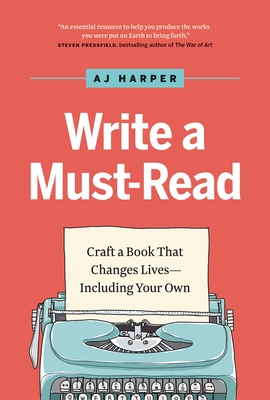
A. J. Harper (no relation) has had a varied career as a ghostwriter on multiple books, publisher, editor, coach, co-writer, teacher, and more. Clients urged her to teach other writers how to write transformational nonfiction books. A nudge from a co-writer and an author retreat helping writers caused her to realize maybe she could write such a book. The result is Write a Must-Read: Craft a Book That Changes Lives—Including Your Own.
Harper’s main theme is “Reader first.” Often writers get started because they feel they have something to say. But writing to impact others isn’t just focused on imparting the writer’s story or information. Even a memoir or biography needs to have a take-away for the reader; otherwise, unless the author is famous, a reader won’t be interested in reading it.
First Harper helps writers identify their ideal reader and what their need is. I appreciated the distinction that the ideal reader is not an avatar, with multiple specific characteristics down to the cereal the reader eats (I’ve seen some writing advice that seems to lead this way). Rather, “Ideal Readers may come from different backgrounds and circumstances (demographics), but their problems, desires, and challenges in pursuit of their desire (psychographics) are the common denominator” (p. 46).
Then she helps writers craft their Core Message: what’s the “foundational truth that your entire book is built on” (p. 65). From there, writers craft the promise they make their readers.
Harper talks about teaching points,stories, anecdotes, case studies, outlines, sequencing, and much more, all under the umbrella of what would best serve the reader.
She includes a multitude of helpful questions to ask while editing and ends with a crash course in the process of publishing and need for marketing.
All her points are illustrated with stories and anecdotes from the authors she has worked with.
Many of the chapters end with exercises to work through and links to her web site for more information or to download worksheets or lists.
Some of the quotes that most stood out to me:
Writing a book is not about organizing content. It’s about creating an experience for the reader (p. 119).
The best outline for your book is the one that meets your reader where they are and takes them on a journey that leads to your Promise, delivered (p. 119).
You are not the hero of this book. They are. You are not the focus of this book. They are. And they need you to help them get where they want to go (p. 121).
Your book is not a collection of stories and knowledge. It is a journey—a quest (p. 130).
With nonfiction, specifically personal and professional development books, the aim is transformation. My singular goal is to help the reader change their life (p. 138).
A book is not about something. A book is for someone (p. 200).
I first read this in the evenings, a chapter or less at a time, before closing out the night with fiction before bedtime. That wasn’t the time I wanted to work through exercises and such. So I am going back through the book now at my desk, making notes, printing out worksheets and filling them out.
Some of my readers would want to know that there’s a smattering of profanity through the book, and the author comes from a completely different worldview than mine.
But the writing advice is excellent all throughout.
 Stray Thoughts
Sounds like a writers’ conference in book form — nice! I appreciated the tips.
It was! If only I could memorize all the tips and principles!
I should have mentioned, and I’ll go back and add this in, that the book is primarily about writing nonfiction.
This sounds like an interesting book and it makes sense to have the reader in mind when writing rather than to impart your own knowledge. Let me know how it works for you.
Those are some very interesting points! I wish more textbook authors took them under advisement. Some of the ones we have come across this year are written as if they are writing to a field professional and not a young student just encountering the content for the first time. All I can say is thank goodness for Google!
Pingback: November Reflections | Stray Thoughts
Sounds like you’ve found this to be useful, thanks for sharing your thoughts