
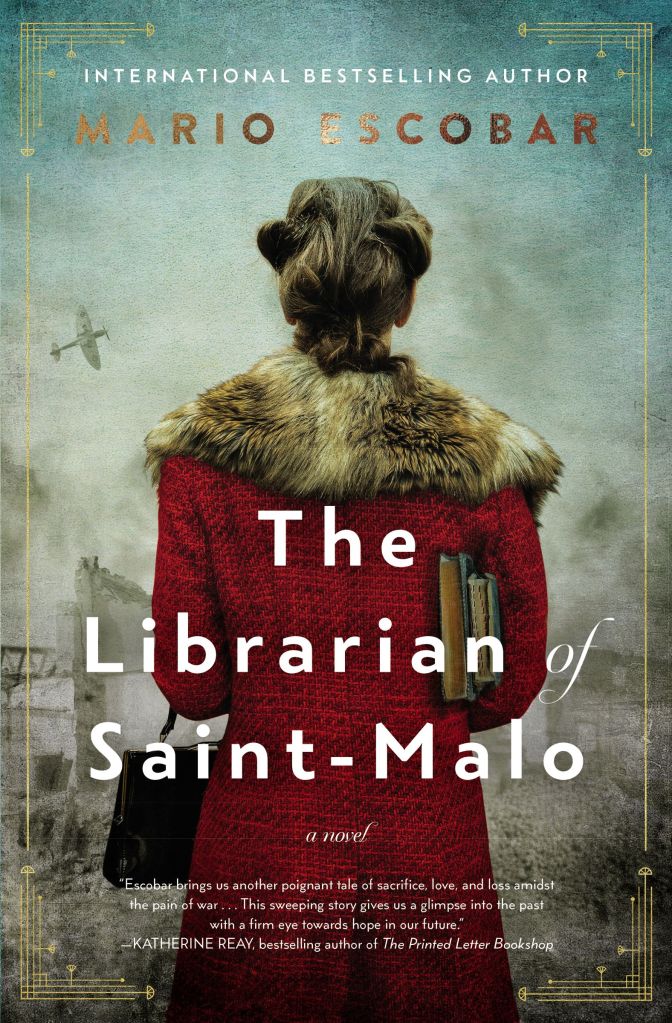
In the novel, The Librarian of Saint-Malo, by Mario Escobar, World War II broke out on the day Jocelyn and Antoine married. She developed tuberculosis on their honeymoon and struggled with her health for a long time.
Jocelyn worked as a librarian’s assistant in Saint-Milo, France, a port city that was once a haven for privateers. Antoine was eventually called for military service. When the Nazis invaded France, Jocelyn and her friend, bookstore owner Denis, hid some of the most valuable and important books away before the Nazis could either destroy or steal them.
A Nazi officer took over one of the bedrooms in Jocelyn’s apartment. The officer in charge of going through the books at the library was kinder and did not search as thoroughly as he could have for forbidden or valuable books.
The longer the Nazis occupied the area, the worse things got: food shortages, restrictions, people being herded and sent to concentrations camps–including Denis.
When the tide turned and the Nazis saw they were beginning to lose the war, they refused to surrender or retreat from Saint-Malo in an effort hold off Allied forces from getting further inland. So the city was besieged by American bombs to try to drive out the Nazis, leaving it nearly totally destroyed.
The book is written as a series of letters from Jocelyn to an author she admires so that he might tell her story. But most of the chapters weren’t really written as letters. When Jocelyn addresses the author at intervals, it seems she does so almost as a reminder to the reader that she’s writing letters.
Escobar writes in his author notes that this book was inspired by a visit he took to Saint-Malo as well as an account of a love story someone shared with him. He shares what circumstances and characters were based on real people.He writes that he “wanted to show the suffering of the common people during the German occupation of France and home in on the terrible persecution that the occupation unleashed on culture and books in particular” (p. ix).
I’ve read a number of WWII novels, mainly because that seems to be the most popular era for historical fiction. Usually this genre details some of the awful things people went through during that time but also highlights the bravery and humanity of the characters and leaves one feeling inspired and hopeful.
But this book fell flat for me, especially the ending. I never really connected with Jocelyn. The fact that this book was translated from another language and written by someone from another culture may have contributed to some of the thinking and conversations seeming a little unnatural to me.
Plus the author had characters, mainly Jocelyn, making sweeping generalizations. At one point she comes to see the wife of the marshal’s daughter because she’s been told letters from her husband have been sent there. She remarks, “I thought about how the rich and powerful never lose a war; they can adapt to any circumstance, as if pain and suffering were never meant for them (p. 46)–as if no one rich or powerful ever suffers. In another place, she says, “Heroism is just selfishness” (p. 46). She writes to her author-correspondent, “Being a writer means feeling things at a deeper level than everyone else and knowing how to communicate those depths, helping readers to see reality in a way they never have before” (p. 112). I agree with the second half of the sentence, but not the first. She tells an officer, “You fail to understand women, Lt. Bauman. We are not moved by ideals—that is a banal game ever played by men. We’re driven by something much deeper that really makes the world turn: affections” (p. 116). That doesn’t make sense to me at all.
And then there’s a vulgar expression that I thought was more modern uttered by the Marshall.
I had thought this was a Christian fiction novel, but it doesn’t seem to be. “Fate” is mentioned several times.
One good thing from the book was learning about Saint-Malo, which I had never heard of before. Somehow it was rebuilt after all the destruction and is now a resort town.
Plus there were a few quotes I loved. A couple of my favorites:
My hope is that someday, when humanity regains its sanity, people will know that the only way to be saved from barbarianism is by love: loving books, loving people, and, though you may call me crazy, loving our enemies. There’s no doubt that love is the most revolutionary choice and, therefore, the most persecuted and reviled (p. 2).
Literature is a weapon against evil (p. 124).
Since Escobar is a new author to me, I looked up several reviews of this book when I saw it on sale. Opinions were mixed. Some, like me, felt the book fell short in some ways; others loved it.
(Sharing with Bookish Bliss Quarterly Link-Up)
 Stray Thoughts
Thanks for the review. This reminds me of the “School Teacher of Saint-Michele by Srah Steele. That was a good one, but I might just pass this one by.
I’ve not heard of that one–I’ll have to look it up.
I just looked it up and found I had bought the Kindle version last year. 🙂
Good review! Bummer that it wasn’t a total winner, but that’s how it goes sometimes. I think I over-read WWII books in the past decade since I am kind of over them!
I’m not sure why that era seems to be so over-represented in historical fiction. Maybe because it has such a wide scope for drama and the Nazis make such good bad guys. But I would like to see more books from other time periods.
I also love books from this era, but I think I will pass on this one. I would imagine you are correct about translation, and it being done from a different culture as well. Thank you, Barbara, for your honest review. I always count on your reviews because I know you give honest ones.
I read books written from different cultures and translated from other languages, but for some reason didn’t connect with this one. Or maybe just didn’t connect with this author’s style.
Hmmmm…..I wonder if I should read it.
I had seen this book and thought it sounded interesting. Though from your review maybe not for me.
Thanks bunches for sharing with Bookish Bliss Musings & More Quarterly Link Up.
Pingback: February Reflections | Stray Thoughts
I visited Saint Malo after reading All the Light You Cannot See by Anthony Doerr. It’s an amazing place.
Thank you for sharing this review with the Historical Fiction Reading Challenge!
I hadn’t realized, or had forgotten, that Doerr’s book was in Saint-Malo. I’ve seen the movie but want to read the book–I want to even more now!