
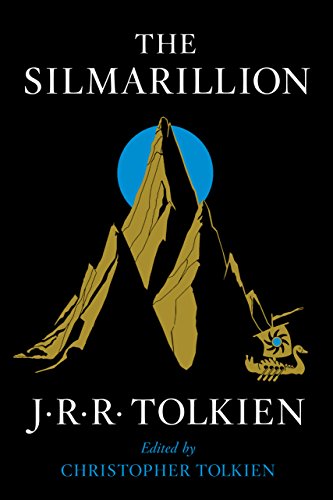
The Silmarillion by J. R. R. Tolkien is a collection of stories and history which precedes The Hobbit and The Lord of the Rings in its setting. Wikipedia says a draft of it was written after The Hobbit’s success, but it was rejected by the publisher. Tolkien went on to write The Lord of the Rings trilogy. After his death in 1973, his son, Christopher, edited, arranged, and added material to publish this book in 1977.
My volume has a foreword by Christopher, in which he says the notes and stories in The Silmarillion, though it wasn’t called that at the time, date back half a century earlier and were added to by his father even in his last years. Christopher writes that his father came to view this book as seeming like a compendium from different (fictional) characters, added to through the years. That helps account for differences of style and tone through the book. It also contains a few separate works and a short summary of The Lord of the Rings at the end. One of these stories was “The Rings of Power,” which the recent series is based on. Taken all together, this provides the history of Tolkien’s mythology.
This edition also contains a very long letter from Tolkien to an editor friend “justifying and explaining” why he thought The Silmarillion and the Lord of the Rings should be published together (for what it’s worth, I think it was wise to separate them). Christopher said he thought this letter was “a brilliant conception of his conception of the earlier ages,” so he included it here are well.
Tolkien says here that he dislikes allegory and writes in the style of myth and fairy tales, though he acknowledges both of those genres use allegorical language. These stories have to do with “Fall, Mortality, and the Machine,” though also with “Art (and Sub-creation) and Primary Reality.” (p. 2, Kindle version). He writes “I believe that legends and myths are largely made of ‘truth’, and indeed present aspects of it can only be received in this mode” (p. 2). C. S. Lewis said something similar: after he had written directly about spiritual truth in Mere Christianity and other books, he wove some of the same truths in stories.
The Silmarillion covers the first two “ages” of Tolkien’s stories, beginning with the creation of the world by Eru, also called Ilúvatar. The angelic-type being he created, the Ainur, then created other things through music. But “it came into the heart of one of them, Melkor [also called Morgoth], to interweave matters of his own imagining that were not in accord with the theme of Ilúvatar; for he sought therein to increase the power and glory of the part assigned to himself” (p. 4).
Some of the Ainur went to live on the world their music created. Later came Elves, called the Firstborn, and later still Men, called Followers.
Much of the book is good vs. evil, the rise and fall of individuals and empires. Some of it is written as history, but a few stories are interwoven.
I thought these lines were particularly apt:
Reward on earth is more dangerous for men than punishment! (p. 2).
There are three phases in their fall from grace. First acquiescence, obedience that is free and willing, though without complete understanding. Then for long they obey unwillingly, murmuring more and more openly. Finally they rebel–and a rift appears between the King’s men and rebels, and the small minority of persecuted Faithful (pp. 2-3).
The title comes from three rings, called the Silmarils crafted with the light of the Two Trees of Valinor before Melkor destroyed them. Melkor stole them and put them in his crown, but battles are fought for them later on.
In the latter part of the book, Sauron, something of a disciple of Melkor, becomes the main villain. He creates the “one ring to rule them all” which figures into The Lord of the Rings.
The wizards and hobbits don’t come into the story until the last few pages. Gandalf shares a line which will become a theme in LOTR: “Help shall oft come from the hands of the weak when the Wise falter” (p. 307).
I listened to the audiobook, read well by Andy Serkis, who played Gollum/Smeagol in the Peter Jackson LOTR films several years ago. I also have the Kindle version, and I think it might have been better to read it than listen to it. Though I enjoyed the audiobook, I found my attention wavering in the historical parts. Plus I think seeing all the names would have helped cement them in my mind.
Many individuals and groups have more than one name, which makes for some confusion at first.
Christopher Tolkien added an index of names as well as “family trees” of some of the main characters in the back of the book.
I was inspired to read this book after seeing the first two seasons of The Rings of Power. I’ll never be an expert on Tolkien lore, but that wasn’t my aim. There are several sites online where we can look up particular people, groups, or events in his books. But reading this did give me a better understanding of events in the LOTR. Some things clicked into place, like Aragorn’s heritage, the buried shards of a sword which are found in the later books, the ancestor of the evil giant spider Shelob, who attacks Frodo, the giant eagles who come to various people’s rescue, etc.
So, though this book doesn’t flow as well as The Hobbit and The Lord of the Rings, I’m glad I finally read it.
(I often link up with some of these bloggers.)
 Stray Thoughts
I’m probably the only person alive who has not read Tolkien…even though we have a copy of Lord of the Rings. I’ve seen the adverts for the series you mentioned, but even that (to me) is scary. I know that Tolkien is one of the great authors…like his friend C.S. Lewis…but I guess my imagination just isn’t up to his level.
I’m glad that reading this book helped you to better understand some of the previous things you wondered about. Thank you for the review, Barbara.
I’ve always been interested in what this book had to say. I’ve always been totally in awe of Tolkien’s mind to come up with such characters and stories, let alone the Elven language. I’ve only read part of Fellowship of the Ring and this spurs me on to read more.
I imagine that it would be very entertaining to listen to Andy Serkis’ narration. Thanks for the review.
I think I need to read something by Tolkein before I can even intelligently comment here — lol 🙂
I admire you for making it through with all the unusual names, places, etc. Very nice review
Pingback: The Silmarillion – J.R.R. Tolkien | Discover the Magic of Middle-earth - The Book Review Hub
Pingback: March Reflections | Stray Thoughts
I have read The Hobbit multiple times, and yet never been able to read any of the LOTR books all the way through! I am not sure why that is!
Thank you for sharing this review with the Historical Fiction Reading Challenge.
Pingback: Review: The Return of the King | Stray Thoughts