
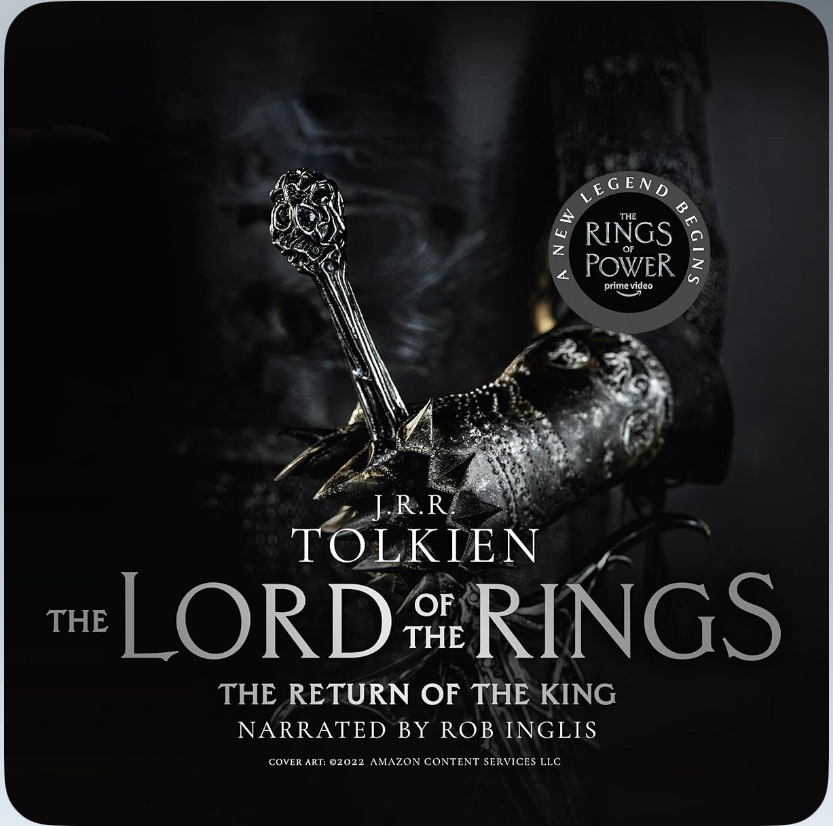
The Return of the King is the third in J. R. R. Tolkien’s trilogy, The Lord of the Rings.
If you’re not familiar with the story, the ring in question was created by Sauron, originally an angelic-type creature who rebelled against his creators. There were actually nine rings made, but that’s a different story. The “one ring” somehow had the power to influence those who had the other rings and would grant Sauron dominion over everyone in Middle Earth. The ring and its power could only be destroyed by being tossed back into the fires of Mordor, from which it was made.
The ring had been lost for thousands of years, but was found by Bilbo Baggins in The Hobbit.
The Fellowship of the Ring told of a group of nine companions on a mission to take the ring to Mordor: Gandalf the wizard; Frodo, the designated ring-bearer and Bilbo’s nephew; Samwise Gamgee, his friend and servant; two more hobbits, Merry and Pippin; one elf, Legolas, a dwarf, Gimli; and two men, Boromir and Aragorn. Aragorn is also know as Strider and is the long-awaited heir to the throne of Gondor, though not everyone knows that at first.
The rest of FOTR and the second book, The Two Towers, tell what happened to the group on their long and dangerous journey.
At the beginning of The Return of the King, Frodo and Sam have been separated from the rest to continue their journey to Mordor. But Frodo had been captured and imprisoned. Sam braves various dangers to rescue him.
Meanwhile, Sauron has sent a great army or orcs (vile creatures) and other beings to Gondor. Gandalf and Pippin go there to warn the steward.
Aragorn, Legolas, and Gimli gather help from an unusual source and Merry joins them to battle Sauron’s troups.
There are a number of subplots with the steward of Gondor and his son (Boromir, his favorite, died, and Faramir, his younger son, isn’t appreciated until almost too late); the area of Rohan with its famous riders and their joining in to help, Merry and the king of Rohan’s daughter being severely wounded, and all kinds of other things going on.
The one ring negatively affects those who have it, especially if they wear it for any length of time. The ring grants the wearer invisibility but builds a craven desire to keep it, plus awakens Sauron to its presence. Frodo is beyond weary with all he has suffered on his long journey plus the increasing influence of the ring the closer he gets to Mordor.
After the last great battle, the fellowship splits up and we see each one as he goes back to his land and people. I didn’t realize that there would be a fairly long section when the hobbits arrive back to the shire. It had been taken over by “ruffians,” and took some time and effort to set right again. The hobbits were not very adventurous folks, but Merry and Pippin had fought orcs and other evil beings. They were not about to put up with some ruffians!
Tolkien said he disliked allegory and didn’t write his saga of the rings that way. But he did feel fairy stories and myths could convey truth. It’s not hard to see Sauron as an instrument of Satan. And the king of Gondor coming into his long-awaited throne has some parallels with Christ, especially in this quote:
But when Aragorn arose all that beheld him gazed in silence, for it seemed to them that he was revealed to them now for the first time. Tall as the sea-kings of old, he stood above all that were near; ancient of days he seemed and yet in the flower of manhood; and wisdom sat upon his brow, and strength and healing were in his hands, and a light was about him (p. 121).
Some of my other favorite quotes:
Yet it is not our part to master all the tides of the world, but to do what is in us for the succour of those years wherein we are set, uprooting the evil in the fields that we know, so that those who live after may have clean earth to till (p. 73).
In that hour of trial it was the love of his master that helped most to hold him firm; but also deep down in him lived still unconquered his plain hobbit-sense: he knew in the core of his heart that he was not large enough to bear such a burden, even if such visions were not a mere cheat to betray him (p. 83).
As a sweet rain will pass down a wind of spring and the sun will shine out the clearer, his tears ceased, and his laughter welled up, and laughing he sprang from his bed (p. 111).
It must often be so, Sam, when things are in danger: some one has to give them up, lose them, so that others may keep them (p. 154).
And this from the appendix: “Let us not be overthrown at the final test, who of old renounced the Shadow and the Ring. In sorrow we must go, but not in despair. Behold! we are not bound for ever to the circles of the world, and beyond them is more than memory” (p. 174).
My favorite quote of all comes when Frodo has reached the end of his strength, and Sam says, “Come, Mr. Frodo! I can’t carry [the ring] for you, but I can carry you and it as well” (p. 105).
On a side note, for many years, we avoided anything to do with witches, wizards, magic, etc., in stories and film. I had to think through those things when the LOTR films came out and the kids wanted to see them. I wrote more about that here, but I concluded most “fairy tale magic” is a different thing than the occult. Gandalf is more like a wise superhero than what we think of as a wizard. But these things require caution and discernment: I’ve seen some alarming aspects of some stories containing “magic.”
Both the audiobook (nicely read by Rob Inglis) and the Kindle version have appendixes at the back, but they are not the same. The audiobook has sections explaining the different races and their characteristics, a history of the kings, a more detailed account of Aragorn’s and Arwen’s lives and romance, a brief account of events in The Hobbit, and a few others. The Kindle ebook has “Annals of the Kings and Rulers,” family trees, a shire calendar, and information about writing and spelling in some of the languages of the book.
I read The Hobbit and the first two books of this trilogy years ago. I had started The Return of the King, but then didn’t finish it when the Peter Jackson films came out. I always meant to get back to it but never did. After I read The Silmarillion (Tolkien’s history and mythology of the world he created in these books), I thought about reading The Return of the King. I wasn’t sure I wanted to get into another lengthy foray into Middle Earth. But then I thought it might be good to read the last book while all the information in The Silmarillion was still fresh. That turned out to be true: I “got” many references that I think I would have otherwise missed.
I almost wish I had started again at The Hobbit and read all the books through. But I am sure I’ll read them again some time.
I thought it would take a little while to get back into Tolkien’s world. But it didn’t: I was caught up in it again right away.
There are many things to love about these books. Yes, they go into much more detail than if they had been written in modern times. But the older style of writing fits in with a story of ancient lore. Tolkien put so much time and thought into the stories, even inventing different languages for the different races.
But what I love most of all is the truth of human nature they contain, and the bravery, heroism, and overcoming evil as well as one’s own limits to accomplish a great quest. And the books contain a couple of sweet love stories as well.
(I often link up with some of these bloggers.)
 Stray Thoughts
The Lord of the Rings and The Silmarillion are among my favorite books ever. My husband read them aloud to our children two times (and their request). Tolkien did an excellent job of presenting good vs evil. And good always wins!
We have The Lord of the Rings here. Our son gave it as a gift to his dad when my husband had surgery one time. But I’ve never read it. Maybe I should? Thanks for the review, Barbara.
Your word, “resilient,” kept coming to mind as I read this one. Or perhaps perseverance or endurance would be more accurate–but they’re related. 🙂
Okay…so now I need to read this one. 🙂
I read The Hobbit many years ago and started Fellowship of the Ring last year and then put it down. I’m very familiar with Peter Jackson’s movies and I think it’s time to catch up on the books. Such a wide sweeping story!
I was a little hesitant to pick up Return of the King and jump back into the flow of Tolkien’s story, because his work is so much more involved that Lewis’s. But my copy provided a summary of what happened to that point, and it was easy to get back into it. I kind of wish I had started at the beginning with The Hobbit and read them all the way through.
This is such an excellent, thorough review — I’m still wondering if I could get into these. I’d like to! I’ve made the same comment to my girls about “Watership Down” — a book they love. They’re not sure it’s my thing, ha ha 🙂
I like that these contain good insights into human nature. I’d enjoy that for sure! Maybe they’re similar to the Narnia books in that way? I know Lewis and Tolkein were friends …
There are some similarities between Lewis’s and Tolkien’s stories, but Tolkien’s were so much more involved. I remember reading he was frustrated with Lewis for including mythological elements from different countries or sources–But I thought it worked pretty well. 🙂
Watership Down wasn’t what I was expecting when I read it. But I enjoyed it.
While Tolkien said more than once how much he despised allegory, he wrote his characters with so many facets of Christ’s character: self-sacrifice, loyalty, endurance, courage, determination. There’s not one character who embodied all. I’m glad you got to the last of the trilogy. Roomie and I often have the audiobook playing while we’re doing chores so that over the years, we may have listened to the whole thing (including the Hobbit) several dozen times. But the Silmarillion is more difficult. Maybe we’ll have to try again. Thanks for this terrific review.
Yes–The Silmarillion reads like a Wikipedia page in some places, with lists of kings and descriptions of so. many. battles. But it does have some stories within it as well.
I agree, too, there is so much symbolism in the books. Along with the Christlike characteristics of some, Melkor and Sauron seem to have some direct correlation to Satan. Sam is my favorite. 🙂
Pingback: April Reflections | Stray Thoughts
I have read The Hobbit numerous times but I can never seem to finish any of the Lord of the Rings books!