
I don’t remember being exposed to classical art or even going to a museum until I got to college. My alma mater had its own art museum at the time. I remember going on a guided tour and being fascinated as the guide brought out details I would never have noticed myself. I took Art Appreciation my senior year. But that was the limit of my art education.
I’ve visited a few museums with my family since then. But I haven’t gotten much beyond wandering around the gallery and noting what I liked and didn’t.
Russ Ramsey is an excellent guide in Rembrandt Is in the Wind: Learning to Love Art through the Eyes of Faith. Not only does he bring out unnoticed details, but he draws spiritual lessons from the lives of the artists as well.
Ramsey says we learn to understand God through truth, goodness, and beauty.
In my experience, many Christians in the West tend to pursue truth and goodness with the strongest intentionality, while beauty remains a distant third. Yet when we neglect beauty, we neglect one of the primary qualities of God. Why do we do that?
The pursuit of beauty requires the application of goodness and truth for the benefit of others. Beauty is what we make of goodness and truth. Beauty takes the pursuit of goodness past mere personal ethical conduct to the work of intentionally doing good to and for others (p. 8, Kindle version).
This is the gift of beauty from an artist to their community—to awaken our senses to the world as God made it and to awaken our senses to God himself (p. 14).
Ramsey focuses on an artist and/or a specific work of art in his remaining nine chapters, which he describes as “part art history, part biblical study, part philosophy, and part analysis of the human experience. But they are all story” (p. 15).
Ramsey includes a black and white image of the paintings he discusses at the beginning of each chapter, and then a small color print at the end of the book. But I found that if a painting had a Wikipedia entry, I could click once on the painting’s image and make it full-screen, then click on it again to zoom in further.
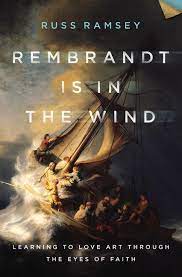
One of the chapters features Rembrandt, especially his Christ in the Storm on the Sea of Galilee (pictured on the cover) one of my al-time favorite paintings. I didn’t know before that Rembrandt painted “himself into several biblical scenes. He did this not for vanity but for the sake of the story. He wanted to draw us in, capture our imaginations, instruct us on how we should relate to what was happening on the canvas, and bear witness to what he believed to be true about the world he painted and his place in it” (p. 73). He’s the one looking straight at the viewer, with one hand on the rope, the other on his hat. “By painting himself into the boat in The Storm on the Sea of Galilee, Rembrandt wants us to know that he believes his life will either be lost in a sea of chaos or preserved by the Son of God. Those are his only two options. And by peering through the storm and out of the frame to us, he asks if we are not in the same boat” (p. 75).
This painting was also part of one of the most infamous art heists in history–and it has never been recovered. Ramsey shares the details of the theft.
Some of the artists, like Caravaggio, perceived beauty, and their hearts were touched and drawn to Christ, yet still didn’t submit to Him.
This is the paradox of Caravaggio—he brought so much suffering on himself, with such bravado and acrimony, yet when he picked up his brush, the Christ he rendered was the Redeemer of the vulnerable. . . He knew what it was to have the ability to render beauty that could bring a person to tears and yet remain unable to live free from his own destructive behavior (pp. 60, 64).
The chapter on Vermeer was wonderfully layered with references to light: the light God created which would make visible His creation, art’s use of light, the “borrowed light” from one source to another and from others who “illuminate the places where we’re doing our own work, and then our work lights the way for others” (p. 96).
This chapter also led to quite an interesting lunchtime discussion with my husband. Rembrandt was thought to use some kind of optical lens as he painted, not to “[pull a trick] on his viewers, He was learning to see” (p. 106). “His use of a lens was not a shortcut, but rather an innovation–the kind that gave his work a mysterious quality” (p. 104).
Rembrandt’s neighbor, and the executor of his estate, was Antoni van Leeuwenhoek, the “father of microbiology” and inventor of a “single-lens microscope that intensified light and enhanced magnification through the use of a concave mirror” (p. 100) (another facet of the theme of light). I asked my husband if he knew of van Leeuwenhoek, and of course, he did. Being interested in microscopes himself, he has a replica of one of van Leeuwenhoek’s devices.
This chapter also discusses the influence of technology on art–not only this lens, but the tin paint tube. Artists usually painted indoors because they often mixed their own paints and had everything at hand in their studios. But with the invention of the paint tube, they could paint anywhere. “Painting is not just an art, but a science. It is an achievement not only in beauty or emotion or color, but in math and geometry and light” (p. 104).
An artist I never heard of before, but enjoyed learning about, was Henry O. Tanner, whose The Banjo Lesson was the “first recognized genre painting of blacks by an African American artist” (p. 152). He often painted an older person teaching a younger person something. But, “Though race would always play an important role in Tanner’s art, in order to expand people’s view of race, he didn’t want to become a niche artist focused only on race. . . As a man of faith, Henry believed persuading one race to regard another with equity and love was a theological endeavor, one which required a biblical view of personhood—that all people are made in the image of God and therefore share an inherent dignity and worth that transcends any human construct” (p. 156).
The last chapter tells of Lilias Trotter, who lived during the time of van Gogh, was pursued by John Ruskin as a pupil, but put aside her artistic career to become a missionary to Algiers. I had read her inspiring story before, but it was good to be reminded of it again.
A few other favorite quotes:
On the other side of the veil is the tangible glory of unfailing perfection, but it is just out of our reach. So we have given ourselves to the pursuit of making copies from the dust of the earth, compressed by time, crafted by pressure, but conceived by something more than mere imagination. Our best attempts at achieving perfection this side of glory come from an innate awareness that it not only exists, but that we were made for it (p. 38).
Ruskin believed “the greatest thing a human soul ever does in this world is to see something and tell what it saw in a plain way . . . To see clearly is poetry, prophecy, and religion—all in one” (p. 197).
A like independence is the characteristic of the new flood of resurrection life that comes to our souls as we learn this fresh lesson of dying . . . the liberty of those who have nothing to lose, because they have nothing to keep. We can do without anything while we have God (Lilias Trotter( (p. 199).
Ramsey includes a few appendices: How to Visit an Art Museum, How to Look at a Work of Art, and an Overview of Western Art: Renaissance to Modern Selected Works.
This book will be one of my top ten of this year. I enjoyed it immensely.
(Sharing with Bookish Bliss)
 Stray Thoughts
Interesting. Thank you for sharing about the book. Have a blessed day!
You, too!
I read this book last year with a group (zooming our meetings). I was amazed by how much I learned. And I appreciated Ramsey’s perspective on the artists. The book is on my shelf and I don’t think I’ll ever want to give it away.
It would have been fun to read this with a group!
I’ve just spent about a half an hour reading about that art heist! LOL 🤣
Lots of info about it on Chat GPT.
It’s a pretty fascinating story! Ramsey even goes into the background of the lady who created the museum this piece was in. Apparently she and her husband were well-to-do, and when their child died, they traveled extensively acquiring art. She wanted to create a place to display it that wasn’t just empty rooms with pictures on the walls.
The thieves had cut the canvas off the frame, and Ramsey showed a photo of the empty frame hung on the wall where the painting used to be.
I always wondered what people did with stolen art. It would be pretty easy to trace. Buyers who knew anything about art would know it was stolen, so they couldn’t display it. Ramsey said Rembrandt, like a lot of artists, had his students practice by copying his works. So the thieves may have passed off the real painting as a student’s replica. They wouldn’t have gotten nearly as much money as it was worth, but they would have gotten some. But these days, if someone thought they might have the real thing, they could have experts look at it. Then again, maybe they don’t want to know, because then they’d likely have to give it up.
OOH this is a book my entire family would love especially my oldest who was an art major at the Christian college (Gordon College near Boston). We exposed our daughters very early on to art museums and their first one was at age 4 to the easy to understand Norman Rockwell Museum in MA. then we exposed them to more of the “greats” by taking them to the Clark Art Institue. (again not too far from our home, just over the border in MA). We then moved up to the art galleries here in Albany and Saratoga, and then to the Fine Art museum in Boston. We also took our oldest to the one in San Francisco. We’ve been to various galleries on Cape Cod and then we moved on up to the Louvre and the Orsay when we were in Paris. Art is beautiful. My fave is Degas and Monet. I also do enjoy looking at Rembrandt so i’m going to get this book for my oldest daughter for xmas!! I’m pretty sure she’s not familiar with it as she’s never mentioned owning it although she has So many art books! Thanks for this great review.
I think she’d love it, even though she has much more art knowledge than I did. He has a second book titled Van Gogh Has a Broken Heart: What Art Teaches Us About the Wonder and Struggle of Being Alive that appears to be in the same vein. I’m reading it next.
This certainly sounds like a book that I could profit from reading. I love beauty, but I’ve not focused much on art. Thank you for the review.
I got so much more out of this book than I have just wandering through museums. Hopefully this will enhance my next museum visit. 🙂 But learning to take time to really see rather than taking a casual glance is good for many things in addition to art.
Thank you for this review. Both this book and the other written by him with Van Gogh in the title sound so interesting!
I’m excited to read Van Gogh Has a Broken Heart: What Art Teaches Us About the Wonder and Struggle of Being Alive by Ramsey next.
Oooh so glad you reviewed this because I know I’d love it as well! Like you, I didn’t grow up with any art appreciation. I first remember learning anything about art after I graduated from high school. I was able to spend 3 wks in Europe with a band (I played oboe) and prior to leaving, we had 3 days of practice and lectures on the places we’d see. I was so fascinated by the artworks we were shown in one class, and the lecturer pointing out the symbolism etc. It fascinated me; none of that had ever occurred to me! This sounds wonderful. Great review.
The symbolism had not occurred to me, either. And I had missed so many details. It helps immensely to have someone knowledgeable bring these things out. He wrote about the “art of seeing”–taking time to slow down and really look. That was good for a lot of life, not just art.
How interesting that Rembrandt painting himself into the Storm on the Sea of Galilee. This sounds like a very interesting book to see the spiritual in famous paintings.
I was never a fan of classical art but have come to really appreciate Monet and Rembrandt. Van Gogh and Picasso, I’m still not too sure about.
I’m more a fan of realistic paintings, too. He wrote about that era and Impressionism here. His next book, Van Gogh Has a Broken Heart: What Art Teaches Us About the Wonder and Struggle of Being Alive, mentions Van Gogh, Picasso and Norman Rockwell. I’m looking forward to reading it next.
Pingback: July Reflections | Stray Thoughts
I am in the middle of “Van Gogh has a Broken Heart” and I love it so much! Thank you for this great review. I love that Ramsay points out that we don’t focus as much on beauty as we should–it’s definitely a characteristic of God to make beautiful things for others to enjoy. That’s a great thought. Visiting from the Talking About it Tuesdays linkup.
I’m reading Van Gogh has a Broken Heart now. I’m just a couple of chapters in, but it’s so good.
Last Sunday the pastor at my son’s church showed a slide of Rembrandt’s painting of the prodigal son–the father, the prodigal and the older son are in the painting. It provided some interesting insights. I may pick up this book that you have reviewed! (I have read about Lilias Trotter also).
I just looked that painting up. I love how the light lands on the three main figures.