
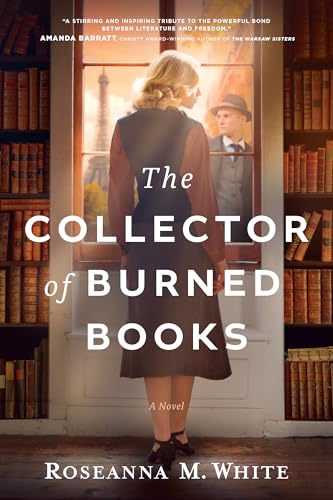
The Collector of Burned Books by Roseanna M. White takes place in Paris during WWII, opening with the Nazi takeover of the city.
Corinne Bastien is a professor at the Sorbonne, but looks more like a student. Secretly, she oversees the Library of Burned Books, a collection of books that have been banned by the Nazis. She encodes some of them with war news and send them out to some of her students, who send encoded messages back. The others Jewish authors who worked with the library fled before the Nazis arrived.
Now, however, Goebbels has sent a “library protector,” Christian Bauer, to take over all the libraries in Paris. Christian is not sure how he got the position. He’s a professor, not a soldier. With his record of speaking out against the Nazis, he’s surprised he hasn’t been arrested. All he can figure is that his friend in the police force, who was absorbed into the Gestapo, has adjusted his records.
He and his friend, Erik, had many discussions about the best way to combat the madness surrounding them–whether to fight against it overtly, only to be arrested, or to battle quietly from within while seeming to go along. They decide on the latter course. Christian knows many of the French Jewish authors personally. Perhaps he can mitigate the damage done to them and their works. At the very least, he can insist on civility among the soldiers assigned to him.
Christian arrives at Corinne’s flat with a list of books checked out by her mother from the Library of Burned Books. He only wants then returned. Corinne plays dumb. Her mother is out of the country and is not very organized–she doesn’t know where the books could be.
As Christian visits repeatedly to search for the books, they discover they have much in common. Corinne still regards him as an enemy, but she realizes he is not like the others.
Eventually, some surprising twists lead them to the truth about each other. And then a shocking betrayal threatens everything they’ve worked for.
Another part of the story involves hiding a boy with birth defects whom the German authorities wanted to have euthanized.
Some of my favorite quotes from the book:
These students had it all wrong—backward. Books didn’t burn. Books ignited. They lit the burning in others. Not with paper and match. With ideas. But then, that was their very argument (p. 1, Kindle version).
The only way to defeat a bully was to win him over. The only way to truly defend what you believe is to make your enemy believe it too (p. 4).
The words we hear, the words we read, the words we sing along to on the radio and study in the papers with our morning coffee, become our thoughts. I think our thoughts become our beliefs. And I think our beliefs become our actions. That is why Goebbels sent us here, Kraus. Because words form the foundation of society. Ideas create culture. Control them, and you can control . . . everything (p. 76).
He would tell you to think, next time, before you blindly chase your ideology. He would ask you to think, not just to feel. To ask, always, if you could be wrong. To listen, always listen, to the other points of view. Because the moment we stop granting someone the right to disagree, Kraus, this is what happens. Do you understand me? This is what turns men into tyrants. This is what leads to fear and death (p. 265).
God could well have said no. Today, he’d extended his mercy. His grace. But as too many in Germany had already learned, sometimes he didn’t intervene. Sometimes he let the monsters come. Sometimes good people, good Christians, good Jews were dragged off in the night, no matter the prayers they cried. He’d promised to be with his people through persecutions—not to prevent them (p. 304).
Read novels, because they will put you in someone else’s skin. Read poetry, because it will give wings to your soul. Read science, because it will show you what’s possible. Read politics, because it will teach you how strongly people care about how their fellow men are treated, wherever they stand on what the best way is. . . . Read things you hate and things you love and things you never thought you’d understand. And never, never accept the excuse that you’re not strong enough to handle it if you read something that offends you. You are. You’re strong enough to be offended and then try to understand why. You’re strong enough to grant that someone can be different and still be worthy of dignity. And if you aren’t? . . . Then read more, until you are (pp. 315-316).
Roseanna is a master storyteller who creates wonderful characters and intricately interwoven plots. I enjoyed both of these characters immensely.
I also enjoyed Roseanna’s notes at the end of the book, where she shares what’s historically accurate and what’s made up. There really was a Library of Burned Books. There really was an anti-Nazi professor who was given a special assignment, though not the one detailed in the book.
There were even some fun surprises, like a character from Roseanna’s Shadows Over England series showing up. This was the first series of Roseanna’s I read, and I loved them. Though there were clues, I didn’t recognize him until his real last name was revealed and he shared a bit of his history. There was a tie-in with another previous character from Yesterday’s Tides, but I didn’t remember him or his situation at all.
The faith element is Catholic, which would have been accurate for the setting and characters. There was mention of some practices I couldn’t agree with–a priest forgiving sins, the need for penance, praying to Mary and saints, the supposed healing power of the Eucharist. But the overall tenor of the characters’ hope in God was touching and inspiring.
I listened to the audiobook, superbly read by Lisa Flanagan. This time, the audiobook did include the author’s notes, which I appreciated. But I also had a Kindle version for reference.
Roseanna mention in her notes that one character will be getting his own story in another book. I don’t know if it will be a sequel, exactly, but I look forward to it.
 Stray Thoughts
This sounds like a good book but also a hard read…at least for me. Did you find it to be so for you, even though I realize you did the audio version? Thank you for your honest review, Barbara.
Do you mean hard to read in regard to the kind of atrocities that happened in WWII? If so, I’d say not really. There are a few tense and scary moments in the book, but since this took place in Paris and mostly had to do with books, there’s not as much violence as in some war stories.
This sounds good! And how nice that the author’s note is included in the audio. Honestly I’m amazed that that isn’t always the case, since I think it’s so important/interesting to know what’s true and what isn’t.
I agree–I wish all audiobooks included the author’s notes.
Barbara, historical fiction is one of my go-to genres, and there seems to be no shortage of stories about libraries and books, two of my favorite things, these days. I couldn’t be happier!
Thanks for sharing your review.
I’ve got that book on my wish list. It really looks so good. Thanks for the review.
This sounds like my kind of book.
Pingback: October Reflections | Stray Thoughts