
If you’ve read much writing instruction, you may have seen this well-known paragraph:
This sentence has five words. Here are five more words. Five-word sentences are fine. But several together become monotonous. Listen to what is happening. The writing is getting boring. The sound of it drones. It’s like a stuck record. The ear demands some variety. Now listen. I vary the sentence length, and I create music. Music. The writing sings. It has a pleasant rhythm, a lilt, a harmony. I use short sentences. And I use sentences of medium length. And sometimes when I am certain the reader is rested, I will engage him with a sentence of considerable length, a sentence that burns with energy and builds with all the impetus of a crescendo, the roll of the drums, the crash of the cymbals—sounds that say, “Listen to this; it is important” (p. 58).
The author of that masterpiece is Gary Provost, who wrote “more than a thousand published article and stories” (p. 160) as well as two dozen books. He was also a writing teacher and the founder of a semiannual Writer’s Retreat Workshop.
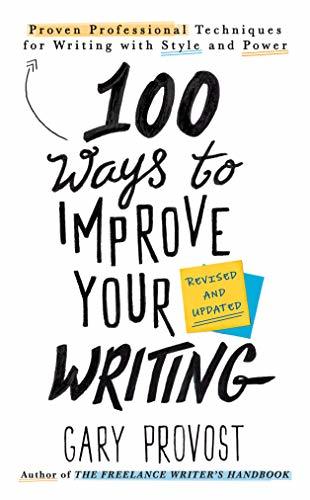
101 Ways to Improve Your Writing: Proven Professional Techniques for Writing with Style and Power was his second instructional book about writing, The Freelance Writer’s Handbook being the first. Some of the material here originally appeared in the Writer’s Digest magazine. The first edition of the book came out in 1985. This 2019 edition has been updated, mostly concerning changes in technology, by his wife, Gail Provost Stockwell, and one of his students who became a teacher and then the director of his writer’s conference, Carol Dougherty.
This book is laid out in eleven sections which are divided into several fairly short topics within the section. Some sections cover broad topics like overcoming writer’s block, developing style, giving words power, and making your writing likeable. But others get into the minutia of grammar, punctuation, and editing. The short pieces on each topic make this book very readable. Since they were so short, I read a handful at a time. But when I read this again, I think I might take one or maybe two at a time and digest them before moving on.
Gary sprinkles succinct but helpful side-by-side good and bad examples to illustrate what he advises.
One aspect of his writing I really appreciated was his saying that his tips are just that: “Tips, not laws” (p. 159). For example:
Never violate a rule of grammar unless you have a good reason, one that improves the writing. But never choose good grammar over good writing. There is nothing virtuous about good grammar that does not work. Your goal is good writing. Good grammar is only one of the tools you use to achieve it (pp. 118-119).
Try to use the active voice. But realize that there are times when you will need to use the passive. If the object of the action is the important thing, then you will want to emphasize it by mentioning it first. When that’s the case, you will use the passive voice (pp. 78-79).
For the past several years, I’ve tried to read at least one book about writing each year, as well as blogs about writing. Much of the information in this book wasn’t new to me, but I benefited from the reminders and the different way of expressing them. Plus, even though I have heard and read many of these things, I certainly haven’t mastered them yet. However, some of the advice touched on subjects we discussed in my last session with my critique group and helped me think through those issues.
I think this book would be an excellent introduction for new writers and a great “refresher course” for more experienced writers.
 Stray Thoughts
This sounds great! Back when I was writing more of my books, I read several books on writing and found them helpful. My main frustration, now and then, is–how to remember all the tips and keep them “top of mind” while writing? I just have to hope that I absorb enough to incorporate many of the tips. “Tips, not laws” is so true. Several times I’ve driven myself nuts trying to change a passive sentence to active. There are times when it just doesn’t work 🙂
Writers can always learn something new. I can glean great information from other writers. Thank you for sharing about this book. Have a blessed day!
This is an excellent post! Very helpful. I tend to write long sentences and am learning to vary them. Thanks!
Thanks, Barbara, for sharing about this book. I can always use help to improve my writing skills.
Barbara, it’s been a while since I read a writing book, so I appreciated this post very much. I don’t remembering hearing about this author before, but this book sounds helpful and interesting, so I’m going to see if my library has. 🙂
I need to look into this book – I have always loved writing, but I know that to be any success at it, I should fine tune what I put “on paper”, so to speak.
Pingback: October Reflections | Stray Thoughts