
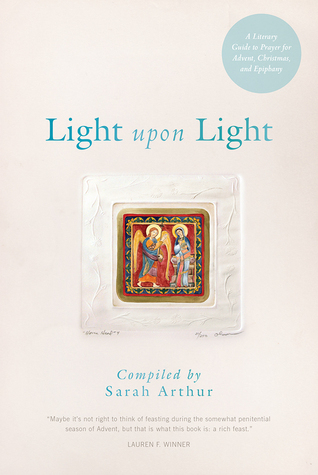
In Sarah Arthur’s introduction to Light Upon Light: A Literary Guide to Prayer for Advent, Christmas, and Epiphany, she writes:
Many of us, when charting the timeline of our lives, can point to a moment when a story or poem happened. It happened the way an accident or a record-breaking snowfall happened: it was perhaps expected, perhaps not. One moment we were performing the usual routine–pouring cereal, say, or opening the mail–and the next moment we sat motionless with a book in our hands, eyes unfocused, a wave of words washing over us as relentlessly as a newsreel.
I’ve had that experience of being stopped in my tracks by a poem or piece of literature, staring out the window or up at the ceiling while the words reverberated in my mind. So I looked forward to such experiences in the pieces Sarah compiled.
There are eighteen sections, beginning the first week in Advent and continuing on until the ninth week of Epiphany. I don’t come from a church background that observes Epiphany, but I knew some churches celebrated it as the time the wise men found the Christ child. I didn’t realize it was observed for several weeks.
Each section has a theme, from Annunciations, to Sojourners, to Love’s Offices, etc. The section begins with an opening prayer, usually taken from a poem. A few Scripture passages are suggested, then several readings from different works are included. There are no assigned readings for specified days: the reader is allowed to meander at his or her own pace.
I loved the idea of this book. Unfortunately, I didn’t enjoy many of the selections. Some I didn’t “get” (my fault). Some were a little off theologically.
I tended to like the classical selections better than the contemporary ones. I don’t have anything against modern literature. I read modern writers all the time. But in this case, the modern pieces were most often the ones I questioned, or the ones that seemed more mystical than biblically accurate.
I did find a few nuggets that spoke to me. There were a couple of old familiar favorites, like an excerpt from Dickens’ The Christmas Carol and G. H. Chesterton’s “The House of Christmas.”
There were some new-to-me treasures, like “Hymn on the Nativity of My Savior” by Ben Johnson, “Moonless Darkness” by Gerald Manley Hopkins, “Ring Out the Wild Bells” by Tennyson, and a handful of others.
The introduction says, “Some of the works in this collection are obviously seasonal, some obviously Christian. Some are neither.” I know even secular work can express spiritual truth, so I don’t have a problem with it being included–as long as it’s not misleading. I have more trouble with spiritual works that are inaccurate.
I suppose if I had looked at the book as a collection of literary pieces on certain themes revolving around the holidays, my expectations would have been different. Looking at the introduction again after finishing the book, I see that’s how it was presented. My disappointment came from thinking the book was from a distinctly Christian viewpoint and finding it wasn’t. It seemed more in the “spiritual” rather than Christian vein.
 Stray Thoughts
I love you words in a book just come alive to us! I’m glad you reviewed this book! Thank you.
Thank you for the review, Barbara. It’s probably something that I wouldn’t fully enjoy, and I always appreciate your honest reviews.
Pingback: March Reflections | Stray Thoughts