
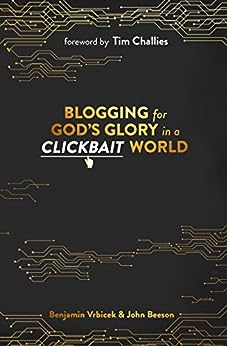
In Blogging for God’s Glory in a Clickbait World, Benjamin Vrbicek and John Beeson propose this definition of blogging for God’s glory: “Blogging for God’s glory means . . . first, to have our motivations aligned with God’s, and second, to pursue excellence in the craft, including theological precision, beautiful prose, visual appeal, and the edification of readers, all drawing from the best industry practices” (p. 14).
First they deal with aligning our motivation with God’s. That’s often the most difficult part to maintain. Usually a Christian blogger begins by wanting to share posts that glorify God and help others. But “our own motives . . . are always layered and mixed” (p. 3). And though Christian writing instructors tell us not to worry about the numbers of those following, liking, and sharing our posts, those who want to move from blogging to publishing a book are told agents and publishers will look at those numbers and won’t consider taking a writer on unless those numbers are high. It’s a continual but necessary struggle to keep our focus on writing for God’s glory and purposes and trusting Him with the results, even when it doesn’t seem like many people are reading.
The authors apply the goal of writing for God’s glory into the everyday nuts and bolts of writing. Write with the reader in mind rather than anticipating accolades. Know your why, what difference you want to make. Serve others, not yourself. But that doesn’t mean never talking about yourself: Paul wanted to proclaim “not ourselves, but Jesus Christ as Lord” (2 Corinthians 4:5), yet 2 Corinthians is “Paul’s most autobiographical letter. He shares much of his own story not because he is narcissistic, but because he knows the church is struggling to trust him and he needs to build rapport” (p. 22).
“If we have any hope of offering others wisdom, listening to God must become a primary and ongoing habit.” We can’t share what we haven’t first taken it. That doesn’t mean every blog post needs to exposit Scripture or be a devotional, but it should still be “subject to God’s truth and ought to reflect His light” (p. 31).
Then, “Christian writers must labor not only to write what is true but also write in a manner that adorns the truth” (p. 38). We need to focus on building up, not tearing down. That doesn’t mean we never share what’s wrong, but we do so with discernment and with the purpose of helping.
The authors give helpful advice with the mechanics of blogging: discerning how much time to give to it, in connection with your other obligations; setting a schedule that works for you; dealing with writer’s block; engaging social media; blogging costs, platforms, layouts; using photos without plagiarizing; networking; monetizing; and more.
They include several appendices. One is a compilation of several bloggers’ answers to the question of whether blogging is dead. One is a glossary of blogging terms. One is a collection of sidebar quotes in the paper version that wouldn’t work in the e-book formatting.
A few other quotes that stood out to me:
Where can you offer yourself to your audience for the sake of proclaiming Jesus Christ as Lord? How can your life become a bridge for the gospel to travel? What work has God done (or is doing) in you that will encourage others? (p. 22).
Don’t feel compelled to chase whatever is hot. Be true to who God has made you to be (p. 23).
Blogging ought to grow us in holiness. When we blog for God’s glory, the discipline of writing becomes integrated into the web of our spiritual disciplines (p. 29).
It is not the size of our platform that assures us how far our words will reach, but rather it is our trust in a God whose word never returns void (Isa 55: 11) (p. 32).
Writing comes down to making and remaking slight improvements to achieve better clarity and aesthetic; writing is the pursuit of marginal gains, insignificant by themselves but significant in the aggregate (p. 37). (I loved the illustration they used here of an eye doctor trying different lenses, asking each time which is better.)
So why should we worry about getting the tone and the content right when we know fewer people will read an article if we write with discernment? We bother because God is God, and on the day of judgment we will give an account for every careless word we have ever blogged (Matt 12: 36) (p. 42).
I think this book is an excellent resource, especially when we need to adjust our motives away from the manipulative and self-focused approach of the world and remind ourselves of our real purpose: glorifying God.
 Stray Thoughts
Good things to think about. It certainly can put blogging in a new perspective.
Excellent things to reflect on. I started blogging only because a church friend thought i wrote good “devotionals”. I’ve never tried to publish them and have no idea how many people even see my blog. hahah. I just like to write and sometimes I share recipes, do book reviews (I enjoy that) and of course participate in the weekly FFF.
I too like the eye dr analogy to “fine-tuning”! Related — a few years back I switched from my own url to a free one. With that I lost lots of sponsorship-type opportunities. But I can’t tell you how freeing it is to just write, without worrying about clicks, seo, etc.
I did the opposite. I had the free version for years. I knew WP placed ads on their free blogs, but since I rarely saw them, I didn’t think they were a problem. But when I started looking at my blog on my phone, I was horrified at how many ads were there. And they were inserted between my paragraphs, so they looked like I had placed them. I switched to the lowest paid version mainly to stop their ads from showing up.
If I spend too much time looking at clicks and stats, I get discouraged. I know those things are a big deal to publishers. It’s hard to know how to get your name “out there” without being a nuisance. And once I start thinking about that, it skews the whole blogging experience. So I try to focus on writing what I think God wants me to write and praying He’ll bring the readers He wants as well as show me if I need to do anything differently.
Oh Barbara, this book seems like a must for Christian bloggers. Thank you.
You’re welcome. 🙂 Even though I knew some of the information they shared, the sections on motivation are some that I need to reread frequently.
Sounds like a wonderful book, Barbara. I’m guessing since they wrote a book about blogging, the authors don’t think blogging is dead? 🙂
You guess correctly. 🙂 Some of the people they polled felt blogging was still valid, but not in the same way as it was years ago.
Pingback: July Reflections | Stray Thoughts
This is one of my favourite writing resources! I really appreciated the way they brought a biblical perspective to blogging. I also liked the quote you shared, “Blogging ought to grow us in holiness. When we blog for God’s glory, the discipline of writing becomes integrated into the web of our spiritual disciplines.” We don’t often think of writing as a spiritual discipline, but when we do it really changes things. Thanks for sharing this Barbara!
It’s at the top of my favorite writing resources, too. I can tell I’m going to need to reread parts regularly.
Thank you for this review Barbara ☺️
Blessings, Jennifer
This is such a great post! I feel like I should post some of these quotes on my wall for daily encouragement and reminders! Thanks for sharing!
Great review barbara. I vary rarely look at my stats. It’s just something that’s not important to me and I also just forget. We may never know who our words touch, and thats okay because God does.
Visiting today from SSPS 272 #137&138.
Thank you for sharing your links with us at #272 SSPS Linky. See you again next week.
Ps: Thanks bunches for sharing this with Sweet Tea & Friends this month.
Pingback: Books Read in 2023 | Stray Thoughts
Pingback: Favorite Books of 2023 | Stray Thoughts
Pingback: 2023 Reading Challenge Wrap-Up | Stray Thoughts