
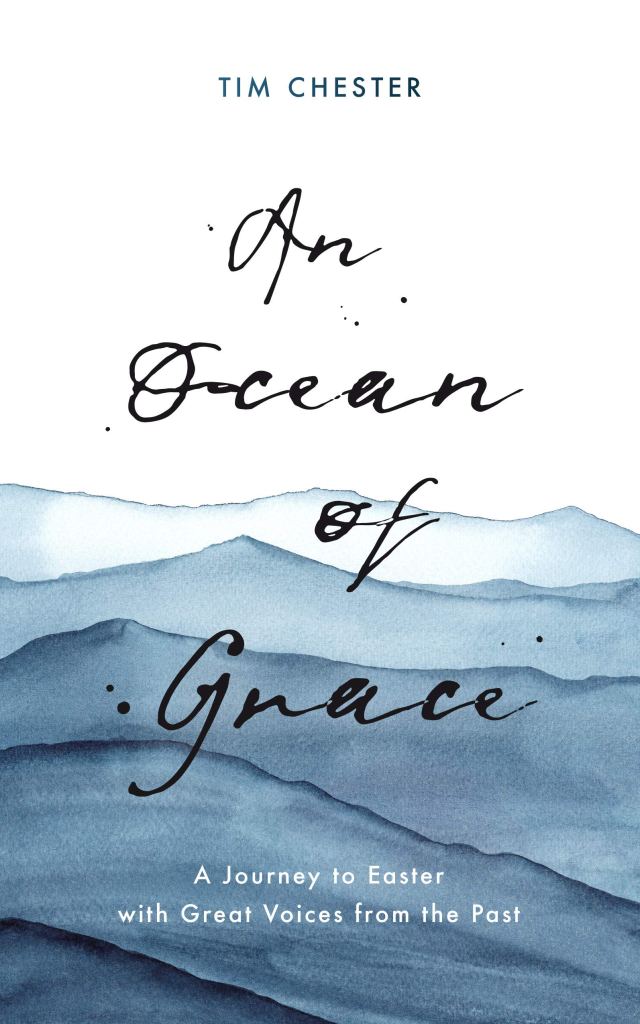
Tim Chester collected collected thoughtful writings about Christ’s death and resurrection and edited them into An Ocean of Grace: A Journey to Easter with Great Voices of the Past.
Some of the selections are from familiar pens: Augustine, Martin Luther, and Charles Spurgeon. Others are more obscure: Cyril of Alexander from the fifth century, Gregory of Myssa from the fourth, Cyprian of the third, and many others. I was delighted to see a piece by Anne Steele, an eighteenth-century female hymn writer. And I was surprised to see a selection from Catherine Parr, Henry VIII’s last wife, leading me to read a little more about her online. I think Spurgeon is the most recent of the authors included.
These selections are divided into daily readings from Ash Wednesday to Easter. They are grouped into themes for each week: The Light of Love, The Welcome of Grace, The Exchange of Places; The Assurance of Faith, The Gift of Christ, and The Victory of God.
In his introduction, Chester says he removed archaic language except for poetry and hymns while trying to retain the “voice” of the original authors. He also says many “descriptions have been turned into a prayer addressed to God or an exhortation addressed to our own souls.” He doesn’t say why, but he also turned what I think were prose selections into a free-verse style of poetry. I wish he had kept the selections closer to the originals–but then maybe I wouldn’t think so if I read the originals.
I began reading this book late in the season due to finishing a previous study. Because of that, and because the selections were fairly short, I read two or three a day. I think that may have lessened the impact of them. If I read this book again, I’ll plan to read one a day as the author intended.
Nevertheless, I did receive much food for thought and warmth for heart by reading this book. I have many places marked, but I will try not to overwhelm you with quotes.
In an excerpt from Catherine Parr’s The Lamentations of a Sinner, she spends several lines listing her sins and Christ’s merits. She concludes:
Shall I fall in desperation?
No, I will call upon Christ,
the Light of the world,
the Fountain of life,
the relief of all careful consciences,
the Peacemaker between God and man,
and the only health and comfort of all true repentant sinners.
By his almighty power he can save me
and deliver me out of this miserable state.
For this is the life everlasting, O Lord,
to believe you to be the true God,
and him whom you sent, Jesus Christ.
By this faith I am assured,
and by this assurance I feel the forgiveness of my sins:
this is what gives me confidence,
this is what comforts me,
this is what quenches all despair (p. 10).
This line of Puritan Stephen Charnock’s “A Discourse of the Knowledge of Christ Crucified” stood out to me: “May all the charms of sin be overcome by this ravishing love” (p. 27). He goes on to say:
How can we, with thoughts of the cross alive in our hearts, sin against so much tenderness, compassion and grace, and all the other perfections of you, our God, which sound so loud in our ears from the cross of Jesus? Shall we consider him hanging there to deliver us from hell and stain, and retain any desire to walk in the way which led him there? Can we take any pleasure in that which caused so much pain for our best friend? Can we love that which brought a curse better than him who bore the curse for us?” (pp. 26-27. I put this in paragraph form just to save time formatting).
This from Isaac Ambrose also stood out to me: “Surely his death is more satisfactory to God than all your sins can possibly be displeasing to God” (p. 94).
This was from Thomas Watson: “We cannot lift up Christ higher in heaven, but we may lift up him in our hearts. So let us believe him, adore him and love him, and exalt him in our lives, for all the doxologies and prayers in the world do not exalt Christ as much as a holy life” (p. 132).
I loved this closing poem from Henry Vaughan titled “Easter Hymn”:
Death, and darkness get you packing,
Nothing now to man is lacking,
All your triumphs now are ended,
And what Adam marred, is mended;
Graves are beds now for the weary,
Death a nap, to wake more merry;
Youth now, full of pious duty,
Seeks in thee for perfect beauty;
The weak and aged tired, with length
Of days, from thee look for new strength;
And infants with thy pangs contest
As pleasant, as if with the breast.
Then, unto him, who thus hath thrown
Even to contempt thy kingdom down,
And by his blood did us advance
Unto his own inheritance,
To him be glory, power, praise,
From this, unto the last of days! (p. 154).
I had a couple of formatting complaints in the book. Chester writes verse references as, for example, Isaiah 61 v 10 rather than Isaiah 61:10. The latter has been used for centuries. I have never seen the former except in Chester’s books. I wondered if perhaps it’s done that way in the UK, but I have read several books from authors from various countries without having seen this way of writing Bible references. I Googled “how to write Bible verse references” just to see if this is a new style, and I didn’t see it mentioned in any source I looked at. It’s not a big deal in the grand scheme of things. It’s more a commentary on my heart to say it irritated me. But I tried to overlook it
The other complaint is not unique to Mr. Chester, but is to all the books I have from The Good Book Company. They put the table of contents in the back of the book rather than in the front after the title page. That doesn’t make sense to me. I use the Table of Contents to look at where a book is going, not where it has been. When I am considering a new book, I look at the front cover, the back cover, the description, the table of contents, and the first few paragraphs or pages. If I look at a sample on Amazon, they usually only include the first several pages. If the Table of Contents is in the back, I am not able to see it in the sample.
I also wish Chester had listed the titles of all the readings in the Table of Contents rather than just the main section headings.
Again, these are minor issues compared to the content of the book.
There were just two or three places where I put a question mark or didn’t quite agree with how something was worded. But overall, I enjoyed this book and plan to use it again for Lenten reading in the future.
(I often link up with some of these bloggers.)
 Stray Thoughts
I was quite surprised to see that Catherine Parr was mentioned. It makes me want to look up more about her as well.
That is a strange chapter and verse format. I’ve never seen that before.
This does sound like an interesting book – to read quotations from those of long ago. Thanks for the review.
This sounds like a really nice pre-Easter read! I liked your comment about wishing some selections had stayed closer to the originals — but then saying maybe you wouldn’t have felt that way if you’d seen the originals 🙂 I like the quotes you mention and I too enjoy seasonal devotions where I could do a brief reading each day, giving me time to ponder it during the day.
I didn’t mind so much the author’s updating the language. In the original of Henry Vaughan’s poem, he has “daies” for “days,” “tir’d” for “tired,” etc. I imagine the authors from centuries earlier would have needed a lot of updating to be understood. But I didn’t like so much his converting prose into poetry or changing the wording to make a passage into a prayer. I guess he had his reasons, though.
I liked that the selections were short, too. I prefer that my seasonal devotional reading doesn’t take over my whole Bible study time. It has sometimes, and that’s fine–but I like these short meditations better.
Pingback: What Does Jesus Pray for Us? | Stray Thoughts
Pingback: What Does Jesus Pray for Us? | Stray Thoughts
Pingback: April Reflections | Stray Thoughts
Oh, I like your thoughts and review her Barbara.
Thanks so much for sharing with Sweet Tea & Friends this month sweet friend. I appreciate you!