Review: The Characters of Easter

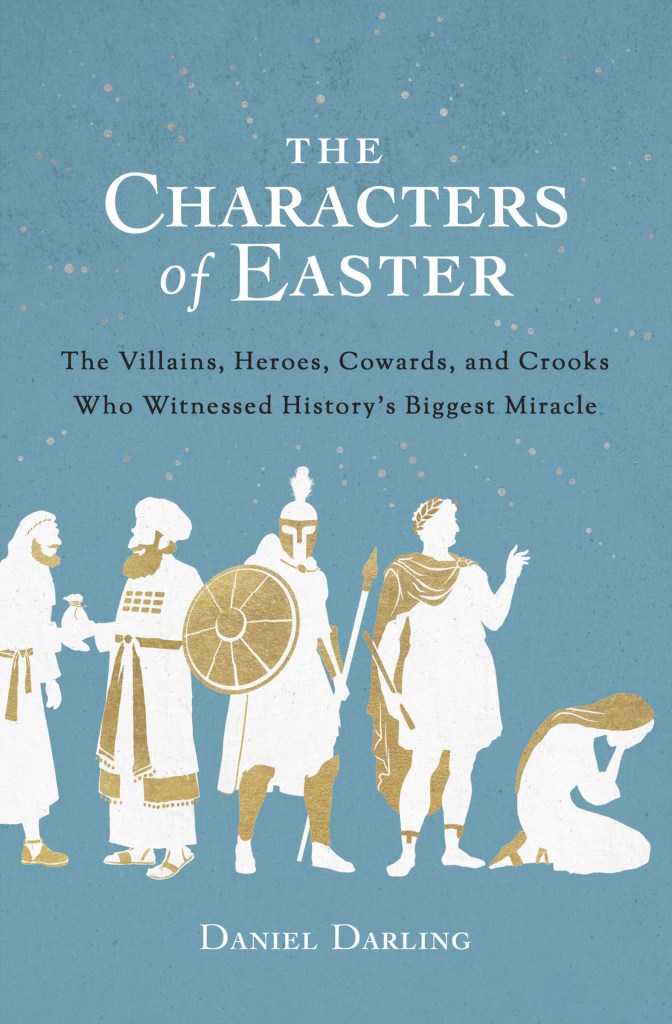
I enjoyed Daniel Darling’s The Characters of Christmas quite a lot. So when I saw he had also written The Characters of Easter: The Villains, Heroes, Cowards, and Crooks Who Witnessed History’s Biggest Miracle, I got it in time for Easter season this year.

Normally I like my seasonal reading in the form of shorter devotionals, because I don’t want them to replace my regular Bible reading. This book was not written in a short devotional style, but it only had ten chapters, so it was easy to work in.

The introduction discusses why Easter is so important and encourages us to look at it through fresh eyes.

Daniel devotes a chapter each to several individuals connected with Easter: Peter, John, Judas, Barabbas, Pilate and Thomas. The remaining four chapters discuss groups: the religious enemies of Christ (Pharisees, scribes, and Sadducees), the women who discovered the empty tomb, the secret disciples (Nicodemus and Joseph of Arimathea), and the Roman executioners.

Each chapter gives what background we know from the Bible of each person, as well as their actions and sayings connected to Jesus’ death and resurrection.

The chapter about John shows that the writer of a book and three letters bearing his name, as well as the book of Revelation, did not start out as the “Apostle of Love.” He and his brother were called “the sons of thunder.” They wanted to call down fire from heaven on a Samaritan village that did not receive Jesus. They wanted places next to Jesus when He established His kingdom. “When John became a disciple, he was far from ready for spiritual leadership. This is a reminder that Jesus didn’t choose His disciples because of their impressive résumés” (p. 47). It was good to follow John’s transformation and to be reminded we’re all in a state of growth. I’m thankful for God’s patience and kindness in dealing with us as we mature spiritually.

The chapter about Thomas was my favorite. We don’t know as much about him as some of the other disciples. Perhaps unfairly, many people only remember him for doubting that Jesus rose from the dead. Earlier, however, he was a brave follower of Jesus when others left because of His hard sayings. When Jesus wanted to go to Bethany after Lazarus died, to an area where His enemies had recently tried to kill Him, Thomas said, “Let us go also, that we may die with him” (John 11:1-16).

It’s kind of a macabre response, perhaps giving us insight into Thomas’s more pessimistic personality. It seems Thomas was the one always counting the cost, weighing the facts, looking for certainty when others like Peter were guided by the more emotional and subjective compass of the heart. And Thomas didn’t understand all that he even said. Thomas or any of the other disciples couldn’t really go with Jesus to die. To pay for the sins of the world, Jesus had to go alone to the garden, alone to the cross, alone to the grave.

And yet in a sense, Thomas understood the call Jesus gives every disciple to come and die with Him . . . 

This is a bold statement. Thomas seems like the silent one, who carefully weighs and thinks before coming to a conclusion, and yet when he speaks, it is a profound statement of courage and loyalty. “Let’s go die with Jesus” could be a life verse, the call of everyone who sees and believes Jesus” (pp. 124-125, Kindle version.).

When Jesus began to tell His disciples that He had to go away, “Thomas, the seeker, the inquirer, the analyzer, asked, ‘Lord, we don’t know where you’re going. How can we know the way?’ (John 14: 5). This is a good question. Thomas, you remember, was the one willing to ‘go and die’ with Jesus. Thomas is willing to obey Jesus at all costs, but he just needs to know where to go” (p. 126).

But Jesus’ response to Thomas—the question-asker, the seeker, the one who hears things and rolls them around his mind until he can process them—is a stunning declaration, perhaps the most important and most controversial words ever uttered in human history:

“I am the way, the truth and the life. No one comes to the Father except through me.” (John 14: 6)

This is the meaning of Easter. There is not a path or a principle. There is only a Person. Jesus is the way. Jesus is the truth. Jesus is the life. He didn’t merely point to the truth. He didn’t merely show them the way. He didn’t merely tell them how to improve their lives. He’s the end of the journey, the object of our obsessions, what our hearts truly long for (pp. 127-128)

And, finally, Thomas wasn’t with the disciples when Jesus first appeared to them after His resurrection. He refused to believe it unless he saw Jesus in person with His scars. “Like a good shepherd, [Jesus] meets His struggling disciple where he is, carefully tending to his soul” (p. 130). Thomas responded, “My Lord and my God!”

Daniel writes of others like Lew Wallace (author of Ben-Hur), C. S. Lewis, and Lee Strobel, who didn’t believe until they looked up the facts for themselves. “Thomas’s story shows us the paradox of Christianity: it is both faith and facts, believing and seeing. Our faith is grounded in a mountain of historical facts . . . ” (p. 131). 

“Jesus is not inhospitable to those who doubt, those who seek earnestly for the truth” (p. 132).

I enjoyed this book so much. I appreciated the author’s perspective and graciousness and his way of looking deeper into each of these people’s lives and hearts.

Looking at Jesus’ life, death, and resurrection through the eyes of people who were there at the time was an interesting and enlightening way to spend Lent and Easter. My heart was touched many times over. I can “amen” what the author said here: “You’ll notice that nobody in Scripture is ever casual after an encounter with the living God: Moses glowed, Isaiah was ‘undone,’ Ezekiel face-planted in fear, John fainted. Peter was overwhelmed—but he left his nets and followed” (p. 25).

(I often link up with some of these bloggers.)

Sure-Footed Confidence

Sure-footed confidence

The book of Habakkuk might seem an unlikely place to draw inspiration for Easter. But my study from Habakkuk last week gave me food for thought this Easter week.

Habakkuk is my favorite of the Old Testament “minor” prophets. His book is just three chapters long and seems to be a lot more understandable than some of the others.

First, Habakkuk laments the violence, destruction, iniquity, and injustice he sees around him. He asks God how long he’ll cry for help without God answering.

God answers that He is sending the “dreaded and fearsome” Chaldeans.

Habakkuk’s response in our day would sound something like, “Wait–what?!” He wonders how God in His holiness can send a wicked nation against His own people.

God’s answer is the longest part of the book, too long to delineate here. But He begins with “The righteous shall live by his faith” and ends with “But the Lord is in his holy temple; let all the earth keep silence before him.”

In other words, “I know what I am doing. Trust me.”

In-between those truths, He promises He will deal with the Chaldeans.

His answer satisfied Habakkuk, who praises Him and prays for revival. In what’s probably the most well-known part of the book, next to “The just shall live by His faith,” Habakkuk proclaims that, “Though the fig tree should not blossom, nor fruit be on the vines, the produce of the olive fail and the fields yield no food, the flock be cut off from the fold and there be no herd in the stalls”–

In other words, through economic collapse, need, everything going wrong–

“Yet I will rejoice in the Lord; I will take joy in the God of my salvation.”

That passage has rebuked and inspired me many times. But what stood out to me on this reading was the next verse: “God, the Lord, is my strength; he makes my feet like the deer’s; he makes me tread on my high places.”

The ESV Study Bible notes say of this verse, “Habakkuk can have sure-footed confidence in God and can live on the heights even amid extreme circumstances.”

Have you ever seen deer or mountain goats walking and leaping in areas where it looks like they’ll take a tumble at any moment? They are much more sure-footed than I would be in their place.

Our day is not unlike Habakkuk’s. Violence, injustice, and iniquity abound. We know from later books in the Bible that things will get worse before the end.

But because Jesus came, lived a totally righteous life in our place, died for our sins, and rose again:

We can be forgiven.

  • “And you, who were dead in your trespasses and the uncircumcision of your flesh, God made alive together with him, having forgiven us all our trespasses, by canceling the record of debt that stood against us with its legal demands. This he set aside, nailing it to the cross. He disarmed the rulers and authorities and put them to open shame, by triumphing over them in him” (Colossians 2:13-15).

We can have everlasting life.

  • “I am the resurrection and the life.Whoever believes in me, though he die, yet shall he live, and everyone who lives and believes in me shall never die. Do you believe this?” (John 11:25).
  • “But our citizenship is in heaven, and from it we await a Savior, the Lord Jesus Christ” (Philippians 3:20).
  • “For we know that if the tent that is our earthly home is destroyed, we have a building from God, a house not made with hands, eternal in the heavens” (2 Corinthians 5:1).

Jesus lives within us.

  • “I have been crucified with Christ. It is no longer I who live, but Christ who lives in me. And the life I now live in the flesh I live by faith in the Son of God, who loved me and gave himself for me” (Galatians 2:20).
  • “To them God chose to make known how great among the Gentiles are the riches of the glory of this mystery, which is Christ in you, the hope of glory” (Colossians 1:27).

We have access to God.

  • “Therefore, since we have been justified by faith, we have peace with God through our Lord Jesus Christ. Through him we have also obtained access by faith into this grace in which we stand, and we rejoice in hope of the glory of God” (Romans 5:1-2).
  • “Since then we have a great high priest who has passed through the heavens, Jesus, the Son of God, let us hold fast our confession. For we do not have a high priest who is unable to sympathize with our weaknesses, but one who in every respect has been tempted as we are, yet without sin. Let us then with confidence draw near to the throne of grace, that we may receive mercy and find grace to help in time of need” (Hebrews 4: 14-16).

We don’t have to fear death.

  • “Since therefore the children share in flesh and blood, he himself likewise partook of the same things, that through death he might destroy the one who has the power of death, that is, the devil, and deliver all those who through fear of death were subject to lifelong slavery” (Hebrews 2:14-15).
  • “When the perishable puts on the imperishable, and the mortal puts on immortality, then shall come to pass the saying that is written: ‘Death is swallowed up in victory.’ ‘O death, where is your victory? O death, where is your sting?’ The sting of death is sin, and the power of sin is the law. But thanks be to God, who gives us the victory through our Lord Jesus Christ” (1 Corinthians 15:54-57).

We have comfort in sorrow.

  • “But we do not want you to be uninformed, brothers, about those who are asleep, that you may not grieve as others do who have no hope. For since we believe that Jesus died and rose again, even so, through Jesus, God will bring with him those who have fallen asleep. For this we declare to you by a word from the Lord, that we who are alive, who are left until the coming of the Lord, will not precede those who have fallen asleep. For the Lord himself will descend from heaven with a cry of command, with the voice of an archangel, and with the sound of the trumpet of God. And the dead in Christ will rise first. Then we who are alive, who are left, will be caught up together with them in the clouds to meet the Lord in the air, and so we will always be with the Lord. Therefore encourage one another with these words (1 Thessalonians 4:13-18).

We have meaning in our work.

  • After 57 verses about the resurrection, Paul writes, “Therefore, my beloved brothers, be steadfast, immovable, always abounding in the work of the Lord, knowing that in the Lord your labor is not in vain” (1 Corinthians 15:58).

We have perspective in our suffering.

  • “So we do not lose heart. Though our outer self is wasting away, our inner self is being renewed day by day. For this light momentary affliction is preparing for us an eternal weight of glory beyond all comparison” (2 Corinthians 4:16-17).
  • “For I consider that the sufferings of this present time are not worth comparing with the glory that is to be revealed to us” (Romans 8:18).

We have focus for our daily walk.

  • “We look not to the things that are seen but to the things that are unseen. For the things that are seen are transient, but the things that are unseen are eternal” (2 Corinthians 4:18).
  • “But one thing I do: forgetting what lies behind and straining forward to what lies ahead, I press on toward the goal for the prize of the upward call of God in Christ Jesus” (Philippians 3:13-14).
  • “We were buried therefore with him by baptism into death, in order that, just as Christ was raised from the dead by the glory of the Father, we too might walk in newness of life” (Romans 6:4).

God has graciously given us more Scripture than Habakkuk had. But the truth remains: “The righteous shall live by his faith” and “The Lord is in his holy temple; let all the earth keep silence before him.”

We don’t know how everything will work out before the Lord comes again. But we can have “sure-footed confidence in God” and “live on the heights even amid extreme circumstances.” Our souls can be stable even when our circumstances are not.

Habakkuk 3:19

(I often link up with some of these bloggers.)

Laudable Linkage

Laudable Linkage

I have just a short list to share today:

Easter Week in Real Time, HT to the Story Warren. Russ Ramsey has put together the Bible accounts of the last week of Jesus’ earthly life in chronological order.

The Day Between Loss and Glory, HT to Challies. “Easter weekend has always been one of contemplation for me; and much more so over the last three years as we continue to navigate what life is like after the death of our eldest son, Ezra. I often think about Friday and Christ’s crucifixion; the incredible sacrifice he made for sinners like me. I love to celebrate on Sunday; the glory and hope of the resurrection. In recent years, however, I find Saturday is much more dear to me.”

All Thinks Considered. Thinking about overthinking. “Overthinking, on the other hand, is getting stuck in woulda, shoulda, what-ifs, and whys, analyzing and reanalyzing the same thoughts, situations, and interactions—past, present, and future—and obsessing about the outcome. It’s that kind of overthinking that can trap us in all kinds of worry and the highest anxiety. It can freeze up our decision-making abilities.”

Spirit-Empowered Growth. “Spiritual growth is possible because of the ministry of the Holy Spirit. The Spirit actively works in our lives to make us more like Christ. He accomplishes His sanctifying work in a number of different ways.”

Why Did God Reject Cain’s Offering? “The second sin in the Bible is Cain’s anger at and murder of his brother. This story is both incredibly relatable, as is seen from the scores of families that have been strained, divided, and ultimately ripped apart from envy, anger, and jealousy. Yet it is also confusing. It’s confusing because it isn’t immediately obvious why God is displeased with Cain’s offering. Several theories have been proposed, and I have a theory of my own to throw in at the end. I want to work through each of these and examine the strengths and weaknesses of each position.”

Grace in the Struggle: 5 Truths from Life with Fabry. Ashley writes about what she’s learned from a chronic illness called Fabry disease, but these truths are applicable for other conditions as well.

Lloyd-Jones quote

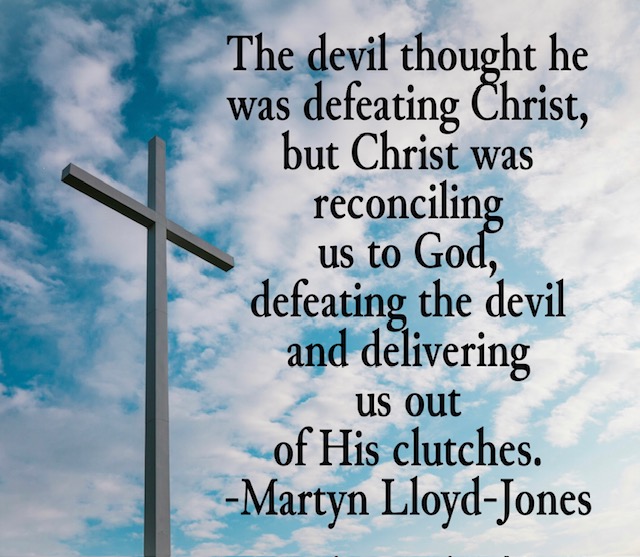
The devil thought he was defeating Christ, but Christ was reconciling us to God, defeating the devil and delivering us out of His clutches. Martyn Lloyd-Jones

Who Is Responsible for Jesus’ Death?

Who is responsible for Jesus' death?

Every now and then, the question comes up: Who killed Jesus? Who is responsible for His death?

Let’s look at the possibilities:

Pontius Pilate, the Roman governor of Judea. Even though Pilate said he did not find in guilt in Jesus (John 18:38; 19:5), and tried to have Jesus released (John 19:12), he still delivered Him over to be crucified (John 19:16). Even though Pilate washed his hands, proclaiming his innocence of Jesus’ blood (Matthew 27:24), he is still responsible.

The Roman soldiers. One could say they were just following Pilate’s orders, that they didn’t authorize Jesus’ death. Yet they were the ones to actually nail Him to a cross. And they went beyond orders to mock and beat Him (Matthew 27:27-31).

The Jewish officials. The chief priests and elders “plotted together in order to arrest Jesus by stealth and kill him” (Matthew 26:3-5). They paid Judas to betray Him. They sent people to seize Jesus (Mathew 26:47). They accused him before Pilate (John 18:28-32; 19:12-16). When Pilate offered to free Jesus as part of his tradition of freeing a prisoner during the Passover week, they urged the people to ask for Barabbas to be freed instead and to call for Jesus to be crucified Matthew 27:15-23).

The Jewish people. When Pilate washed his hands, saying he was innocent of Jesus’ blood, “all the people answered, ‘His blood be on us and on our children!’” (Matthew 27:24-25). This is not a reason for antisemitism, nor is it saying that all Jews of all time are guilty of Jesus’ death. It’s just saying that the people who had rejected Jesus during the time of His ministry called for His death and willingly took responsibility.

Judas. Judas betrayed Jesus for thirty pieces of silver and led those seeking Him straight to Him. I don’t know if he realized his actions would result in Jesus’ death. But whether he intended it or not, he had a hand in Jesus’ crucifixion.

God the Father. None of the above could have happened if God did not allow it. But God the Father did not merely allow events to happen that resulted in His Son’s death. He gave His Son to die for our sins. “For God so loved the world, that he gave his only Son, that whoever believes in him should not perish but have eternal life” (John 3:16). “In this the love of God was made manifest among us, that God sent his only Son into the world, so that we might live through him” (1 John 4:9).

Jesus Himself. Jesus was not an unwilling pawn in His death. He said, “I lay down my life that I may take it up again. No one takes it from me, but I lay it down of my own accord. I have authority to lay it down, and I have authority to take it up again. This charge I have received from my Father” (John 10:17-19). “Christ loved us and gave himself up for us, a fragrant offering and sacrifice to God. . . Christ loved the church and gave himself up for her, that he might sanctify her, having cleansed her by the washing of water with the word, so that he might present the church to himself in splendor, without spot or wrinkle or any such thing, that she might be holy and without blemish.” (Ephesian 5:2, 25-27).

Us. How can we be responsible for Jesus’ death when we didn’t live at the time of His crucifixion? He died for the sins of the whole world. “For our sake he made him to be sin who knew no sin, so that in him we might become the righteousness of God” (2 Corinthians 5:21). “But he was pierced for our transgressions; he was crushed for our iniquities; upon him was the chastisement that brought us peace, and with his wounds we are healed. All we like sheep have gone astray; we have turned—every one—to his own way; and the Lord has laid on him the iniquity of us all” (Isaiah 53:5-6). We may not have held the hammer that drove the nails or shouted for His crucifixion. But he was on the cross to pay for our sins.

So–who was ultimately responsible?

Well, the disciples said in Acts 4:27-28 (NKJV), “For truly against Your holy Servant Jesus, whom You anointed, both Herod and Pontius Pilate, with the Gentiles and the people of Israel, were gathered together to do whatever Your hand and Your purpose determined before to be done.” The Roman officials, the Jewish people, and even the Gentiles are mentioned–but so is God’s plan and purpose.

Likewise, Acts 2:23 says, “This Jesus, delivered up according to the definite plan and foreknowledge of God, you crucified and killed by the hands of lawless men.” The Father and Son planned this ahead of time, but it was accomplished “by the hands of lawless men” (some translations say wicked men).

Somehow God’s rule and man’s will worked together to accomplish God’s purposes. It’s like what Joseph said of his brothers’ wrongs committed against him: “As for you, you meant evil against me, but God meant it for good, to bring it about that many people should be kept alive, as they are today” (Genesis 50:20).

The good news is that Jesus didn’t die just to heap guilt on us. He died to save us from our sins. He prayed for forgiveness even for the men who killed Him. “Father, forgive them, for they know not what they do” (Luke 23:34). And His desire is that people believe on Him and accept His forgiveness.

“For the wages of sin is death, but the free gift of God is eternal life in Christ Jesus our Lord” (Romans 6:23).

“If you confess with your mouth that Jesus is Lord and believe in your heart that God raised him from the dead, you will be saved. For with the heart one believes and is justified, and with the mouth one confesses and is saved” (Romans 10:9-10).

He died for us. He died for you. Please don’t neglect this wonderful gift of love.

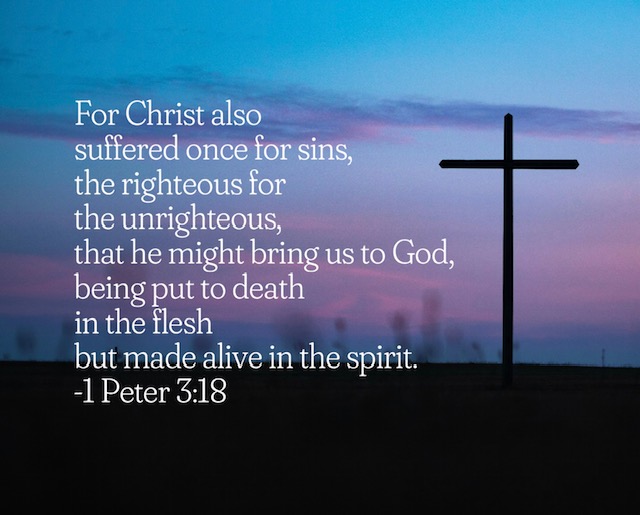
1 Peter 3:18

(I often link up with some of these bloggers.)

Devotional Books for Lent and Easter

Devotional books for Lent and Easter

I don’t observe Lent per se, but I do like to spend the weeks leading up to Easter reading devotional-type books on the death and resurrection of Christ. Otherwise, this season goes by too quickly without thinking of its meaning as much as I would like.

I’ve been surprised that there are far fewer books of Lenten and Easter reading than there are for Advent and Christmas. Of course, there are multitudes of books about Jesus’ death and resurrection that are not just for Easter.

Personally, I don’t want Lenten reading from a Catholic or liturgical viewpoint, which narrows down the reading selections even further: I just want to mediate on what Jesus did for us and our response. We do that often, not just this time of year. But it’s good to have a special emphasis on these things at this season.

Here are some of the books I have enjoyed for Lent and Easter, linked to my reviews:

Jesus Keep Me Near the Cross

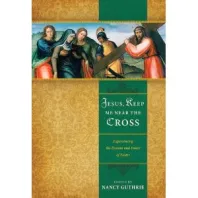
Jesus, Keep Me Near the Cross: Experiencing the Passion and Power of Easter compiled by Nancy Guthrie from writings as far back as Augustine and Luther through to writers as current as John Piper and John MacArthur. I think I have read this at least three times. One favorite quote from the book:

In human religions, it’s the worshipper who placates the offended deity with rituals and sacrifices and bribes. But in the gospel, it is God Himself who provides the offering.Ray Ortland

Women of Easter

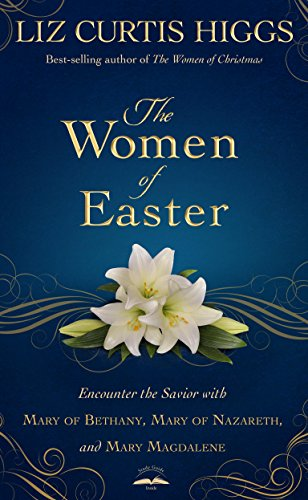
The Women of Easter: Encounter the Savior with Mary of Bethany, Mary of Nazareth, and Mary Magdalene by Liz Curtis Higgs. The book does just what the subtitle says. Liz considers Jesus’ life, death, and resurrection through the eyes of these three Marys. Liz has done extensive study in different translations and commentaries. I think I have read this twice. A favorite quote:

Worship isn’t a task. Worship is a response.

Song of the Morning

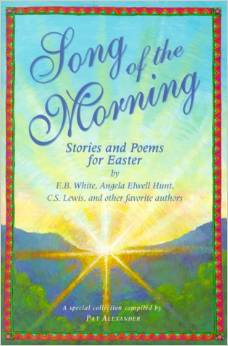
Songs of the Morning: Stories and Poems for Easter was compiled by Pat Alexander and includes excerpts from the writings of C. S. Lewis, E. B. White, Dickens and others, some (mostly poems) written by children. I don’t think I realized this book was written for children (about the age of those who would enjoy the Narnia books) when I first got it. But I enjoyed it. Unfortunately, I didn’t list any quotes from this one in my review.

Preparing for Easter

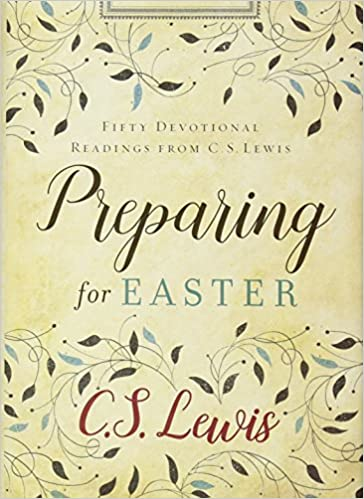
Preparing for Easter: Fifty Devotional Reading from C. S. Lewis is a compilation of selections from his writings. I include this one with a bit of caution. As much as I love C. S. Lewis, I differ with him on a few points of theology. I noted in my review that some of the selections used didn’t seem to fit the theme of the book or suffered from being taken out of their context. But there were still some good nuggets here. One such quote:

Keep back nothing. Nothing that you have not given away will be really yours. Nothing in you that has not died will ever be raised from the dead. Look for yourself, and you will find in the long run only hatred, loneliness, despair, rage, ruin, and decay. But look for Christ and you will find Him, and with Him everything else thrown in (p. 212, originally from Mere Christianity).

Ocean of Grace

An Ocean of Grace: A Journey to Easter with Great Voices of the Past, another compilation of quotes from across the centuries, this time by Tim Chester. Chester says he updated some of the archaic language and changed some of the description into prayers or exhortations. I think he overdid the editing. But I did enjoy much from the book. One favorite quote:

May all the charms of sin be overcome by this ravishing love, from Stephen Charnock’s “A Discourse of the Knowledge of Christ Crucified”

I may have read other Easter devotional books, but these are the only ones I can remember or that I made note of here on the blog.

I own, but have not yet read, The Case for Easter: A Journalist Investigates Evidence for the Resurrection by Lee Strobel. It’s not a devotional book, but I think it would be valuable reading. I enjoyed The Case for Christ by Strobel.

This year I am planning to read a couple of new-to-me books. I enjoyed The Characters of Christmas: 10 Unlikely People Caught Up in the Story of Jesus by Daniel Darling so much that, when I saw he had a similar book based on Easter, I immediately got it. It’s title is The Characters of Easter: The Villains, Heroes, Cowards, and Crooks Who Witnessed History’s Biggest Miracle. It’s not exactly a devotional, but I am using it in that way.

I’m also going to at least dip into Bread and Wine: Readings for Lent and Easter, another compilation from writings across the centuries recommended by Michele. I can tell, from the writers listed, that I am not going to agree with all of them. But there are several others that I am sure I’ll enjoy.

Do you enjoy reading that focuses on Lent and Easter?

(I often link up with some of these bloggers.)
Review: An Ocean of Grace

Ocean of Grace

Tim Chester collected collected thoughtful writings about Christ’s death and resurrection and edited them into An Ocean of Grace: A Journey to Easter with Great Voices of the Past.

Some of the selections are from familiar pens: Augustine, Martin Luther, and Charles Spurgeon. Others are more obscure: Cyril of Alexander from the fifth century, Gregory of Myssa from the fourth, Cyprian of the third, and many others. I was delighted to see a piece by Anne Steele, an eighteenth-century female hymn writer. And I was surprised to see a selection from Catherine Parr, Henry VIII’s last wife, leading me to read a little more about her online. I think Spurgeon is the most recent of the authors included.

These selections are divided into daily readings from Ash Wednesday to Easter. They are grouped into themes for each week: The Light of Love, The Welcome of Grace, The Exchange of Places; The Assurance of Faith, The Gift of Christ, and The Victory of God.

In his introduction, Chester says he removed archaic language except for poetry and hymns while trying to retain the “voice” of the original authors. He also says many “descriptions have been turned into a prayer addressed to God or an exhortation addressed to our own souls.” He doesn’t say why, but he also turned what I think were prose selections into a free-verse style of poetry. I wish he had kept the selections closer to the originals–but then maybe I wouldn’t think so if I read the originals.

I began reading this book late in the season due to finishing a previous study. Because of that, and because the selections were fairly short, I read two or three a day. I think that may have lessened the impact of them. If I read this book again, I’ll plan to read one a day as the author intended.

Nevertheless, I did receive much food for thought and warmth for heart by reading this book. I have many places marked, but I will try not to overwhelm you with quotes.

In an excerpt from Catherine Parr’s The Lamentations of a Sinner, she spends several lines listing her sins and Christ’s merits. She concludes:

Shall I fall in desperation?
No, I will call upon Christ,
 the Light of the world,
  the Fountain of life,
   the relief of all careful consciences,
    the Peacemaker between God and man,
     and the only health and comfort of all true repentant sinners.

By his almighty power he can save me
and deliver me out of this miserable state.
For this is the life everlasting, O Lord,
 to believe you to be the true God,
 and him whom you sent, Jesus Christ.
By this faith I am assured,
and by this assurance I feel the forgiveness of my sins:
 this is what gives me confidence,
 this is what comforts me,
 this is what quenches all despair (p. 10).

This line of Puritan Stephen Charnock’s “A Discourse of the Knowledge of Christ Crucified” stood out to me: “May all the charms of sin be overcome by this ravishing love” (p. 27). He goes on to say:

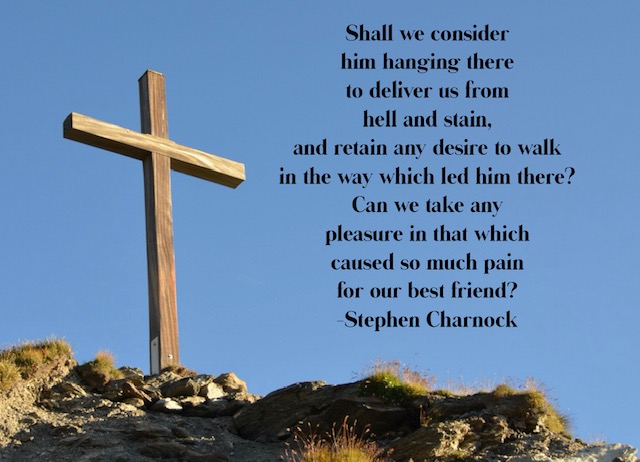
How can we, with thoughts of the cross alive in our hearts, sin against so much tenderness, compassion and grace, and all the other perfections of you, our God, which sound so loud in our ears from the cross of Jesus? Shall we consider him hanging there to deliver us from hell and stain, and retain any desire to walk in the way which led him there? Can we take any pleasure in that which caused so much pain for our best friend? Can we love that which brought a curse better than him who bore the curse for us?” (pp. 26-27. I put this in paragraph form just to save time formatting).

This from Isaac Ambrose also stood out to me: “Surely his death is more satisfactory to God than all your sins can possibly be displeasing to God” (p. 94).

This was from Thomas Watson: “We cannot lift up Christ higher in heaven, but we may lift up him in our hearts. So let us believe him, adore him and love him, and exalt him in our lives, for all the doxologies and prayers in the world do not exalt Christ as much as a holy life” (p. 132).

I loved this closing poem from Henry Vaughan titled “Easter Hymn”:

Death, and darkness get you packing,
Nothing now to man is lacking,
All your triumphs now are ended,
And what Adam marred, is mended;
Graves are beds now for the weary,
Death a nap, to wake more merry;
Youth now, full of pious duty,
Seeks in thee for perfect beauty;
The weak and aged tired, with length
Of days, from thee look for new strength;
And infants with thy pangs contest
As pleasant, as if with the breast.
Then, unto him, who thus hath thrown
Even to contempt thy kingdom down,
And by his blood did us advance
Unto his own inheritance,
To him be glory, power, praise,
From this, unto the last of days! (p. 154).

I had a couple of formatting complaints in the book. Chester writes verse references as, for example, Isaiah 61 v 10 rather than Isaiah 61:10. The latter has been used for centuries. I have never seen the former except in Chester’s books. I wondered if perhaps it’s done that way in the UK, but I have read several books from authors from various countries without having seen this way of writing Bible references. I Googled “how to write Bible verse references” just to see if this is a new style, and I didn’t see it mentioned in any source I looked at. It’s not a big deal in the grand scheme of things. It’s more a commentary on my heart to say it irritated me. But I tried to overlook it

The other complaint is not unique to Mr. Chester, but is to all the books I have from The Good Book Company. They put the table of contents in the back of the book rather than in the front after the title page. That doesn’t make sense to me. I use the Table of Contents to look at where a book is going, not where it has been. When I am considering a new book, I look at the front cover, the back cover, the description, the table of contents, and the first few paragraphs or pages. If I look at a sample on Amazon, they usually only include the first several pages. If the Table of Contents is in the back, I am not able to see it in the sample.

I also wish Chester had listed the titles of all the readings in the Table of Contents rather than just the main section headings.

Again, these are minor issues compared to the content of the book.

There were just two or three places where I put a question mark or didn’t quite agree with how something was worded. But overall, I enjoyed this book and plan to use it again for Lenten reading in the future.

(I often link up with some of these bloggers.)

If Jesus Had Not Been Resurrected

If Jesus Had Not Been Resurrected

There’s an old Christmas song I’ve only heard a few times titled “If Jesus Had Not Come” by Albert C. Norton and Donald P. Hustad. The songwriters list several consequences we would face if Jesus never came to earth. Then the rousing chorus affirms:

But Jesus came! He came to earth,
And men beheld His manger birth!
The shepherds heard the angels sing,
The wise proclaimed Him Lord and King!
He died, He rose; and by His blood,
We too become the sons of God;
We preach the gospel in His name!
For Jesus came! Yes, Jesus came!

This Easter week, I’m thinking about what the consequences would be if Jesus had not been raised from the dead.

No resurrection for us. 1 Corinthians 15:20-23 says Jesus was the “firstfruits of those who have fallen asleep. For as by a man came death, by a man has come also the resurrection of the dead. For as in Adam all die, so also in Christ shall all be made alive. But each in his own order: Christ the firstfruits, then at his coming those who belong to Christ.” If He wasn’t raised from the dead, we won’t be, either. “If in Christ we have hope in this life only, we are of all people most to be pitied” (verse 19).

Futile faith. “If Christ has not been raised, then our preaching is in vain and your faith is in vain . . . And if Christ has not been raised, your faith is futile and you are still in your sins” (1 Corinthians 15:14, 17).

No meaning in life. Paul questions the worth of the dangers he endured for gospel’s sake if there is no resurrection. “If the dead are not raised, ‘Let us eat and drink, for tomorrow we die'” (1 Corinthians 15:30-32).

Death’s sting. Paul concludes his “resurrection chapter” with this: “For this perishable body must put on the imperishable, and this mortal body must put on immortality. When the perishable puts on the imperishable, and the mortal puts on immortality, then shall come to pass the saying that is written: ‘Death is swallowed up in victory.’ ‘O death, where is your victory? O death, where is your sting?'” (1 Corinthians 15:53-55). But if Jesus is not risen, death’s sting is still with us.

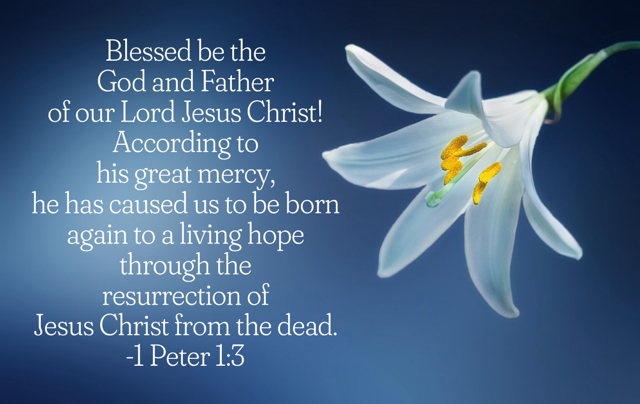
No hope. Peter begins his epistle by saying, “Blessed be the God and Father of our Lord Jesus Christ! According to his great mercy, he has caused us to be born again to a living hope through the resurrection of Jesus Christ from the dead” (1 Peter 1:3). But if there is no resurrection, we don’t have a living hope.

No inheritance. Peter speaks of an “inheritance that is imperishable, undefiled, and unfading, kept in heaven for you” which encourages us in our trials. But we’ll never receive that inheritance if there is no resurrection. (Ephesians 1 also speaks of our inheritance.)

No seeing loved ones again. When a loved one dies, or when facing our own death, one comfort is that we’ll see our loved ones again if they’ve believed on the Lord. Paul shares in 1 Thessalonians 4:13-18 that those who have already died will be reunited with those of us who are still alive when Jesus returns. Therefore we do “not grieve as others do who have no hope.” But without that hope, we’ll be swallowed up in grief.

No comfort. After sharing the expectation that we’ll see our loved ones again after death, Paul tells us to comfort (some versions say encourage) one another with these words. Likewise, Peter says we can rejoice in our sufferings when Jesus’ glory is revealed (1 Peter 4:12-14). But with no resurrection, there is no comfort.

No power. Paul prays that we may know “what is the immeasurable greatness of his power toward us who believe, according to the working of his great might that he worked in Christ when he raised him from the dead and seated him at his right hand in the heavenly places” (Ephesians 1:19-20). But with no resurrection, there is no resurrection power.

No intercession. Hebrews 7:25 says Jesus “is able to save to the uttermost those who draw near to God through him, since he always lives to make intercession for them.” I can’t imagine being without His prayers!

No wrongs set right. One of our comforts in a world where there are so many wrongs is that some day they will be set right. Paul preached that God “has fixed a day on which he will judge the world in righteousness by a man whom he has appointed; and of this he has given assurance to all by raising him from the dead” (Acts 17:31). But without the resurrection, those wrongs will never be righted.

No seeing Jesus. In this life, we love and believe in Jesus, though we do not see Him (1 Peter 1:8). We look forward to that “blessed hope, the appearing of the glory of our great God and Savior Jesus Christ, who gave himself for us to redeem us from all lawlessness and to purify for himself a people for his own possession” (Titus 2: 13-14). If he’s still buried, we won’t see Him.

No motivation. Paul concludes all he says about resurrection by encouraging, “Therefore, my beloved brothers, be steadfast, immovable, always abounding in the work of the Lord, knowing that in the Lord your labor is not in vain” (1 Corinthians 15:58). But without resurrection, our work would be largely in vain and we’d lose our impetus to keep going.

Facing God’s wrath. Paul writes of the Thessalonians who “wait for his Son from heaven, whom he raised from the dead, Jesus who delivers us from the wrath to come” (1 Thessalonians 1:10). But if Jesus was not raised from the dead, we’re not delivered.

How bleak and hopeless life would be if Jesus had not been raised from the dead.

But, thank God, He has been raised! Not only that, He is the resurrection! He told Martha, “I am the resurrection and the life. Whoever believes in me, though he die, yet shall he live” (John 11:25).

I love how Krissy Nordhoff and Michel Neale expressed the joy of Jesus’ resurrection in The Mercy Tree (these are some middle verses and the chorus):

Hope went dark that violent dayThe whole earth quaked at love’s displayThree days silent in the groundThis body born for heaven’s crown.
 
And on that bright and glorious dayWhen heaven opened up the graveHe’s alive and risen indeedPraise Him for the Mercy Tree!
 
Death has died, love has wonHallelujah!, Hallelujah!Jesus Christ has overcomeHe has risen from the dead.

May we rejoice in all Jesus accomplished through His life, death, and resurrection! Hallelujah!

1 Peter 1:3

(I often link up with some of these bloggers.)
Laudable Linkage

Laudable Linkage

Here are some of the good reads found this week:

The Resurrection and the Rest of Your Life. “Encountering Jesus—walking with Him through both suffering and resurrection—changes you. When you trace His steps all the way to the cross and begin to grasp the weight of His love, when you witness His power over death and realize what He has already overcome—you don’t walk away the same.”

The Most Radical Thing You Can Bring to Easter Dinner, HT to Challies. “You look at the calendar and begin counting down the days to Easter—not with anticipation, but with angst. What should be a grateful celebration of the greatest event in history, Christ’s resurrection, is instead a time of stress as you think about getting together again with troublesome friends or family members.” Thankfully, none of the people we’re having for Easter is troublesome. But these reminders are good for any time of year.

The Dragon and the Rooster, HT to Challies. A father and daughter at odds and the power of forgiveness.

When Scripture Gets Stale, HT to Challies. “If you’re getting mired down in your reading, I want to give you some tips to help you refresh your mindset. If reading the Bible began to feel stale to me, here are five things I would do.”

When a Good Thing Turns Deadly, HT to Challies. Good and harmless things can become deadly if overindulged.

How to Publicly Thank God After a Work Win, HT to Redeeming Productivity. “Over the years, we’ve watched as the occasional actor or athlete directs thanks to God during an award show acceptance speech or after a big game. While most of us will never celebrate a win on national network television, gone are the days of a simple in-office announcement or a quiet dinner with family to celebrate a work promotion. Now, we update our LinkedIn profiles with a carefully crafted announcement that reaches beyond the intimate circles of our workplace or kitchen table. It’s wise to be discerning about how (and to whom) our gratitude is directed when we share good news.”

Shall we consider him hanging there to deliver us from hell and stain, and retain any desire to walk in the way which led him there? Can we take any pleasure in that which caused so much pain or our best friend? Stephen Charnock

Laudable Linkage

Laudable Linkage

Here’s another weekly round-up of good online reads.

Sacrifice Is the Beginning. “Maybe the giving up, the surrendering, is not the end at all. Maybe it is the very beginning of something new, something bigger, and more purposeful.”

Longing for More, HT to Challies. “On a soul level, whether in our highest or lowest moments, we know from our earliest memories that something critical is missing. And God shows us in all kinds of ways that He is that vital ingredient.”

Resurrection Sunday Hope for a Tuesday Afternoon. “While we can’t ride the Easter high every day of the year (the jelly bean supply just can’t keep up!), the hope of the resurrection never wanes. You can have hope, joy, and peace in the middle of your Tuesday doldrums or Thursday despair because Jesus is our risen Savior.”

Is the Lord’s Supper a Feast or a Funeral? HT to Challies. “When we approach the Lord’s Supper we should do so with an attitude marked primarily by joy, and not sorrow. We come singing and rejoicing, not mourning or weeping. Yet, how can this be if the thought of death pervades the very foundations of the sacrament? The answer lies in the gospel.”

Is the ‘Silent Treatment’ a Godly Approach to Conflict? HT to Challies. Though I agree with the writer that silence and withdrawal shouldn’t be used as punishment, some quiet time lets emotions cool down and helps us process what the conflict was all about and how to deal with it.

10 Reasons to Hate Hospitality and 10 ways to rethink it.

Jesus destroyed sin by letting it destroy him.

That he, the God of life, should conquer death by embracing it.
That he should destroy the power of sin by letting it destroy him.
Joni Eareckson Tada, When God Weeps

The Tomb Is Empty that We Might Be Filled

The tomb is empty that we might be filled.

Some people only think about Jesus at Christmas. Perhaps they are inspired by sweet paintings of a mother and child and promises of peace on earth and good will to men.

But Jesus is no longer in the manger.

He grew up to be a man, led a righteous life, kept all of God’s law in our place, and died on the cross for our sins. His death on the cross canceled our sin debt, demonstrated His love, reconciled us to God, took the punishment for our sins, made it possible for us to be saved, and more.

But Jesus is no longer on the cross.

Some of His last words were “It is finished.” He had done everything necessary to make it possible for people to be saved.

He was taken down from the cross and buried in a borrowed tomb.

But Jesus is no longer in the tomb.

When friends came to care for His body, instead they found an angelic messenger declaring, “He is not here; He is risen, just as He said.” “God raised him up, ending the pains of death, because it was not possible for him to be held by death” (Acts 2:24, CSB).

Jesus’ resurrection testifies that Jesus is the Son of God, validates His claims, removes death’s sting, gives hope in sorrow, show’s God’s power, and so much more.

Now Jesus is sitting at the right hand of the Father, praying for us, and preparing a place for us to be with Him. Yet He also dwells in our hearts through faith. “Christ in us” is “the hope of glory” (Colossians 1:27).

The manger, the cross, and the tomb are all empty—that we might be filled with His presence, pardon, power, and peace.

Emptied that Thou shouldest fill me,
A clean vessel in Thy hand;
With no pow’r but as Thou givest
Graciously with each command.

Witnessing Thy pow’r to save me,
Setting free from self and sin;
Thou who boughtest to possess me,
In Thy fullness, Lord, come in.

Mary E. Maxwell, “Channels Only”

“If you come to seek His face, not in the empty sepulchre, but in the living power of His presence, as indeed realizing that He has finished His glorious work, and is alive for evermore, then your hearts will be full of true Easter joy, and that joy will shed itself abroad in your homes. And let your joy not end with the hymns and the prayers and the communions in His house. Take with you the joy of Easter to the home, and make that home bright with more unselfish love, more hearty service; take it into your work, and do all in the name of the Lord Jesus; take it to your heart, and let that heart rise anew on Easter wings to a higher, a gladder, a fuller life; take it to the dear grave-side and say there the two words ‘Jesus lives!’ and find in them the secret of calm expectation, the hope of eternal reunion.” —John Ellerton

Jesus is the resurrection and the life. Whoever believes in Him will live though he dies.

This post was inspired by a short piece written by Terry Rayburn.

I often link up with some of these bloggers.