

I am in a writing critique group where we take turns presenting a piece to the others for their feedback. Few things have impacted my writing more than having others read it and make suggestions to improve it.
With my last submission, I asked the group about what tone came across. I wanted to sound like an encouraging friend sitting across the table, not a lecturer.
Some of the ladies pointed out that I used “should” a number of times and suggested that I reword those sentences.
They were absolutely correct. Writing what people “should” do can sound like wagging my finger in their faces while frowning over my eyeglasses at them, even when that’s not how I’m thinking as I write.
For instance, instead of writing “You should read your Bible every day,” it’s more encouraging to say “Reading the Bible regularly helps us know God, His character, and His will for us.” The first sentence seems guilt-inducing (not only the “should,” but also saying “You” instead of “we”).
Those thoughts led to a rabbit trail concerning “should.” The word often grates. Buy why?
For instance, recently I bristled in response to an article which said I should read a certain author’s books. I didn’t know the author. None of his book titles interested me. Nothing I read about the author inspired me to read him. I left the site feeling irritated rather than inspired. .
“Shoulds” can seem to imply judgment. I don’t think they are always judgmental; but they feel that way. If we don’t want to do what the other person says we should, we feel guilty–even when we disagree with what they think we should do.
Also, when someone says we should do a thing, it makes them sound superior. Their way, their foods, their health practices, their books, their preferences–whatever they are recommending, they think it’s better than what we’re doing. And that makes us (or at least me) think, “Who do you think you are?” They may be sharing excellent advice, but it hits wrong.
Even if others don’t sound superior, they can seem like busybodies. An older lady at one of our churches told a young married lady she and her husband needed to get busy and have kids, and an older woman with six kids that she needed to slow down her baby production. That advice definitely crossed lines and caused hurt. But even lesser “shoulds” can do that.
Sometimes “should” affects us negatively because we just don’t like being told what to do.
Often, though, I think “should” deflates us because we’re heaped up with so many “shoulds” already that we can’t keep up with. We’re pressured by a whole list of unmet “shoulds” for family, our spiritual lives, health, friends, church, neighbors, our homes . . . we never get it all done, leaving us in an endless guilt cycle.
However, “should” is not always negative.
If I’m teaching my child to brush his teeth, I might say, “You should brush your teeth twice every day.” My dentist told me I should floss daily. “Should,” in those cases, is helpful.
Sometimes “should” is instructional. A math teacher will tell students why they should do long division or multiply fractions a certain way. A science teacher will tell students what they should and shouldn’t do in the lab, for everyone’s safety as well as their learning.
“Should” can even be a promise, or at least a hope. A financial advisor might recommend certain investments which should yield a profit.
“Should” is somewhat easier to take from an authority. We expect a parent, teacher, coach, or boss to tell us what we should do. In fact, we often welcome it. I would feel lost and frustrated in class or at a job where I had no idea what was expected of me.
“Should” also comes across better when there is a relationship behind it. I could probably handle “should” better from my husband or a good friend than from a casual acquaintance or an Internet stranger.
The Bible is full of shoulds and should nots, even when that exact word isn’t used. God is our ultimate authority. But His instructions and requirements are also based on His relationship with His own, His love for them, and His desire for their best interests.
Some of my favorite “shoulds” in the Bible:
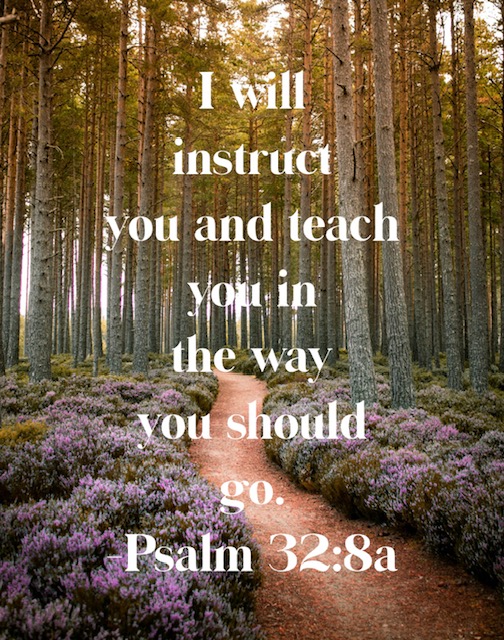
I will instruct you and teach you in the way you should go; I will counsel you with my eye upon you (Psalm 32:8).
There is nothing better for a person than that he should eat and drink and find enjoyment in his toil. This also, I saw, is from the hand of God (Ecclesiastes 2:24).
The Lord is good to those who wait for him, to the soul who seeks him. It is good that one should wait quietly for the salvation of the Lord (Lamentations 3:25-26).
Thus it is written, that the Christ should suffer and on the third day rise from the dead, and that repentance for the forgiveness of sins should be proclaimed in his name to all nations, beginning from Jerusalem (Luke 24:46-47).
For I have given you an example, that you also should do just as I have done to you (John 15:16).
They should repent and turn to God, performing deeds in keeping with their repentance (Acts 26:20b).
One person esteems one day as better than another, while another esteems all days alike. Each one should be fully convinced in his own mind (Romans 14:5).
But all things should be done decently and in order (1 Corinthians 14:40).
Brothers, if anyone is caught in any transgression, you who are spiritual should restore him in a spirit of gentleness. Keep watch on yourself, lest you too be tempted (Galatians 6:1).
And this is love, that we walk according to his commandments; this is the commandment, just as you have heard from the beginning, so that you should walk in it (2 John 1:6).
“Should” has its place.
In my writing, I need to be careful with “should.” It’s usually best to avoid it and reframe my sentences to sound more encouraging.
But when I read or hear “should,” I need to consider it prayerfully and take into account who is saying it and what they are saying I should do. If they are heaping more on me than I can take, imposing their own opinions, or trying to induce shame or guilt, it may be best to ignore their “shoulds.”
But if the admonition is coming from someone who knows me and cares for me, who is responsible for me, who has my best interests in mind, they might be trying to help or guide me. I should probably heed what they say.
(I often link up with some of these bloggers.)
 Stray Thoughts
Yes, “should” has it’s place in the world. We must remember that everyone is unique in what they are doing. Sometimes, listening instead of saying “you should” is more helpful. 🙂 Have a blessed Sunday!
Definitely, listening should (there’s that word again 🙂 ) come before any advice, if advice is needed at all. Hope you’re doing well.
I love how you re-worded the sentence about reading the Bible. I remember being in a marriage ministry session with my hubby and 3 other couples and how the leaders (one was a trained and licensed counselor) said that we should avoid “should” statements. the way she said it was “it is best to avoid using “should’ as it comes across as accsatory”. I’ve tried to remember that especially in dealing with my youngest daughter who is sensitive to tones or words that might seem accusing, etc.
I love the Scripture you posted at the end!
Your last two paragraphs really resonated with me. I remember a time when in our former church that is now sadly becoming a bit “cult like” and no longer even has a pastor over them, when a woman whom might have meant well, told me “I SHOULD homeschool my children”. I asked her how that would work given that hte Lord called me to be a special education teacher of prek kiddoes and both daughters were in public school and thriving. That’s when she said “You SHOULD be a stay at home mom’. I reminded her I had been given a fellowship to get Masters degree and permanent certification and that it was a total God thing. And then….it dawned on me: she barely knew me, she had no covenant friendship with me, and I didn’t have to answer to her, I had to live for God and what HE was directing me to do. (along with hubby’s wisdom and counsel). It really freed me up!!
thanks for a great post.
In my younger Christian life, I used to think that since we’re all filled with the same Holy Spirit, we would all come out at the same place in our preferences. We should when it comes to core doctrines–the deity of Christ, salvation by grace through faith, etc. But it was eye-opening to me to realize there are many lesser areas where good people who love the Lord have quite different opinions. Romans 14 helped me a lot. Even beyond the weaker/stronger brother idea there, God often leads people different ways for different purposes.
YES!! when we got to our new church (our current one where we’ve been members since 2005) the first thing we learned was the “3 Circles” concept that our head pastor teaches and which is actually a part of our core curriculum for becoming covenant members. Inner circle is small but is the CORE BIBLICAL truths: Jesus died, rose again, is coming again, the commandments, etc etc etc. ). Then the next circle are convictions: it’s ok to have a glass vs I’m going to abstain; I need to be dunked in water for baptism vs I’m going to have water poured over me, etc). then the larger outer circle are things called Preferences (He uses another C word but i can’t remember it right now) and that’s things like I prefer hymns vs modern songs; i prefer to homeschool my children vs sending to public; I prefer to dress casual vs wearing suits, etc. It really freed us up from some “wrong teachings” we received in the church where we met.
This makes me think of Shel Siverstien’s poem, Listen to the shouldn’t haves…
I had never heard of this before, so I looked it up. It looks like the title is “Listen to the Mustn’ts.” The “analysis” on the site where I found it talked about defying societal norms and the limitations of “mustn’ts” and “shoulds.” There are times for that–but there are some limitations for our good.
Barbara, thank you so much for this post. It has me wondering how many times I use “should” and it comes across as negative, even though I don’t mean it to. I’m going to be paying more close attention to the usage of that word.
If something comes to mind I really feel I need to say to someone else, especially my husband or kids, I try to frame it as a thought or suggestion. “One thing to consider about that is . . .” or “One idea is . . . ,” etc.
That really was great writing group advice! Knowing you, I’m sure you wouldn’t have meant “should” in a derogatory, finger-wagging way. But it can be hard to “see the face”/intentions behind writing. And you make several good points here; I was nodding my head throughout as I agreed that “should” comes across better from an authority, or from a parent to a young child. Makes me want to be more careful with the words I use. Being with my sisters the last few days, I was reminded how easily words can wound, whether that’s the intent or not. More than once I also thought of your recent post on trying not to be “irritatable” 🙂
This post had me sitting and thinking of the times when I have said, “I should have listened.” I am going to be more mindful of when I use those words, and appreciate that you shared this bit of advice.
I hadn’t thought of this in references to ourselves, but it applies there, too. Sometimes we do need to evaluate our words and actions to see if they’re what they ought to be. But other times we just heap guilt on ourselves. When we’ve done wrong, we need to confess it to the Lord, accept His forgiveness, and learn from the situation rather than continually berating ourselves. Plus, there’s always more it seems like we “should” have done, but we have to accept we’re limited in time and energy and resources and seek what God most wants us to do.
Pingback: July Reflections | Stray Thoughts
Love this Barbara! You are so right here. I can relate a identity with you.
Thanks bunches for sharing with Sweet Tea & Friends this month dear friend.