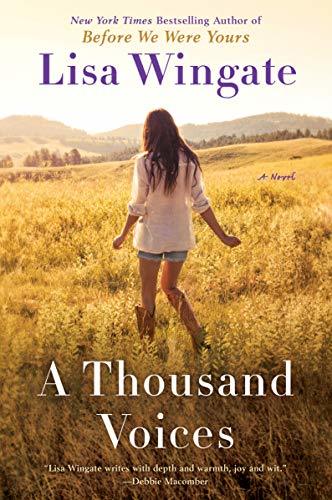
A Thousand Voices is the fifth and final novel in Lisa Wingate’s Tending Roses series.
Dell Jordan was a side character in the first couple of books but is the main character in this one. She was Grandma Rose’s neighbor as a child, living with an ailing grandmother. Her father had not been around since her birth. Her mother had been in and out with drug addictions but died a few years before. After she and Grandma Rose became friends, she became an unofficial part of the family until Rose’s granddaughter and her husband, Karen and James, officially adopted Dell.
When Dell was discovered to be something of a musical prodigy, Karen enrolled her in a performing arts magnet school. Dell had trouble adjusting, but eventually found her way.
As this story begins, Dell graduated two years earlier, spent one year touring Europe with an orchestra, and a second year working in a Ukrainian mission orphanage. Her parents and teachers want her to apply to Julliard. But the appeal of music has faded with the pressures of performance and expectations.
She loves her new family, but she still feels “different,” with her brown eyes and hair and “cinnamon” skin amidst everyone else’s fair skin, blue eyes, and blond hair. She grieves over her birth father’s desertion, her birth mother’s neglect, and the derogatory comments from her uncle.
All she knows about her father is his name on her birth certificate and the fact that he was part Choctaw. When she learns about agencies in Oklahoma that help find Choctaw ancestors, she drives there from Kansas City to see if she can find any information about her father. She doesn’t tell her adoptive parents, feeling they wouldn’t understand and might be hurt.
After a series of mishaps in her travels, including losing most of her money, she arrives at a campground and sleeps in her car. A large group of tents and motor homes in the next campsite hold an extended Choctaw family, there for the annual Choctaw festival. They invite Dell into their gathering, where she becomes friends with several of them and feels a sense of belonging that she has never experienced before. A couple of them help her in her search.
A few quotes that stood out to me:
It’s a powerful thing to realize you were put in this world on purpose. It changes the way you feel about everything afterward (p. 2, Kindle version).
The past, even if you don’t talk about it, still exists, and no matter how hard you try to turn your back, no matter how dangerous it is to look at, part of you cries out to understand it.
Part of growing up is learning that people can’t give what they don’t have. The rest you have to find in yourself (p. 310).
The plot moves rather slowly until the last couple of chapters. There are some scenes that don’t seem to advance the plot at all, like a lengthy encounter with a skunk at the campground.
I was frustrated with Dell’s lying to her parents concerning her whereabouts, especially since she also lied to them in the previous book about her problems at school.
I wondered if Lisa intended for the series to lead to Dell’s journey from the beginning, or if Dell’s story emerged along the way. Apparently, the latter scenario was the case. Lisa said in the discussion questions at the end that the first book in the series was written with no thought of a sequel. But readers’ questions as well as her own musings about the characters grew into subsequent books. She also says there, “Dell was, in many ways, the catalyst for change in Grandma Rose’s family, and in turn she was changed by Grandma Rose’s family.”
I also wondered if Dell was originally thought of as Native American. She has always been described as having cinnamon-colored skin, but in a previous book, her uncle uses a different racial epithet about her. I wasn’t sure if that was just to show his ignorance, or if Lisa switched gears about what race Dell was part of.
I was dismayed by minced oaths (like “Geez”), language that was not profanity but also was not polite, and especially a bawdy description of an old woman whose robe had come undone. On the one hand, the people involved didn’t profess to be Christians. On the other hand, that was conveyed well enough without those elements. Because of this, the sheen of Wingate’s appeal has been a little tarnished for me.
It was interesting to read of Choctaw history. If this is an accurate representation, it seems that, among modern Choctaw, some are really into their heritage while others are not.
I thought the last couple of chapters were the best in the book. My heart went out to Dell in her struggles.
I know some don’t like neatly-wrapped-up-in-a-bow endings. But this book had more loose threads than I like. I would have enjoyed an epilogue, if not one more chapter.
 Stray Thoughts
I’ve read a few of her books. Not this series though although it sounds pretty good! Well at least she doens’t usually use Christ’s name in vain nor does she use the F word on every page unlike many authors I’ve read this year!! There’s no reason for the crass language and to me, it represents a lack of creativity.
To me, minced oaths like “Geez” do take God’s name in vain. But I understand not everyone sees it that way. I agree about the F word–that’s thrown around way too much in secular books and programs.
Good review with lots to think about. If the series already has 5 book, and there are still some loose threads–maybe a sequel will be in the works? I know you said this was the final one, but an author could always put out another, or even spin Dell into another series? Yeah, it’s a bit off-putting when you feel like you “know” an author and then they put some elements into a book that strike you in a negative way 😦
I envy Dell, touring Europe for a year with an orchestra. Ahhhhh ….
I saw in the discussion notes that this was the author’s eighth book out of thirty–so I doubt she’ll go back to this story. The loose threads were just from Dell’s life–everything else was pretty well settled. The book ends with Dell finally making peace with what she discovers, but we don’t know if she’s going to go to Julliard or come back to OK to settle in there, whether she’s going to pursue a relationship with the guy she met in OK (who ended the relationship because he thought he was too old for her and she needed to pursue her dreams). I don’t need to know when she gets married and how many babies she has and all that, but I’d like a little more closure. 🙂 I think the ending was meant to convey that, now that her heart is settled, she’s ready to move on and the future is bright. But I would have liked some indication which direction she was going.
This sounds very interesting. I’ve just begun reading the series so I have a ways to go.
I’m really saddened to hear how Lisa seems to be moving more to writing in the way of the world because the other books of hers that I have read have been really good ones. I’ve always admired her because she dared to tackle hard cultural issues, but I think I would definitely pass on this series.
I saw in the discussion questions that this book was the eighth in what was then thirty books. I think she has written more since then. Some of her later ones were better, so I think she moved away from that style of writing.
I’m really glad to hear that, Barbara. Thank you for letting me. Maybe I won’t cross her off the list just yet. ~ wink~
Pingback: November Reflections | Stray Thoughts