
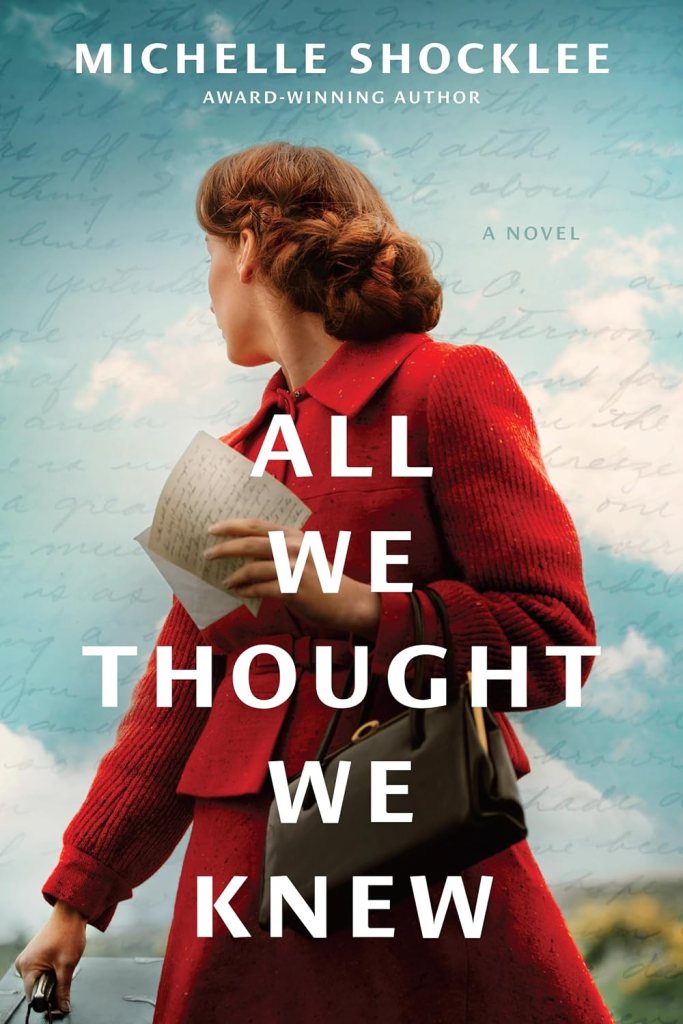
In All We Thought We Knew, a novel by Michelle Shocklee, Mattie Taylor was adamantly against the Viet Nam war. So she was stunned when her twin brother, Mark, and his best friend joined the military. She blamed her father for not discouraging Mark from going. Then Mark died in the war. The day after his funeral, Mattie left for the hippie movement in California.
Now, a year later, Mattie receives news that her mother is dying and wants to see her. Though Mattie still bristles with anger over the war, she rushes home to see her mother.
Mattie’s mom, Ava, wants Mattie to read some old letters hidden away in a shoebox. Mattie isn’t very motivated–she doesn’t know the people addressed in the letters nor the senders. But she reads a letter or two at a time to placate her mother.
Ava had become a young widow during WW2 when her new husband was killed at Pearl Harbor. Ava lived with her unkind mother-in-law on the horse farm her husband, Mark, had intended to sell. When the military opens a base nearby and sends out a notice that they are hiring civilians, Ava applies for a job to help support herself and her mother-in-law.
Part of Ava’s job is to update the ever-changing personnel files. One day this takes her to a German detainee, Gunther. She learns that Gunther had come from Germany to America before the war to study medicine and become a doctor. Yet when America joined the war, officials rounded up German citizens and detained them at military bases as enemy aliens. Some were allowed to work on the base. Gunther’s medical experience opens a door for him to work as an orderly while under guard.
The point of view switches back and forth from Mattie in 1969 and Ava and Gunther in 1942, slowly unraveling the mystery of what ties the three together.
Though I have read several novels set in WW2, this is the first one that has touched on German detainees in America. It’s heartbreaking that they were gathered up and treated as Nazis, even though some fled their country because of Nazism.
It was also interesting to see the inner workings of a couple of temporary military bases in the WW2 section of the story and the horse farm in the 1960s section.
Mattie got on my nerves a bit. She’s totally self-centered–her opinion is the only right one in her eyes. But there was hope that she would mature and grow through the novel, and she did. I liked the way the others in her life patiently dealt with her anger, doubts, and questions.
I felt the “reveal” of the mystery was pretty obvious by the time it came out (to everyone but Mattie). But overall I enjoyed the book.
 Stray Thoughts
This sounds like a very good book. I love mysteries and watch a character’s progression of understanding and maturing. Thanks for the review.