
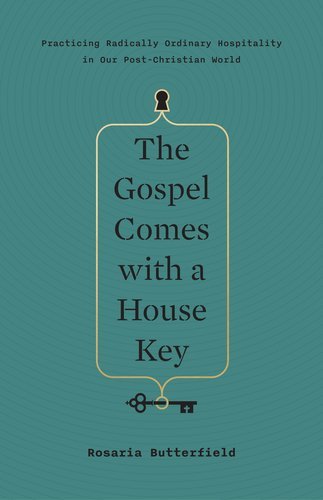
In Rosaria Butterfield’s book, The Gospel Comes with a House Key, she advocates for “radically ordinary hospitality.”
For a bit of background, her first book, The Secret Thoughts of an Unlikely Convert, tells how she, as an atheist, leftist, feminist, lesbian professor who hated Christians, ended up becoming one. A major tool in her conversion was a pastor who contacted her and invited her to dinner with him and his wife. They didn’t attack her or argue with her–they just discussed their mutual views. She spent two years meeting with them and studying Scripture before setting foot in a church. God slowly transformed her thinking and then her life.
Also, hospitality was a big part of the LGBTQ+ community she had been a part of. Many lost family and friends when they “came out” as gay, and they became family for each other. She saw how hospitality can build bridges and bind people together in the Christian community as well.
She defines “radically ordinary hospitality” as “using your Christian home in a daily way that seeks to make strangers neighbors, and neighbors family of God. It brings glory to God, serves others, and lives out the gospel in word and deed” (p. 30).
“Ordinary hospitality is the hands and feet of Jesus, and it holds people together with letters to prison or hugs. Hospitality reaches across worldview to be the bridge of gospel grace” (p. 208).
The author combines memoir with instruction. She makes several good points, among them:
- “Those who live out radically ordinary hospitality see their homes not as theirs at all but as God’s gift to use for the furtherance of his kingdom” (p. 11).
- “The truly hospitable aren’t embarrassed to keep friendships with people who are different. They don’t buy the world’s bunk about this. They know that there is a difference between acceptance and approval, and they courageously accept and respect people who think differently from them. They don’t worry that others will misinterpret their friendship. Jesus dined with sinners, but he didn’t sin with sinners. Jesus lived in the world, but he didn’t live like the world” (p. 13).
- “Where else but a Christian home should neighbors go in times of unprecedented crisis? Where else is it safe to be vulnerable, scared, lost, hopeless?” (p. 19).
- “Radically ordinary hospitality is this: using your Christian home in a daily way that seeks to make strangers neighbors, and neighbors family of God. It brings glory to God, serves others, and lives out the gospel in word and deed” (p. 30).
- “The Christian home is the place where we bring the church to the people as we seek to lock arms together” (p. 32).
- “Christian hospitality cares for the things that our neighbors care about. Esteeming others more highly than ourselves means nothing less. It means starting where you are and looking around for who needs you. It means communicating Christian love in word and deed. It means making yourself trustworthy enough to bear burdens of real life and real problems” (p. 166).
- “Hospitality shares what there is; that’s all. It’s not entertainment. It’s not supposed to be” (p. 216).
Rosaria shares many examples mainly from her own family, but also from others. One story woven throughout the book is that of a reclusive neighbor named Hank. It took months of friendly overtures, short encounters, and befriending his dog before he opened up to their family to any degree. And then he was arrested for operating a meth lab in the basement of his house. The Butterfields continued to pray for him, write to him, send books as allowed by the prison, and send pictures colored by the children.
One area of hospitality I hadn’t considered was how befriending such people might tarnish one’s own reputation. When Hank was arrested, some of the neighbors assumed the Butterfields had to have known what he was up to (they didn’t). As mentioned above, Jesus was known as the “friend of sinners” and scandalized the Pharisees by eating with them.
Another topic I had never connected with hospitality was the area of church discipline. She tells of a season in their church when two men were outed for committing grievous sexual sin. One repented, the other did not. When someone persists in unrepented sin, fellowship with them has to be broken–but the point is not to ostracize them, but to bring them to repentance and reconciliation.
We’ve known of situations in other churches where a man has preyed on a woman he was not married to or on a teen. When the situation came to light, it was hushed up lest there be a scandal, and the victim was urged to forgive. But no counsel or comfort was given to the victim. Plus there was no thought of future victims if men like this were not dealt with. It’s much more scandalous to avoid dealing with sin like this rather than to handle it in a biblical way.
Back to Rosaria’s book: there was much to convict me. This is an area where I have failed many times over.
However, there were also aspects of the book I disagreed with. The Butterfields have neighbors and others in their home most nights of the week–in fact, she said it’s unusual to have dinner with just their family. That’s fine if that is how the Lord has led them, but there’s nothing in the Bible that says every dinner needs to include guests. There are times you need to be with just your family to minister to them.
Plus, all her examples seem to be really big. In sharing examples of other people’s hospitality, she mentioned one woman who liked crafts, so she invited some neighbors over to work on projects while they memorized Scripture. She ended up with fifteen ladies coming regularly. Again, that’s fine–in fact, that’s wonderful. But hospitality doesn’t always have to be a big group. It can involve one other person. In fact, some people are less likely to open up in a group setting.
She says her home looks on the outside like a “Christian commune. And we do not believe that this is excessive. We believe this is what the Bible calls normal” (p. 34). I disagree. There was a time in the early church when “all who believed were together and had all things in common” (Acts 2:44), but this is descriptive, not prescriptive. It’s the only place something like this is mentioned. The Bible tells us to welcome the stranger and exercise hospitality, and to be open-hearted and open-handed with each other, but it doesn’t tell us to run communes.
She says things like being a barista and having an Air B&B are “counterfeit hospitality,” but she doesn’t explain why she thinks that.–maybe because people are being paid for those services? I don’t know baristas–I’m happy with my instant Taster’s Choice decaf at home–but a waiter or waitress can either be hospitable or detached as they serve. I think being kind and welcoming in one’s job counts as being hospitable even if one is getting paid.
Some of her statements border on arrogance, like this one: “If Mary Magdalene had written a book about hospitality for this post-Christian world, it would read like this one” (p. 14).
And, her tone comes across so strong sometimes that it’s off-putting.
However I think she does have some important things to say about exercising hospitality. As I said, I was convicted many times over. I loved some of her summations:
Imagine a world where neighbors said that Christians throw the best parties in town and are the go-to people for big problems and issues, without being invited.
Imagine if the children in the neighborhood knew that the Christians were safe people to ask for help . . .
Imagine a world where every Christian knew his neighbors sufficiently to be of earthly and spiritual good (pp. 218-219).
(I often link up with some of these bloggers.)


That sounds like a really interesting book but I can definitely see how the tone could be off putting at times just based on your that one example that shows her arrogance. As a real homebody/introvert nightly hospitality sounds completely exhausting!
It sounds exhausting to me, too. The author says she is an introvert but gets her alone time in the mornings.
WOW she has some testimony! I definitely don’t agree with commune living unless we adopt some socialist policies to go along with it yet many of them are anti-Christian so…..hm…..in Acts, the point of their community was to do life together….our pastor has explained this was very important….but…..we do life together by being in small groups/Bible studies…so I’m guessing communal living falls under the preference area. It’s not fully Biblical nor is it the main thing (the Gospel is).
And I disagree that we should be entertaining every evening for dinner. I have people over about 1-2 times a season (in fact we have people coming over Sunday after church!) but our work day evenings were for immediate family….we both worked full time for many years and our daughters needed us to listen and talk…..my family has to come before others and after God. Again, this would fall in the preference or conviction area NOT core Biblical truth.
Sounds interesting though and I especially like the 3 quotes you have at the end!!
Thanks for this review I would be more inclined to read her first book about her conversion.
Her first book is excellent and I highly recommend it. It gives me great hope for some loved ones who aren’t in that lifestyle but who don’t seem to be open to the truth. God can open hearts!
I think that hospitality is indeed a gift. It’s needed but some people sre shy. To others, it comes naturally. I also don’t agree with the need to invite others to dinner every night. Time with family only is also important.
I agree, some people are more gifted for it. I think it’s like mercy and giving and helps–we’re all supposed to do those hings, though some are especially gifted at it. I needed the conviction to be more open-hearted towards people, whether that results in actually having people over or just being more aware of people and engaging them.
Pingback: April Reflections | Stray Thoughts
I have this on my TBR list. I appreciate your review.
Thanks so much for sharing with Sweet Tea & Friend’s this month.