
Charles Dickens’ David Copperfield is a comfort read for me. I’ve read it at least twice, if not more. I’ve had a hankering to listen to the audiobook, but I waited to finish my project of reading the other Dickens’ novels that I had not yet encountered.
David Copperfield is a coming-of-age novel, based in part on Dickens’ life. The novel begins with his birth to a young widowed mother. She and Pegotty, who acts as maid and companion to David’s mother and nurse to David, bring him up in a loving home.
When David is seven, his mother marries the stern Mr. Murdstone, whose sister, Jane, also comes to live with them. The Murdstones tyrannize the household. When he tries to whip David for failing in his lessons (because David is so intimated he can’t think straight), David bites him. Murdstone sends him away to a harsh schoolmaster, where he is picked on by the boys until their leader, James Steerforth, stands up for him.
When David’s mother and baby brother die, Murdstone pulls David out of school and sends him to work at a wine factory.. In that day, such labor was considered lower class. David lamented not being able to continue in school. But his landlord, Mr. Micawber, is kind, if loquacious and constantly in financial difficulties.
David eventually runs away to find his only known living relative, Miss Betsey Trotwood. Though she comes across as formidable at first, she has a sensible and kind heart.
She finds David a better school, and he boards with her financial adviser, Mr. Wickfield and his daughter, Agnes. Wickfield has a clerk, Uriah Heep, who constantly proclaims his “humbleness,” yet hides an avaricious heart.
Through the rest of the novel, these lives and others intersect back and forth, some with grace and some tragically.
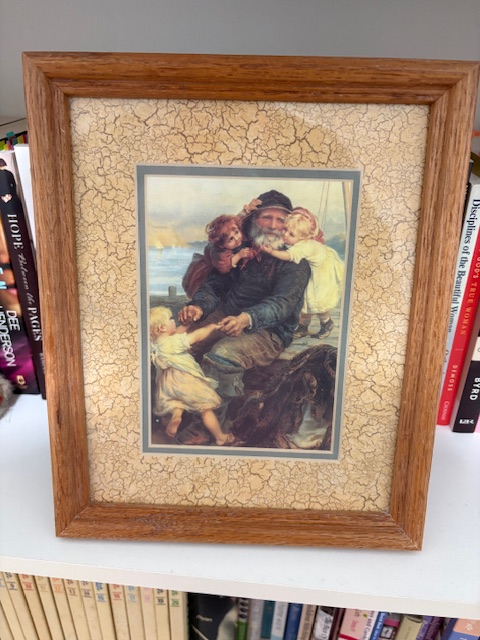
I mentioned in my Bookish Questions post that Mr. Peggoty, brother to David’s nurse, is one of my favorite secondary characters. An old sea captain, he has no family of his own, but took in a niece, nephew, and the widow of his business partner. When one of them gets into trouble and runs away, he spends years looking for her. I mentioned this inexpensive print I got years ago reminded me of him
Another is Tommy Traddles, one of David’s schoolmates, who is in love with “the dearest girl in the world,” as he often says. Dickens always has a couple or more characters like this, good, salt-of-the-earth people.
The book ends, not with David becoming an adult, but with his coming to maturity and a settled life.
I wondered if I might be a little bored with the story, since I knew the basic plot. But there were scenes and characters I had forgotten. And I looked forward to the parts I did remember.
I also caught a lot of foreshadowing that I may have missed in earlier readings.
One thing that stood out to me in this reading was David marriage to Dora Spenlow, his boss’s daughter, who is pretty and sweet, but not much else. When David tries to help her learn to keep accounts or cook, she gets upset and David gets frustrated. David wites,
I did feel, sometimes, for a little while, that I could have wished my wife had been my counsellor; had had more character and purpose, to sustain me and improve me by; had been endowed with power to fill up the void which somewhere seemed to be about me; but I felt as if this were an unearthly consummation of my happiness, that never had been meant to be, and never could have been.
And later,
‘There can be no disparity in marriage like unsuitability of mind and purpose.’ Those words I remembered too. I had endeavoured to adapt Dora to myself, and found it impracticable. It remained for me to adapt myself to Dora; to share with her what I could, and be happy; to bear on my own shoulders what I must, and be happy still. This was the discipline to which I tried to bring my heart, when I began to think. It made my second year much happier than my first; and, what was better still, made Dora’s life all sunshine.
A couple of favorite quotes:
The days sported by us, as if Time had not grown up himself yet, but were a child too, and always at play.
“I never thought, when I used to read books, what work it was to write them.” “It’s work enough to read them, sometimes,” I returned.
This audiobook was narrated by Richard Armitage, who played John Thornton in North and South and Thorin Oakenshield in The Hobbit trilogy a few years ago. He did a superb job. Dickens always has a lot of characters, and I can’t imagine a narrator trying to keep all the voices different. But Armitage did them well.
I thoroughly enjoyed visiting with David Copperfield again.


I’ve never read this — I should! I enjoyed your review. I like the quotes on marriage as well. And yes, I too find it fun to reread a favorite and come across a scene that I’d totally forgotten. Like a hidden treasure 🙂
For some reason I have never read David Copperfield!! I’m going to see if one of my daughters owns it and make it a goal to read before the end of the year. I absolutely LOVED Tale of Two Cities. My husband hated it! And we both loved Oliver Twist as well as Christmas Carol of course. Hubby really likes Great Expectations but I did not care for that one. Maybe because i was only 16 when we had to read it for Advanced English 10
I enjoyed your review!
Thank you! A Tale of Two Cities is my favorite of his, too–one of my top three classic novels ever. But it took me maybe three attempts before I could get into it.
I always love when a narrator picks a “voice” for each character and can effortlessly go from one to another. I found that with John McDonough for the Mitford series and Ryan Lee Dunlap for the last Mitford book.
I’ve never read David Copperfield. Like the synopsis of other Dickens’ novels, they seem so sad and full of poverty. I guess I’d have to be in a certain mood to enjoy them.
There are some parts of David Copperfield that are very sad, but there are some victorious, overcoming parts as well as humor sprinkled throughout. And it ends up in a great way.
I read this last year – it was my first real Dickens. (I’m not counting A Christmas Carol as it’s so short compared to many of his books.) It took me a while but I did enjoy it. You have done an excellent review.
David Copperfield is one of my very favorite (I, too, am a Dickens fan). I love the 1945 Copperfield movie. I’ve not listened to an audio book yet – but you have tempted me to give it a try! Thank you for the review – and audio recommendation.
Pingback: May Reflections | Stray Thoughts
I bought this years ago precisely because Richard Armitage is the narrator! I never got very far with it though!
Thanks for sharing your review with the Historical Fiction Reading Challenge!