
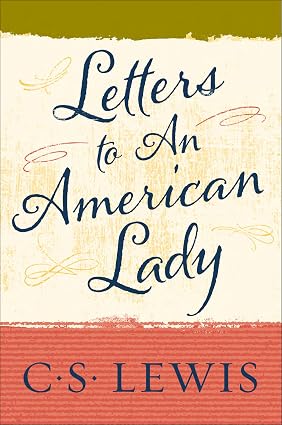
C. S. Lewis was a prolific letter-writer. Just the third volume of his collected letters covering the last thirteen years of his life is over 6000 pages.
Yet Lewis often felt burdened by the volume of letters he needed to write. He even asked friends not to write to him at Christmastime because he heard from so many people then, answering their correspondence became almost impossible.
Clyde S. Kilby says in his preface of Lewis’ Letters to an American Lady that Lewis said “one essential of the happy life is ‘ that a man would have almost no mail and never dread the postman’s knock.'” Yet he wrote because he “believed taking time out to advise or encourage another Christian was both a humbling of one’s talents before the Lord and also as much the work of the Holy Spirit as producing a book” and “one’s days and his talents are given him not for private expenditure but to be used in all lowliness within the will of God. Though the flesh abhorred it, he mortified the flesh.”
The American lady this collection of letters was written to is unnamed, by her request. After Lewis’ death, she donated his letters to Wheaton College. She was a widow and a “southern aristocrat” who “loves to talk and speaks well.” She also wrote “reviews articles, poems, and stories.” She had fallen upon hard times financially as well as family problems and, in the end, various health issues.
Her letters to Lewis are not printed here, but her first seems to have praised him for his books. He writes that he would have to “be either of angelic humility or diabolical pride not to be pleased at all the things you say about my books.” She must have shared some of her troubles with him, because he assures her of his sympathy and prayers.
Their correspondence goes on to include over a hundred letters. His tone is always cordial, though at times he says he can only write “a pen scratch” because of busyness or illness.
She writes that she has converted to Catholicism. He says that path is not for him, but he did not want their correspondence to be controversial. He was happy that her “faith and joy are so obviously increased.”
Some of his notes are sprinkled with humor:
About sleep: do you find that the great secret (if one can do it) is not to care whether you sleep? Sleep is a jade who scorns her suitors but woos her scorners.
As for wrinkles—pshaw! Why shouldn’t we have wrinkles? Honorable insignia of long service in this warfare.
Over the thirteen years they wrote to each other, we see glimpses of his personal life and what books he was working at the time. His marriage to Joy and her death took place in this time period. But most of the letters focus on encouraging her in her troubles.
Some of the quotes that stood out to me, some of which are well-known:
How little people know who think that holiness is dull. When one meets the real thing (and perhaps, like you, I have met it only once) it is irresistible. If even 10% of the world’s population had it, would not the whole world be converted and happy before a year’s end?
(Concerning someone she had a problem with) I mustn’t encourage you to go on thinking about her: that, after all, is almost the greatest evil nasty people can do us—to become an obsession, to haunt our minds. A brief prayer for them, and then away to other subjects, is the thing, if one can only stick to it.
I suppose the only way with thorns in the flesh (until one can get them out) is not to press on the place where they are embedded; i.e. to stop one’s thoughts (firmly but gently).
Your faith is a support to me as well as to yourself.
Remember one is given strength to bear what happens to one, but not the 100 and 1 different things that might happen.
As for the bug-bear of Old Peoples’ Homes, remember that our ignorance works both ways. Just as some of the things we have longed and hoped for turn out to be dust and ashes when we get them, so the things we have most dreaded sometimes turn out to be quite nice. If you ever do have to go to a Home, Christ will be there just as much as in any other place.
Re some of their health problems:
Not that you and I have now much reason to rejoice in having bodies! Like old automobiles, aren’t they? where all sorts of apparently different things keep going wrong, but what they add up to is the plain fact that the machine is wearing out. Well, it was not meant to last forever. Still, I have a kindly feeling for the old rattle-trap. Through it God showed me that whole side of His beauty which is embodied in colour, sound, smell and size. No doubt it has often led me astray: but not half so often, I suspect, as my soul has led it astray.
Pain is terrible, but surely you need not have fear as well? Can you not see death as the friend and deliverer? It means stripping off that body which is tormenting you: like taking off a hairshirt or getting out of a dungeon. What is there to be afraid of?
Has this world been so kind to you that you should leave it with regret? There are better things ahead than any we leave behind.
Remember, tho’ we struggle against things because we are afraid of them, it is often the other way round—we get afraid because we struggle. Are you struggling, resisting? Don’t you think Our Lord says to you “Peace, child, peace. Relax. Let go. Underneath are the everlasting arms. Let go, I will catch you. Do you trust me so little?”
Of course this may not be the end. Then make it a good rehearsal.
Though I’ve had this book in my Kindle collection for several years, it wasn’t on my radar to read any time soon. But in looking for a particular quote (the one about having better things ahead than behind), I began to read that in context, then read some more, then started at the beginning. Though I read some of these in the last volume of his collected letters, it was good to have all his correspondence to one person put together.
I’m so thankful this lady shared Lewis’ letters with the public. They were an encouragement to me, as I am sure they have been to many others.
(I often link up with some of these bloggers.)
(Updated to add: someone thought this book contained letters written to Joy Davidman, who later became Lewis’ wife. No, these letters are to someone named Mary. I don’t think Lewis knew Joy yet when he first started writing to “Mary.” None of his letters to Joy are in the larger volume of collected letters.)


Now I need to find my copy for a reread!
TT
[image: –Join me at Living Our Days]
Join me at Living Our Days https://michelemorin.net “The way we live our days is, of course, the way we live our lives.” (Annie Dillard)https://linktr.ee/MicheleDMorin
This sounds so interesting. Thank you for sharing, Barbara.
Oh wow, imagine having CS Lewis as a penpal?! I felt the same way with the guy he wrote to whose wife died … “A Grief Observed”?? Then I also thought how I really enjoy getting “snail mail” — while realizing that email is kind of the equivalent today. Then I was convicted because a (non-Christian) friend emails me these super long emails every now and then and I procrastinate answering like crazy because I know it’s going to take so long. I have a June email from her sitting in my in-box and today I think I’m going to use your lovely review of this book as motivation to answer. This sounds good and I’d enjoy reading it!
So interesting! And the quotes you shared show everyday wisdom that is timeless, like C S Lewis himself!
When I first read the title, I thought it was about C.S. Lewis’ letters to Joy because that’s how they first “met”. This sounds very interesting and especially poignant that so many were written around the time of Joy’s (his wife by now) death.
Thank you for sharing this. I am familiar with many C S Lewis quotes but have not read his books.
I’ve seen this title in his collection of books, but had not delved further about who this lady would’ve been. I, too, had thought it was letters to Joy. Thanks for pulling out these wonderful quotes and a bit of the context of their dialogue and circumstances.
Pingback: August Reflections | Stray Thoughts
I’m glad you enjoyed it, thanks for sharing your thoughts