
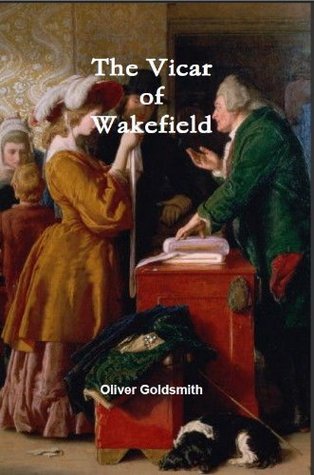
The Vicar of Wakefield is the only novel and best-known writing by Oliver Goldsmith. His other work includes poems, essays, and plays.
The title character is a Dr. Charles Primrose, a vicar in an English country village, married with four sons and two daughters. He’s fairly well-to-do and generous in giving his money to the poor.
Just as the vicar’s oldest son, George, is about to be married, the vicar learns the person he invested a large sum of money with has lost his money and left town. George’s fiance’s father calls off the wedding.
Thus begins a series of catastrophes for the Primrose family. They have to move to a smaller parish only to find their landlord, Squire Thornhill, is a womanizer who preys on one of the vicar’s daughter. Their house burns down, the vicar is thrown into prison by Thornhill, and that’s maybe about a third of the family’s troubles.
Primrose is not faultless–he’s too trusting and somewhat pigheaded about certain beliefs that no one else agrees with. But he maintains his faith and integrity throughout and is ultimately rewarded.
Some of the quotes that stood out to me:
No situation, however wretched it seems, but has some sort of comfort attending it.
I armed her against the censures of the world, shewed her that books were sweet unreproaching companions to the miserable, and that if they could not bring us to enjoy life, they would at least teach us to endure it.
We are not to judge the feelings of others by what we might feel in their place.
The heart that is buried in a dungeon is as precious as that seated upon a throne.
I’ve seen this called a “sentimental” novel but also a satire of the upper classes as compared to the Primrose family’s more simple lifestyle. I’ve also seen it called a satire of a sentimental novel.
This book has been mentioned in several other classics, according to Wikipedia: George Eliot’s Middlemarch, Jane Austen’s Emma, Charles Dickens’ A Tale of Two Cities and David Copperfield, Mary Shelley’s Frankenstein, Charlotte Brontë’s Villette, and Louisa May Alcott’s Little Women, to name a few.
I can’t say I enjoyed the book as much as I thought I would. It was written in the 1760s, about a hundred years before many other classics I’ve read. I don’t know if it was the language (one political diatribe was six-page long paragraph, and one chapter title is “Happiness and misery rather the result of prudence than of virtue in this life. Temporal evils or felicities being regarded by heaven as things merely in themselves trifling and unworthy its care in the distribution”). Or perhaps the audiobook narration I listened to dulled the story for me. Librivox offers free audiobooks in the public domain. Some of the recordings are great, some not so much. The narrator of this one had a pleasant voice, but he didn’t do different voices for the different characters, and he had the same cadence to most of his sentences. I read some of the Kindle version and enjoyed it more. If I ever read it again, I’ll either try a different narrator or just read the print book.
Nevertheless, I am glad to have read the book and made acquaintance with the Vicar.


Thank you for the review. Some of those older books are interesting for their historical aspect but I don’t tend to gravitate towards them. I’ll probably give this one a pass.
It’s funny, I don’t remember seeing this book mentioned in those other books I read. But the title was vaguely familiar to me, I’m sure because of seeing it mentioned by others so often. I almost want to scan some of these other books now to see how they mention this book and what they say about it. I won’t because I have too many other books stacked up to read. But at least now I’ll know about the book when I see it referenced again. And I probably will delve into some of the books, like Little Women and Emma, again.
Yes, I have trouble wading through difficult language. I tend to want to read novels rather quickly as I get absorbed in their storyline. Sadly, the old English weighs me down.
Interesting! The title and author are both new to me (although probably shouldn’t be, since I’ve read some books it was referenced in). Kudos to you for tackling so many classics. This one does sound challenging but I totally “get” still being glad you’ve read it. I’m not sure if it’s the same place you referenced or not, but I’ve listened to audiobooks by a free place and at times had to wonder if some of the narrators were practicing English as a second language! (plus on the service I used, one narrator would do a few chapters and then they’d switch to someone totally different for the next part — which was a little disconcerting!).
Librivox does do that sometimes–different readers will pick up where the previous one left off. Very disconcerting! And often their volunteer readers just read it like they were reading the newspaper, with no inflections or emotion or anything. But others are very good. I did see that this version just used one voice and I listened to a sample before downloading. But I guess I didn’t listen long enough.
Pingback: September Reflections | Stray Thoughts
I have heard of this book too, but never read it!
Thanks for sharing your review with the Historical Fiction Reading Challenge!