
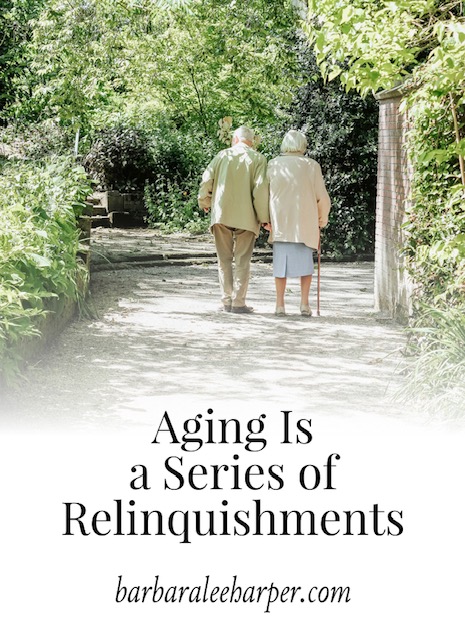
Sometime in our thirties, we realize we can’t do everything we did in our teens and twenties. My sons that age have joked about throwing their back out when they sneezed or turned quickly.
In our forties, suddenly our body chemistry changes. I never had problems with dairy products until I was forty. When I asked my doctor why I suddenly did, he just answered “hormones.” I also became allergic to penicillin and sulfa around that time, though I had taken them for years before.
It seems the older we get, the more we lose physically. Our energy diminishes. Our health may go downhill. Our looks melt into wrinkles and greyness. Our vision and hearing may become problematic. Eventually, we might have to give up car keys. Our decreasing mobility may require walkers or canes.
In some ways, we might feel we’ve lost our identity. Women facing the empty nest and men facing retirement may struggle with who they are and what to do with themselves. We may not be able to participate in the ministries or activities we always used to.
We might feel the sting of lost influence as younger people think we’re out of touch and seek their peers’ advice and fellowship instead.
And, if we live long enough, we might lose our homes and end up in a facility. I remember when my mother-in-law moved into assisted living, I was sad that her life was now reduced to one room.
We may lose our privacy and dignity if we can no longer take care of our bathing, dressing, and toileting. And we may lose our memories if we develop dementia.
This all might sound really depressing except for a few factors.
I heard someone on the radio years ago say that one reason our bodies start falling apart as we age is to make us willing to let loose of them. We have such a strong survival instinct, and we often want to stay for our families. But gradually we admit that heaven looks much better than life here.
God is gracious to make us aware of our mortality in increments. As we face each relinquishment, we’re geared a little more toward eternity.
I like to think of it something like a butterfly emerging from a chrysalis. It doesn’t need its caterpillar appearance any more. It doesn’t need the chrysalis. It would look absurd if it tried to hold on to its old “house” while flying around with its beautiful new wings. Whatever we relinquish here, we won’t need in heaven. As C. S. Lewis wrote in Letters to an American Lady, “There are better things ahead than any we leave behind.”
And those who know God have his promises in our old age:
- “So we do not lose heart. Though our outer self is wasting away, our inner self is being renewed day by day. For this light momentary affliction is preparing for us an eternal weight of glory beyond all comparison, as we look not to the things that are seen but to the things that are unseen. For the things that are seen are transient, but the things that are unseen are eternal (2 Corinthians 4:16-18).
- “For we know that if the tent that is our earthly home is destroyed, we have a building from God, a house not made with hands, eternal in the heavens. For in this tent we groan, longing to put on our heavenly dwelling, if indeed by putting it on we may not be found naked. For while we are still in this tent, we groan, being burdened—not that we would be unclothed, but that we would be further clothed, so that what is mortal may be swallowed up by life. He who has prepared us for this very thing is God, who has given us the Spirit as a guarantee (2 Corinthians 5:1-5).
- “Even to your old age I am he, and to gray hairs I will carry you. I have made, and I will bear; I will carry and will save” (Isaiah 46:4).
- “But I trust in you, O Lord; I say, ‘You are my God.’ My times are in your hand” (Psalm 31:14-15a)
- “My flesh and my heart may fail, but God is the strength of my heart and my portion forever” (Psalm 73:26).
- “They still bear fruit in old age; they are ever full of sap and green, to declare that the Lord is upright; he is my rock, and there is no unrighteousness in him (Psalm 92:14-15).
When we took care of my husband’s mother, she slept most of her last two years. I wondered how this verse played out in her life–how was she still bearing fruit in that condition? Part of it was her testimony all her life until that time. Part of it was her lack of complaining and her willingness to undergo whatever she had to. And part of it was the peace that hospice workers and caregivers sensed when they came to see her.
I’ve often been inspired by the poem from William Newton Clarke:
Gone, they tell me, is youth.
Gone is the strength of my life:
Nothing remains but decline,
Nothing but age and decay.
Not so, I’m God’s little child,
Only beginning to live;
Coming the years of my prime,
Coming the strength of my life;
Coming the vision of God,
Coming my bloom and my power.
To be sure, I still don’t look forward to the process of death or the decline that leads to it. The Bible calls death the last enemy (1 Corinthians 15:26), so it’s right to think of it as such.
And I don’t mean to give the impression that aging is all negative. There is a settledness that comes with aging. We don’t know everything, of course, but some of the issues we wrestled with in younger years are no longer a problem. Our limitations make it clearer what we can and can’t do, so it’s easier to make choices and to say no when we need to. We’ve developed some degree of wisdom by walking with the Lord for so many decades. We don’t need to go at the driven pace we used to.
We’ve experienced a few of these relinquishments. We hope to escape some of them and we hope that others are two or three decades away. We’ve talked about various scenarios that might play out in our final years–if he should go first, if I should, if one or the other of us needs more care than the other can give. We’ve shared our preferences, but, truly, we may not have any control when the time comes.
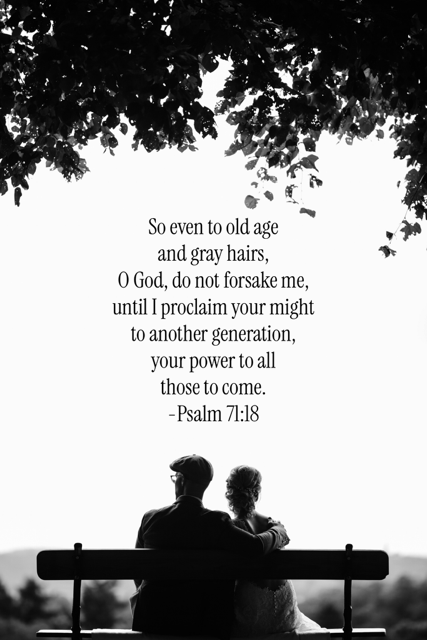
But whatever happens when, God promises His grace through it. We don’t have grace for it now because we don’t need it yet. Until then, each reminder that I have an expiration date spurs me to make the most of the time I have left. I pray along with the psalmist, “So even to old age and gray hairs, O God, do not forsake me, until I proclaim your might to another generation, your power to all those to come” (Psalm 71:18).
(I often link up with some of these bloggers.)


Love the Psalm 71:15 verse.
Such a well written piece, Barbara. Thank you.
I’m thinking a lot about aging these days, and your thoughts here are both stimulating and encouraging. I’m REALLY looking forward to Jen Wilkin’s new book on aging that releases sometime this month: Dust to Dust.
I am, too! I may put her book on my wish list for my birthday in August.
Such a timely post for me, with my dad just dying and my mom in bad shape — AND many parallels to the Jen Wilkin book on aging. You’re right; it’s not all bad — but it’s hard for us to relinquish control, privacy, and more, even as we grow in Christlikeness. I humbly ask for God’s help in the process, that’s for sure.
As we watched my mother-in-law’s decline, I saw so many things I hope I never have to experience. I hope my children don’t have to take care of us in that way. But I have to trust God’s grace will be there for them and us in whatever way things work out.
Very touching. I am in my 70s and still feel very capable of doing all I used to do–it just might mean a slower pace of more frequent breaks tro get it done. My husban and I try to exercise and stay active and I hope and pray we will keep our strength for more decades.
I’m experiencing that need for breaks and a slower pace, too. I used to think it was good to push myself beyond my limits. But nowadays, that gets me in trouble with various health issues.
I think sometimes it is having people help us find something to help us live our lives with what we have at any stage of our lives. We often cling because the next stage doesn’t look promising at all.
My In-laws retired to a smaller place and it increased their ability to have a social life because they needed to drive less, the activities were closer, they didn’t have to worry about driving after dark, etc.
Eventually that too became too hard to manage and when FIL passed MIL moved into a rather active assisted living community. Her living space has again decreased but she has regained community which she had lost when she could no longer easily get out of her home any longer. Now she schedules when her family can visit because she is busy and doesn’t want to miss out on activities she enjoys.
She now attends church services at the assisted living with community members where she’d been restricted for many years to only seeing services on TV. TV is important for people who have no other options but when you can be together with community to worship after years of not it is a reason to be grateful.
At some point she may need more care and I hope we are able to find a place where she continues to find reasons to find gratitude even as she loses some of the life she cherishes until it is time to leave this earth.
That was true for my grandfather. He lived with my aunt, who worked full time. He didn’t eat right or take his medications regularly when he was home alone. And when she was home, he didn’t like her telling him to do those things, no matter how nicely she tried. 🙂 When he had a series of small strokes, Medicare only paid for him to be in a hospital for a certain number of days. Then he had to be transferred to a nursing home. But when he recovered, he decided to stay. His meals and medications were taken care of, and he found lots of activities that he enjoyed being involved in.
My mother-in-law was a different story. She was always a homebody. She loved her church, family, and neighbors, but she didn’t meet strangers well. When she was in assisted living, I tried to encourage her to go to some of the activities in the main room and get out of her four walls sometimes. She said she did get out three times a day for meals. 🙂 That was true–that was a lot more socializing than she was used to.
But she did enjoy the prospect of not having to cook or clean any more. The facility had a bookmobile that came around regularly, and she could read to her heart’s content.
I appreciate your thoughts about this topic, Barbara. I love how you describe the way your mother-in-law was bearing fruit even though she slept most of her last two years. In my parents’ last months, it gave me comfort to remember that as long as they were still here, God still had “work” for them to do. And some of that work may have been tied to what my siblings and I were learning from the whole experience. I’m so thankful for God’s promises pertaining to growing older, especially Psalm 73:26.
A friend of mine who cared for her mother-in-law for a number of years said that was one reason she thought God allowed her mother-in-law to remain here even after her mind failed–in order for her as the daughter-in-law to learn loving, sacrificial service.
Pingback: A La Carte - Aging, Birthdays, Ready to Meet the Lord.
Dear Barbara,
This has been such a blessing to me today as it expresses so well my thoughts on the subject. I’m 74 and have lived with a disabling chronic illness for 40 years. I’m now homebound and have been unable to attend church for two years. My dear husband and I celebrated our 53rd anniversary yesterday and he is my caregiver. He was a pastor for many years and we served together so I truly understand all you’re talking about. We’ve also lost most our siblings and many of our dearest friends.
I can attest to God’s grace as we are forced relinquish so many things as the time draws near. It’s been said that He never gives us more than we can handle but that has not always been true for me. However, it’s in looking back upon such trials that I clearly see how His grace sustained my faith through them. Perhaps this is one reason we are told to “Remember “ all the things that God has done for us throughout our lives. Great is His faithfulness to us! Indeed, Heaven does look sweeter every day!
Thank you for this beautiful post.
Thanks so much, Diane. Belated happy anniversary! I hadn’t thought of losing loved ones and friends as another loss of aging. It’s true–the longer we live, the fewer of our peers are still with us.
I disagree with the saying God doesn’t give us more than we can handle. He often does. But that makes us look away from ourselves to Him.
I’m struggling with this very thing right now. A great post. Thank you.
Pingback: Crude Language - Autumn's Garden
Beautiful. Thanks so much.
A dear friend and I were talking about aging yesterday. 2 Corinthians 4:16-18 is what came to my thoughts yesterday so I appreciate reading this post this morning. May we cling to God’s promises for He surely is faithful!
That verse is such an encouragement. Without its truth, aging would be gloomy.
Perfect silent reading for us all. One of my features for this week’s SSPS, thank you for sharing with us.
Thanks so much, Melynda.
Thank you for sharing your post with us at SSPS 419. You are being featured on Monday
Thanks so much, Esme.
This is such an encouraging and comforting peace. The aging process comes for all of us, with its joys and struggles, but God is in control. Our times are in his hands. I’ve said goodbye to two very dear elderly relatives in recent months, and I have another that surely won’t be with us on earth much longer so this has been on our minds. And my husband and I both are dealing with minor (in the grand scheme of things) tribulations of aging right now as well, so this is timely. Doing our best to fight aging in the ways that are appropriate, while remembering that this is part of God’s plan for us, and finding the balance there.
Those are such good promises, Barbara. Health is one of the biggest hurdles for me and my parents. With no children of my own and no nieces or nephews, future care is a worry. But we trust in God’s provision and His grace for whatever comes.
Pingback: July Reflections | Stray Thoughts
I agree Barbara that aging definitely has it’s bonuses.
Visiting from Paula’s today.
blessings, Jennifer