
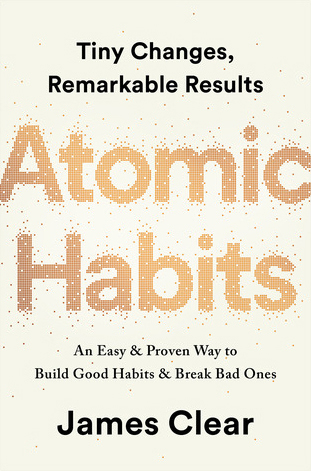
Atomic Habits: An Easy & Proven Way to Build Good Habits & Break Bad Ones by James Clear was all the rage a few years ago. I was interested, but for some reason I never got the book. Then when I saw the e-book on sale last year, I figured it was finally time to look into it.
The “atomic” part of his philosophy involves breaking new habits down into small components. Usually, when we want to change something–lose weight, start working out, learn a new skill–we make big goals and grand plans. But then we either never get around to them, or we peter out after a short time. Clear’s advice is to start small and sustainable. “Changes that seem small and unimportant at first will compound into remarkable results if you’re willing to stick with them for years” (p. 6).
The “habit” part of the book comes partly from the thought that “the more tasks you can handle without thinking, the more your brain is free to focus on other areas” (p. 19).
Through his own experience and study, he shares “a synthesis of the best ideas smart people figured out a long time ago as well as the most compelling discoveries scientists have made recently” (p. 9). He started out with a website, then a newsletter, then articles, and eventually this book.
Instead of setting goals, he advocates for establishing systems. “Goals are about the results you want to achieve. Systems are about the processes that lead to those results” (p. 23) Establishing small habits and building on them is the basis of those systems.
He shares four steps to creating a good habit, the reverse of which helps break a bad habit. I can’t share all of that as it makes up the meat of the book. But to just give you a taste, one thing he recommends is “habit stacking”: add a habit to something you are currently doing. Like eating dinner, then putting your dishes straight into the dishwasher, then wiping off the counter, then putting out what you need for the morning.
Another is the “two-minute rule”: break any habit you want to establish into a two-minute version. Then it’s not overwhelming, plus your brain will likely want to keep going once you start. For instance, instead of “I’m going to walk for an hour, ” you might start with, “I am going to change into my walking shoes after dinner and step outside.” “What you want is a “gateway habit” that naturally leads you down a more productive path” (p. 162).
A few more quotes that stood out to me:
Habits do not restrict freedom. They create it (p. 46).
Many people think they lack motivation when what they really lack is clarity (p. 71).
The first mistake is never the one that ruins you. It is the spiral of repeated mistakes that follows. Missing once is an accident. Missing twice is the start of a new habit (p. 201).
Too often, we fall into an all-or-nothing cycle with our habits. The problem is not slipping up; the problem is thinking that if you can’t do something perfectly, then you shouldn’t do it at all (p. 201).
One thing I love about this book is his short summaries of key points at the end of each chapter. When I mentioned this, my husband said, “Then someone could just read the chapter summaries rather than the whole book.” That’s possible, but one wouldn’t get nearly as much out of the book that way. They work better as reinforcing key points and looking back as a review.
This is a secular book, coming at some things with an evolutionary mindset which I wouldn’t agree with. I’d also disagree with some of what he says about self-control.
But overall, there are many good tips I one can glean from the book. I’m glad I finally read it.


I read this book a few years ago at the recommendation of a friend. I have to confess that it didn’t really resonate with me although I may just have not been in the right frame of mind. Reading over your review makes me think I should re-read it. Thanks for the review.
I didn’t buy into every little point be made, but I did find some good ideas.
I’m not sure I’d read the book, but many things you mentioned sound just like the way I operate on a daily basis. Habits are important! I think of how I wrote each of my books by MAKING MYSELF work for 1 hour each morning on them (no internet checking or other interruptions). It kind of amazed me what I could accomplish in several weeks or months of consistently doing that. I try to suggest a version of this to my piano students, but very few seem interested. I think many (maybe most?) people lack the discipline needed to sustain new habits.
The author is somewhat against self-discipline and leans more towards making habits rewarding. But you’ve got to have some degree of self-discipline to make any changes, I think.
I’ve been hearing or seeing the phrase “habit stacking” frequently over the last few years. It’s similar to breaking down goals into small steps, isn’t it? And just get started…even if it is just picking up that pen to start writing. 🙂
Habit stacking is tying one habit you want to start with another you’re already doing. Like if I wanted to memorize more Scripture, that’s probably not going to happen out of the blue. But if I make it a part of my devotions or part of my bedtime routine, I’ll be more likely to work it in. And yes, getting started is half the battle. 🙂
I’m very interested in the role habits play in our lives, so this book has been on my radar. Jen Pollock Michel has a book about Habits coming out soon-ish… TT
[image: –Join me at Living Our Days]
Join me at Living Our Days https://michelemorin.net “The way we live our days is, of course, the way we live our lives.” (Annie Dillard)https://linktr.ee/MicheleDMorin
I read this book a couple of years ago and when you mentioned recently that there was a book review coming up soon, I was looking forward to your post. My thoughts were very similar to yours. Some of the things that I put in place after reading that book have stayed with me, but not all of them. Thanks for your review, Friend.
Pingback: September Reflections | Stray Thoughts