

I don’t remember where this little bookmark came from, except that it was tucked in as an unexpected freebie with something else that I had ordered.
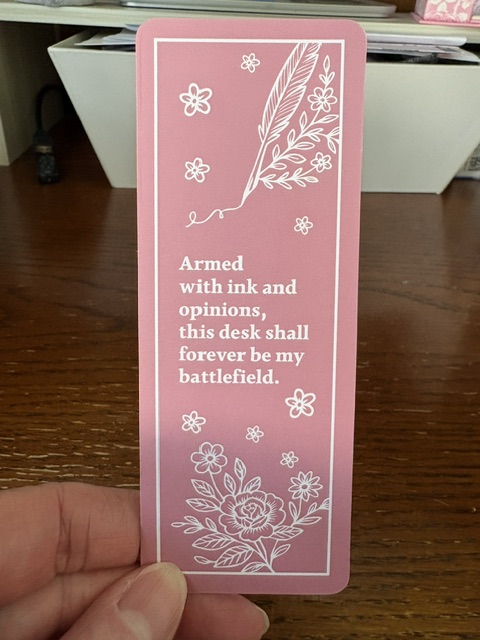
The design is cute. One side says “Quill Power.” But the quote on the other side is a little strange: “Armed with ink and opinions, this desk shall forever be my battlefield.”
A quick Google search doesn’t show any sources for this quote. But doesn’t it sound just like a lot of Internet communication these days?
There are a few problems, though, with being “armed with opinions.”
Our opinions might not be right. We might not have all the details. Our sources may be wrong. Our views may be skewed by our own frame of reference and not understanding another’s.
Even if our opinions are on the right track, however, is it best to “go to battle” with them?
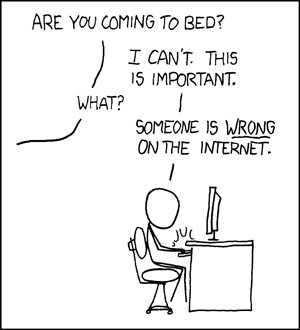
It depends.
According to the Merriam Webster online dictionary, one definition for “opinion” is “a view, judgment, or appraisal formed in the mind about a particular matter.” Another is “belief stronger than impression and less strong than positive knowledge.”
If we go to battle with our opinions, judgments, and views, how do we determine who wins the battle? The one who speaks the loudest? Or uses the most words? Or is the most condescending towards other views? Or gathers the most “likes” and agreeing comments?
If my opinion is my own view or judgment, and the other person’s opinion is their view or judgment, how can we determine who is right? Even if our opinion is based on facts (as we perceive them), the other person might have the same facts, but interpret them a different way.
It’s not wrong to have opinions, even strong opinions. We don’t have to be spineless and wishy-washy, never expressing an opinion for fear of offending someone. But we need to remember our opinions are just that, and other people are entitled to theirs.
And then, do we even need to express our opinions all the time? A while back, during a period of unrest, the online sentiment was, “If you don’t share a correct opinion on these issues, then by your silence you’re complicit with the wrong side.” But not everyone with a blog or social media account will want to get in on every cultural conflict. They may have strong opinions but not feel their venues were the best place for them. They may want to reserve those thoughts for quieter, less volatile conversations.
Plus, we have access to so much more news and information these days, we can’t possibly have an opinion on everything, unless maybe we spend all day online.
Even on lesser matters, we don’t always need to share our own opinions. You’ve probably met people, as I have, who not only hold strong opinions about nearly everything, but must express them.
If a fellow blogger shares that she enjoyed roasted eel recently, we don’t have to say, “Eww, gross,” even though that’s what we are thinking. We might say, “Interesting. I’ve never had that.” Or we might not mention it at all.
It’s okay to discuss differing opinions if both sides can do so without devolving into anger and put-downs. If I say I love a certain book, and someone else says, “Oh, I hated that one.” I’d probably ask, “What didn’t you like about it?” And we might have an enlightening conversation. Or we might not. You learn, over time, what people you can have those kinds of conversations with and what people you can’t.
I respect and am more likely to listen to those whose opinions are slow in forming, based on years of wisdom and life experiences as well as Scripture, than those who write an opinion piece every week (or day) on the current hot topic. I’ve been greatly helped by sorting through issues by discussing opinions with a trusted friend.
If I am asked my opinion on something, I try to hedge it with “Based on my understanding . . . ” or “My thought is . . .”
But there is a difference between an opinion and absolute truth. An opinion may be based on truth or may not be. I can give way to some opinions, but I can’t give way on truth. Contrary to popular belief, truth is not elusive or ephemeral.
The Bible says, “God is spirit, and those who worship him must worship in spirit and truth” (John 4:24).
Jesus said, “I am the way, and the truth, and the life. No one comes to the Father except through me” (John 14:6).
The Holy Spirit is “the Spirit of truth” (John 15:26).
God’s Word is truth (John 17:17).
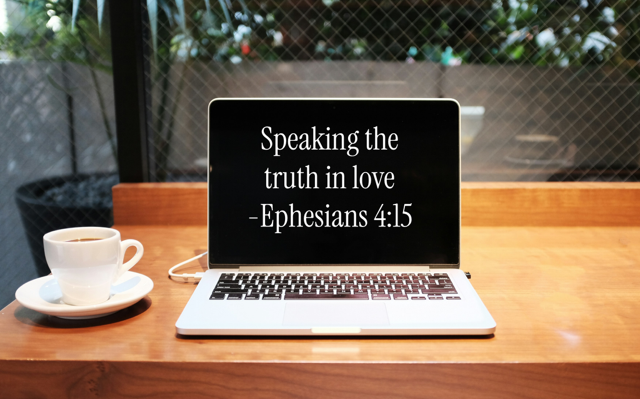
But even armed with truth, we don’t use it to bludgeon. We’re told to “speak the truth in love” (Ephesians 4:15). Our purpose isn’t to battle with our opinions, but to be gracious instruments through which God might “open their eyes, so that they may turn from darkness to light and from the power of Satan to God, that they may receive forgiveness of sins and a place among those who are sanctified by faith in me” (Acts 26:18).
(I often link up with some of these bloggers.)


Social media is so rife now with armchair critics and strong opinions. And because the person can be anonymous to a point, there are no filters. Strong opinions can be good in many cases but not to the hurt or rudeness to others. I’m finding that keeping my opinions to myself gives me a lot more peace.
It’s often hard to know when to share and when not to. But social media is probably not the best–it’s hard to engage in genuine conversation there.
In my younger days I had strong opinions. I still have them but I no longer am making a racket on the internet with them. Part of my compulsion to share my opinion was because of Facebook. Not a place for me. Thankfully I haven’t been on there since 2020. I’m much happier now. 😊
I don’t get into much on FB besides keeping up with family and a few friends. It doesn’t seem the best place for deep conversations. People tend to be too reactionary.
This was a good topic for today; I feel like social media has really ramped up peoples’ opinions and certain people have become more and more forceful in sharing theirs. I agree that we can’t have enough knowledge to be informed (and therefore to have an opinion on) everything, and honestly it’s kind of a relief sometimes to admit that! I appreciate people who are more reticent or at least take a while to thoughtfully form an opinion rather than loudly advocate it. I can relate to the earlier poster re. Facebook. There have been times when I’ve typed out a response, thought a minute, and then deleted it rather than posted it. That was a freeing feeling!
It does seem like a lot of social media is everyone talking and few people listening.
Timely wisdom! I happen to have strong opinions about quite a few things, but generally don’t use the internet and social media to share or discuss for two main reasons – social media users tend to wind up siloed into interacting mostly with other users who agree (through algorhythms more than through our own choices) so it can be an echo chamber; and it’s much harder to have productive discussion that leads to anyone changing their mind or even being willing and able to hear another point of view. That’s better done in person when we’re less likely to say the mean things too many people are willing to type anonymously.
Speaking the truth in love, and being prepared to give an answer for our hope in Christ should be our goal. All the opinions on other topics may be important, but must be secondary.
Amen and amen! The best conversations, especially on touchy subjects, are best had in person when the time is right. I agree most social media conversations aren’t productive.
Barbara, thank you for this wonderfully written post on opinions. It’s one that we can all profit from. In this day and age, it does seem that hiding behind a computer monitor and typing out our thoughts and opinions, regardless of how they may come across to others, has become the “norm” without thought of how it may hurt or offend someone.
It does seem like people online use their opinions as weapons and taking sides rather than being genuinely helpful or seeking others’ points of view.
This >> “Our purpose isn’t to battle with our opinions, but to be gracious instruments …” Will the Lord be displayed through the manner in which I share my opinion? They may not even remember my opinion, but they will remember how I said it. Such a wise and needed post.
That’s a good point–people will remember how I shared something more than what I actually said.
The older I get, the less I am willing to argue about.
I remember Elisabeth Elliot referring to some opinionated person in her world as having “whims of iron.” I never want to harden into that sort of person.
I don’t remember that phrase of EE’s, but it’s a good one. I agree about being less willing to argue about much. Everything is secondary to the gospel, and so many have alienated people from their gospel witness by being so forceful in their opinions on lesser things.
I think of Pro. 16:21 (NLT). “The wise are known for their understanding, and pleasant words are persuasive.”
I love that translation of that verse.
Barbara, I love what you’ve written. We’ve been called to encourage one another daily, yet our culture is always pushing us into fight mode. It is exhausting and futile.
May we learn to love well even when we don’t agree with another soul.
Amen! We can love even when we don’t agree.
Barbara, I really appreciate what you’ve written here. You’re right–it’s fine to have opinions, even strong ones, and also for other people to have the same. I especially love your approach: “If I am asked my opinion on something, I try to hedge it with ‘“’Based on my understanding . . . ‘ or ‘My thought is . . .’ ” Such a gracious way to respond.
Pingback: September Reflections | Stray Thoughts