
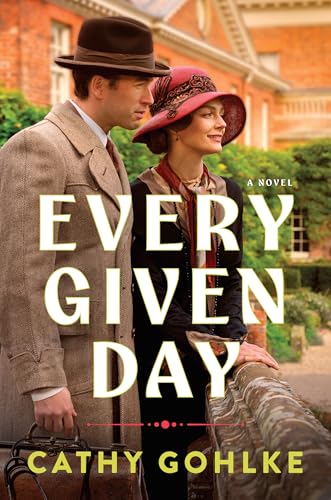
Every Given Day by Cathy Gohlke is set in New York City, 1918, and is inspired by true events.
Gwen Armstrong had taken care of her little sister, Marion, after her mother died of consumption (tuberculosis). When the time came that Marion would take care of their father so Gwen could pursue her dreams, instead, Marion married the man Gwen thought she’d had an understanding with. The sisters had little contact for twelve years.
In the meantime, their father died and Gwen took a job as a teacher. Then Gwen receives a letter from Marion. She has tuberculosis and wants Gwen to come and tutor her two children.
Gwen feels she can’t tell Marion no in her hour of need. Plus this gives her a chance to get out of the small town she has been tied to for years.
When Gwen arrives in NYC, Marion has already been sent to the sanatorium. Spanish flu is raging through the city, and the house has been put under quarantine. No visitors are allowed, because if any of them caught the flu, it could have fatal consequences for Marion.
Gwen settles into a new routine with the children, Alistair and Clara, with help from the housekeeper, Mrs. Barrie. Russell, Marion’s husband, is away most of the time on business. There are strange cars and trucks that come in the middle of the night every few weeks, but Russell says they are for his business and not to worry about them. He buys and sells antiquities from archeological digs in Egypt, Cairo, and other places.
Despite the family’s best efforts, however, the Spanish flu hits them, leaving devastating losses.
And the Alastair develops juvenile diabetes. The number of cases increases in the wake of the Spanish flu epidemic. Also known as the “wasting disease,” juvenile diabetes is a death sentence at that time.
One doctor has developed a diet for children with diabetes, but it is nicknamed the starvation diet and very controversial. It’s not a cure, but it holds out hope to keep children alive until help can be found. There is promising research with a recently-discovered hormone called insulin. But it’s so far from being available. It’s in an unpurified form and needs testing and processing for distribution. Will it come in time to save Alistair?
The author was inspired to write this story because her own granddaughter developed Type 1, or juvenile diabetes, after a bout of Covid. In fact, there was a higher outbreak of Type 1 diabetes cases after Covid just like there was after the Spanish flu.
Thankfully, the audiobook (nicely read by Aimee Lily) did include the author’s notes this time and shared how she wove the real facts about insulin discovery and usage into this story. One of her interviews here tells a little about this miraculous discovery and the rough road to its availability.
The first part of the novel, dealing with the Spanish flu, sounded eerily like our Covid epidemic, with masks being required in public and disagreements about whether isolation was helpful or harmful.
Interest in Egypt was at an all-time high in this era, too. And there was a fun cross-pollination of reading interests when this book told of Howard Carter’s and Lord Carnarvon’s discovery of King Tut’s tomb. Lord Carnarvon owned Highclere Castle, home of the fictional Downton Abbey. I had read of this historic find a couple of years ago in Lady Almina and the Real Downton Abbey: The Lost Legacy of Highclere Castle, written by the current Countess of Carnarvon.
There’s an undercurrent of a faith element as Gwen has only a passing belief in God, fights for control in Alistair’s treatment, and ultimately has to surrender him to God.
It’s not much of a spoiler to say that Russel is a jerk from the beginning. I couldn’t understand Gwen’s being taken in by his “charm.” And I felt the story dragged just a little about three-fourths of the way through, going through the same arguments over Alastair’s treatment and Russell’s demands of Gwen.
But overall, I enjoyed this story very much. Juvenile diabetes is still no picnic, but I am thankful for God’s gift of insulin.


I have a great aunt who died at age 15, in the 1920s, because insulin was not yet available.
I’m so sorry! That’s right in the timeline of this book.
Yes, diabetes treatments have come a long way! I can just imagine the “starvation diet,” sadly 😦 And yes I too love when there is ‘cross pollination’ (love the term!) in books, where I can put things together from book to book or from book to history. Egypt connection is interesting. And yes, I took have thought how eerily similar the Spanish Flu epidemic and covid were, coming about 100 years apart. It’s sad we didn’t seem to progress a whole lot, in many ways, between the two. Nice review!
This sounds like an interesting but sad book. I read that book by the Countess of Carnarvon. That was also interesting.
You find some of the most intriguing fiction!
TT
[image: –Join me at Living Our Days]
Join me at Living Our Days https://michelemorin.net “The way we live our days is, of course, the way we live our lives.” (Annie Dillard)https://linktr.ee/MicheleDMorin
I like everything I’ve read of Cathy’s so far, so when I needed a new audiobook and saw this was hot off the press, I snapped it up.
Sounds like an interesting read. Thank you for your review, Barbara.
Pingback: September Reflections | Stray Thoughts
Thanks for sharing your review with the Historical Fiction Reading Challenge!