
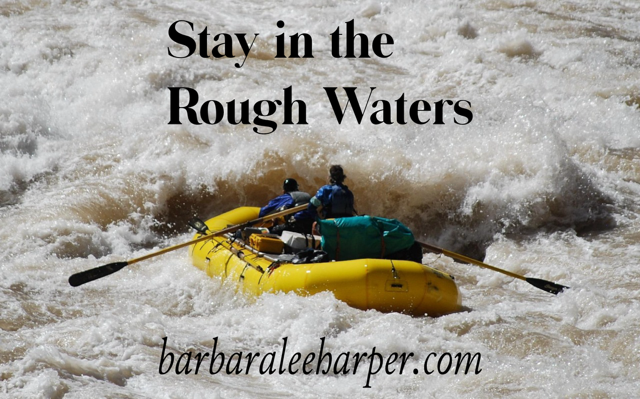
While I was making breakfast one morning last week, I listened to Dr. Stephen Davey’s radio program, Wisdom for the Heart. He told one man’s account of preparing to go white-water rafting at the base of Victoria Falls in Africa. He said the highest class of rapids one can legally take a raft on in the US is Class 5. These rapids were Class 8.
Among the guide’s instructions were these: when (not if, but when) your raft overturns, stay in the rough waters. He said your first instinct is to make it to the shore where the waters are still and quiet. However, you don’t want to do that because that’s where the crocodiles are.
I am not planning to ever go white water rafting. But when I am in life’s rough waters, my first instinct is to get out of them as soon as possible. When life is calm again, then I’ll be ready to learn whatever lessons I need to.
Yet life doesn’t work that way. God wants us to trust Him in the rough waters as well as the still ones.
Sometimes you have to let the waters take you to their expected end. Sometimes there are hidden dangers in what seems safe.
That same morning, I had read Exodus 5 and 6 where Moses approached Pharaoh for the first time to tell him God had said to let the Israelites go three days’ journey into the wilderness to sacrifice to the Lord. Pharaoh, of course, did not consent. In addition, he stopped supplying them with brick-making material, told them to find their own, yet required the same quota of bricks for them.
The people were upset with Moses for making life worse for them. Moses cried out to God. Why have you brought this trouble on Your people? Why have you sent me here? You haven’t delivered Your people (with the seeming implication, “Like you said you would”).
God was going to keep His promises. He loved His people and was going to deliver them from Egypt’s oppression. But He had a larger purpose. In Exodus 6:7, God told Moses, “You shall know that I am the LORD your God.” But in 7:5, He also said, “The Egyptians shall know that I am the LORD.”
The process would take time and be difficult. But they would see the hand of the Lord like never before.
Similarly, after Israel was freed from Egypt and standing at the edge of the land God had promised to them, they refused to go in. It was going to be too difficult, too dangerous, too much work. They had God’s promises plus the experience of seeing all He did to deliver them from Egypt. But they wanted to play it safe. For their unbelief and disobedience, they were made to wander forty years in the wilderness.
Sometimes troubled waters come on us unexpectedly, like the Israelites in Egypt. What’s happening doesn’t seem like an answer to prayer. In fact, the situation seems the opposite of answered prayer. But God sees the bigger picture. He often has more in mind than we know. He knows what He wants to accomplish, where He plans to lead us, and how He will take care of us.
Sometimes, like the Israelites just outside the promised land, we foresee real or imagined difficulties ahead. Even though we’ve followed God’s leading and we’re right where He wants us, even though we have His promises and experience with His power, we decide the rough waters are just going to be too hard.
Dr. Davey didn’t share the rest of the guide’s instructions. I assume if you fall into rough waters, you let the waves carry you until you can either get back into the raft or until you come to a calmer place that doesn’t have crocodiles.
The psalmist tells of people caught in a storm at sea who, after a harrowing journey, were brought to quiet waters in “their desired haven” (Psalm 107:23-32).
The disciples experienced something similar when they got caught in a storm on a lake. Jesus rebuked the wind and told the sea to be still. (Mark 4:36-41). “And the wind ceased, and there was a great calm.”
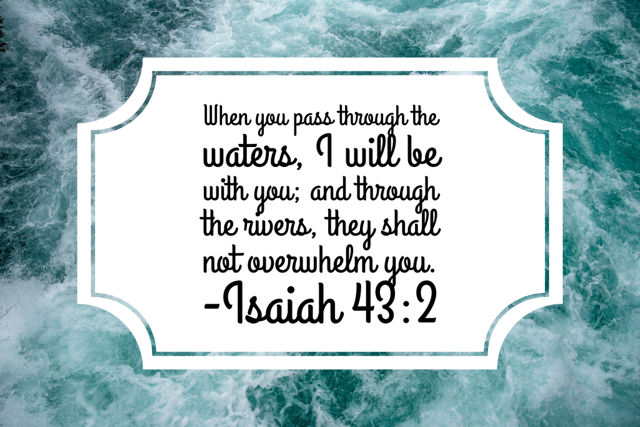
Whatever metaphorical rough waters we might be facing–an unexpected diagnosis, family problems, financial troubles, relational woes, and many others–there are really no options but to ride the waves through the situation. Yet we have His promise that “When you pass through the waters, I will be with you; and through the rivers, they shall not overwhelm you” (Isaiah 43:2).
Then, with the psalmist we can say, “For you, O God, have tested us; you have tried us as silver is tried. . . . we went through fire and through water; yet you have brought us out to a place of abundance) (Psalm 66:10, 12).
(I often link up with some of these bloggers.)


Good word ma’am. There’s a reason God led me to choose Psalm 107:30 as the name for my little cabin in the woods (now our little cabin). We call it, “The Haven”. For He is here among us.
What a sweet name for your new home. You’ve been through some rough waters in previous years–so glad they’re calm for you now.
Aaargh! The WordPress login is so frustrating and half the time I can’t leave a comment. So … I just wanted to say that this is a wonderful essay, Barbara, and I’ll be sharing it on Facebook AND with my old ladies in our nursing home Bible study. Excellent!!! Kitty Foth-Regner262/263-9122 edgarsfan@aol.comwww.EverlastingPlace.comAuthor ofThe Song of Sadie SparrowIt’s never too late to change your tune
I’m so sorry about the commenting frustrations! I am glad you persevered.
This was a most insightful and needed post. Thank you for sharing this wisdom and encouragement! Blessings!
Thank so much, Joanne!
Comforting post Barbara; thank you! The older I get the more I realize that we often need to be content with focusing on the knowledge that God is with us, and that someday (often not in this life) we’ll understand and feel our “rough waters” were worthwhile.
I have to keep reminding myself we’re not in heaven yet–this world is not going to operate like it is.
It is amazing how so true when life is giving us lemons and rough times, and we can’t see the outcome, but praises that He does. When all said and done, we have that “ah-Ha” moment of okay, I see now. And it is amazing as we alone cannot fathom the outcome. Enjoyed reading this great reminder to just be patient and tread rough waters for a bit, and trust. 🙂
Tread and trust–I like that!
Good post. God doesn’t always make things easy but we always seem to learned a lesson.
Sometimes I want the lesson quickly so the rough waters will calm down, but it doesn’t always work that way. I guess one thing He wants to teach us is endurance.
Barbara, the detail that the still shore is where the crocodiles are is going to stay with me. Our first instinct in hard times is to get out of the water as fast as possible, even when the calmer-looking option carries its own hidden dangers. In my work building privacy-first home sensing technology, families teach me a version of this often. When an aging parent has a scare, the first instinct is to make a big change right away, yet sometimes the wiser path is to stay the course with the right quiet support around the life they already have. Thank you for this encouragement.
Pingback: September Reflections | Stray Thoughts
Barbara, thank you so much for this post. I know I’m reading it a few days after you posted it, but I just want you to know that it was a very timely piece for me to be reading at this time. Thank you so much for being an instrument of God’s grace.
Goodness, I would love to go white water rafting but absolutely NOT anyplace where there are crocodiles, hippos, or alligators! LOL I do appreciate the wisdom in this post – it’s our nature to want to get out of the rough waters immediately, but that’s not always best for us. Puts our faith to the test, but God is faithful.
My heart is encouraged after reading this, Barbara. I want to play it safe too often. But you’re right. God sees the bigger picture and has more in store than we could ever know. Even if what’s in store is hard, He will be with us.