
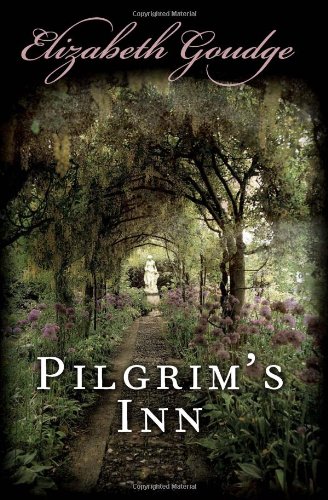
The Pilgrim’s Inn is the second book in the Elliot family trilogy. For some reason, the British version has a different title, The Herb of Grace.
In the first book, The Bird in the Tree, family matriarch Lucilla Elliot fought hard to reunite her son, George, with his estranged wife, Nadine. When Nadine fell in love with Lucilla’s grandson, David, reconciliation looked impossible. (It sounds weird that a woman would fall in love with her husband’s nephew, but apparently she was much younger than her husband and a little older than David.) This is a spoiler alert if you haven’t read that book, but eventually David and Nadine broke up and Nadine went back to her husband.
As The Pilgrim’s Inn opens, seven years have passed. George and Nadine had a set of twins in addition to the three children they had before. David had gone off to war (WW2) and came back a broken man in need of quiet and rest.
Though David and Nadine did the right thing, their hearts aren’t all the way in the right place yet. They’re not doing anything inappropriate. Lucilla feels George and Nadine would have a better chance in the country rather than London (where Nadine wants to live). Lucilla manipulates circumstances to get George and the children to view an old inn that’s for sale, the Herb of Grace. An older lady had run it, but it was getting beyond her capabilities now. George and the children fall in love with the place, as Lucilla knew they would. Nadine ends up agreeing.
Their oldest son, Ben, who is a pre-teen or young teenager, discovers the house was a “pilgrim’s inn”–a hostel run by the monks of a local abbey. The family lives there and restores the place, thinking at a later point they’ll open it to guests. But then a man and woman who live in a boat and say they are father and daughter come along and help with the repairs while taking their meals at the inn. Nadine is drawn to the young woman, Annie-Laurie, in a maternal way that she hasn’t felt with her own children. “She was not an unloving mother, but she was not naturally a lover of children, and she was so desperately tired” (p. 35, Kindle version). Everyone feels there’s something a little off with Annie-Laurie and her “father,” but their story doesn’t come out til later.
Meanwhile, David runs into a young woman named Sally Adair at a London party. Sally’s father is an artist, and she recognizes David from one of her father’s paintings. She is drawn to David but senses that his heart isn’t free. Plus, he is a famous actor, and she feels herself too plain and ordinary.
Sally maligned herself when she said that she had no intellect. It was true that at school she had never passed any examination by anything except the skin of her teeth, but when it came to the business of living she was a clever woman. She liked everyone she met, and she enjoyed everything she did so intensely that her relationships and her activities were touched with that spark of light that men call genius. She was not an artist in the accepted sense of the word, but when she cooked a meal or tidied a room she was yet unmistakably her father’s daughter. A room arranged by Sally, a meal she had cooked, were as unforgettable as her father’s pictures. Imaginative, deft touches here and there were like the glimmer of light on water that without it would have been opaque and dull (p. 8).
When Sally’s father books them at an inn called the Herb of Grace for a few weeks, she’s surprised to learn that the children are the same ones she saw regularly at the grocer’s in London, and that David is staying with his grandmother nearby.
The inn, as well as Lucllla’s house, Damrosehay, are almost characters in themselves. Much is made of the fact that people feel safe and welcomed there, not just from the residents, but from the houses.
There’s a lot that takes place in the woods as well as several mentions of The Wind in the Willows.
This is the second book of Goudge’s I have read which had child characters who were unruly and self-willed, yet somehow supposedly adorable. It doesn’t usually work like that in real life.
Though I felt Lucilla came across as manipulative in this book (even though meaning well and having everyone’s good in mind), and a couple of characters were way more intuitive than anyone I’ve known in real life, I loved this story.
All of Elizabeth’s books seem to have a theme. This one appeared to be the importance of home, especially in the aftermath of WW2, still dealing with shortages and healing from the war and what it did to individuals and families :
It was homemaking that mattered. Every home was a brick in the great wall of decent living that men erected over and over again as a bulwark against the perpetual flooding in of evil. But women made the bricks, and the durableness of each civilization depended upon their quality, and it was no good weakening oneself for the brick-making by thinking too much about the flood (p. 58).
A few other quotes that stood out to me:
Funny thing, memory . . . Like a storeroom full of cupboards. Something makes one of the doors fly open, and out falls a lot of stuff you didn’t even know you had (p. 254).
Excessive shame was just as distorting to the judgment as excessive arrogance (p. 342).
I know of no better incentive for the building of a decent world than the possession of children who must live in the world you’ve built (p. 360).
I listened to the audiobook which was nicely read by Elisabeth Martin, except she had an annoying habit of pronouncing words that end with a “d” sound as if they ended with a “t.” You don’t realize how many words end with a “d” until someone does that. Plus, this is an English book, and she is American. Though she reads the narration in an American accent, she does a great job with the different voices of the characters. I also borrowed the ebook via LIbby to look up some quotations and read a few sections in more depth.
Unfortunately, the third book in the series, The Heart of the Family, doesn’t come out in audiobook form until next week. But I look forward to listening the last book of Goudge’s Eliot trilogy.

