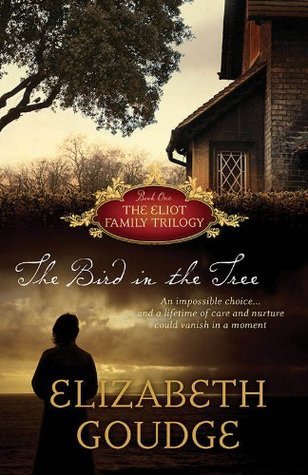
The Bird in the Tree

The Bird in the Tree by Elizabeth Goudge is the first in a trilogy of novels about the fictional Elliot family in England between the two world wars.

Lucilla is the widowed matriarch of the family. She lives with her daughter, Margaret, and long-time maid, Ellen. Currently three of her young grandchildren are staying with her as well. Their parents, her son and daughter-in-law George and Nadine, have been divorced. George is out of the country and Nadine is establishing her own life. Lucilla hopes they will restore their marriage.

Her favorite grandson, David, lived with her from the time he was a boy after his parents died. He’s grown now, an actor, and is coming for a visit. However, when he arrives, she senses something is wrong. It’s not until the next day that he tells her he is in love with Nadine and they plan to marry. They’ve not told anyone else yet.

If it sounds strange that he’s in love with his aunt–she’s several years younger than her husband (his biological uncle) and a few years older than David.

Lucilla is distressed, as David knew she would be. She asks that Nadine come for a visit so she can talk with both of them. She shares why she doesn’t think they should marry: their union would be a blow to family unity, would make it impossible for Nadine and George to reconcile, and would destroy David’s special relationship with Nadine’s children, who loved and missed their father and would have difficulty if David tried to step into that role. Lucilla doesn’t press the issue after that, though she worries and prays.

Then the question becomes whether David and Nadine will follow their passions or do what’s right.

Parts of the book sound like it could have been written today:

His love for Nadine was the most shatteringly real thing that had ever happened to him. It was the truth, and it must be served…

Truth. He would have to try to make Lucilla understand how he felt about it, how it was to him the lamp that lit all life. It would be difficult, for her generation and his felt so differently about this truth. Her generation had built from without inwards, had put the reality of law and tradition above the reality of personal feeling, but his built from within outwards, the truth of personal feeling must come first; when there was no longer reality in a union, smash the union; never mind what laws were broken or what lives were crippled; live the truth.

The young people think that Lucilla, wrapped in “law and tradition,” can’t possibly understand their “truth.” But as we learn more about Lucilla’s past, we see she had her own long struggle between desire and duty.

The family home, Danrosehay, is almost a character of its own in the story. I liked how Lucilla wanted the home to always be a refuge from the storms of life for her present and future family.

There’s an interesting backstory of a historic storm and a sea captain who crashed into the marshes and lived in the area afterward. The story is told near the beginning as just village lore, but it turns out to have great significance for the family later on.

A few other quotes that stood out to me.:

She tried very hard to teach her grandchildren how to extract the last drop of beauty out of all the small things of life, words and scents and sounds.

In times of storm and tempest, of indecision and desolation, a book already known and loved makes better reading than something new and untried. The meeting with remembered and well-loved passages is like the continual greeting of old friends; nothing is so warming and companionable.

I realize now that there is such a mixture of good and evil in all we think and are that everything, every instinct and thought, needs to be tested by the teachings of Christ.

All bereavement, whether fate inflicts it on you or whether the relinquishment is your own, changes you . . . Don’t people say that nature abhors a vacuum? Something lost in the present means something new flowing from the future; often a new and stronger faith.

This was his first big trouble and she hardly knew how to bear it; when she had been young she had borne her own troubles, now she was old she bore her children’s and grandchildren’s and found them far worse to put up with than her own had been.

There is mention of a blackbird singing in an ilex tree about twelve times. With that, and the bird in the title, I felt it had to have some significance. I searched online for a while but didn’t turn up much opinion on that front, though some sources said the ilex tree (mentioned 28 times in the book), a type of holly, was thought to be representative of Christ’s sacrifice. I felt the last line of the book finally gave some insight; but, of course, I can’t share that without spoiling the story.

This book started out with tons of description, of the main characters, the house, the village, and its history. But, once again, once it got into the story, I loved it. The characters are so well drawn that they seem real and relatable. And, though some of the language and situations are a little old-fashioned, the underlying truths are eternal.
The Scent of Water

The Scent of Water

The Scent of Water by Elizabeth Goudge takes its title from Job 14:7-9, KJV: “For there is hope of a tree, if it be cut down, that it will sprout again, and that the tender branch thereof will not cease. Though the root thereof wax old in the earth, and the stock thereof die in the ground; Yet through the scent of water it will bud, and bring forth boughs like a plant.”

The novel shares the story of several people in a small English village in the late 1950s, but especially Mary Lindsay. She’s a woman in her fifties in London who began as a teacher, then went into government services, then became something like an administrator for a ministry. She receives word that an aunt for whom she was named has died and left Mary her house in the country and a small legacy. At first Mary plans to go down to Appleshaw, get the house in order, and sell it.

But then she remembers visiting Aunt Mary when she was about eight. Aunt Mary had showed her a collection of “little things,” miniatures, that young Mary had been enchanted with. Aunt Mary had offered to give them to her, but in the busyness of a London home with other siblings, she was afraid they’d get lost or broken.

Mary wonders now whether the “little things” are still there. She uncharacteristically decides to quit her job in London and take possession of Aunt Mary’s home in the countryside.

As Mary starts to get the house in shape, she meets other villagers. There are children next door who regard her garden as theirs and are quite hostile, until Mary makes friends with them. There’s a blind veteran, Paul Randall, with his discontent, grumbly wife. There’s the vicar with his anxious, easily frightened sister. And a dear older, feeble couple with a wayward son.

Part of Mary’s reasons for coming to the quiet of the country is to process her feelings for her aunt and her fiance, who had been killed at war a week before the wedding. She felt like perhaps she hadn’t really loved him as she should have since she didn’t grieve as deeply as she had seen others do. And she wanted to get to know her mysterious Aunt Mary, whom she had only seen that one time as a child. Fortunately, she finds Aunt Mary’s diary.

“The scent of water” is mentioned many times through the book as different characters experience renewal and new life in various ways.

Some of the quotes that stood out to me:

I had not known before that love is obedience. You want to love, and you can’t, and you hate yourself because you can’t, and all the time love is not some marvelous thing that you feel but some hard thing that you do. And this in a way is easier because with God’s help you can command your will when you can’t command your feelings. With us, feelings seem to be important, but He doesn’t appear to agree with us.

Suffering had had an effect with which she was familiar. The refusal of self-pity and despair had turned it from lead to fire, burning up the subterfuges and dishonesties below the surface of the inherited veneer of manners and thought that most men and women think are their true selves, and the veneer with them.

Mary sat up late that night with the diary. She had been reading it slowly and steadily, passing with Cousin Mary through the first few years at Appleshaw, years of alternate illness and respite, so much at one with her cousin that she seemed to be learning with her how to accept the first with hope and the second with wonder and gratitude. Cousin Mary hoped her journey through periods of dark and light was like that of a Swiss train toiling up the mountainside, in and out of tunnels but always a little farther up the hill at each emergence. But she could only hope that this was so. She did not feel it.

No desert is so dusty as not to have an oasis here and there.

I liked this quote about a writer who gave Mary some of his work to critique.

He had found in her what he had never had, a sympathetic but intelligent critic. She could wield the pruning knife mercilessly yet at the same time she watered the roots.

I think most writers would appreciate that kind of feedback.

However, there were a couple of things that puzzled me. One was that Mary finds herself falling for a married man. She never acts on her feelings or lets anyone know. He’s a writer and finds in her a meeting of the minds unlike what he has with anyone else. But that being understood and appreciated seems to make him more determined to make his relationship with his discontent wife right.

Another was this exchange with a child who had taken a couple of the “little things” from Mary’s house:

“Then you don’t think I’m awfully wicked?” whispered Edith. “You don’t think I’ll go to hell?”
Mary laughed. “No, I don’t. It’s like this, Edith. Why you do a thing is more important than what you do. And so stealing because you love is really better than not stealing because you don’t. Not that I am advocating stealing exactly. This question of good and evil is very complicated. Life has been very difficult for us all since Eve ate the apple.”

Mary was not a believer at this point, so she can be forgiven for not having her theology quite right. But it seemed an odd thing for the author to include.

I was surprised to see a handful of “damns” in the book.

In an earlier book I read by this author, The Dean’s Watch, it seemed to take her a long time to actually get into the story. In this book, she seemed to jump right in, so that was helpful. Still, it’s kind of a slow-moving, character-driven rather than action-packed novel. But I liked the theme of renewal and how it worked out in the lives of its characters.

The Dean’s Watch

Dean's Watch

The Dean’s Watch is a novel by Elizabeth Goudge, published in 1950 but set in an English cathedral town in the 1870s. The town is unnamed but based on Ely, where Goudge lived for a time, bordering the marshy Fens region.

The story opens with watch- and clock-maker Isaac Peabody, a shy, quiet man working in his shop repairing Dean Ayscough’s watch. We’re told about his work, his shop, his lack of faith in God, and his fear of the cathedral (though we’re not told why he fears it until much later). He’s currently in one of his “good times.”

He lives with his sister, Emma, a rigid, brittle woman. Emma considers herself a gentleman’s daughter and is ashamed that her brother is a tradesman with his own shop. Her shame is deepened by the fact that Isaac visits the local pub during his “bad times.” Her mission in life is to “turn him into a sober, businesslike, gentlemanly good man,” and she knows she is failing.

Their maid, Polly, is a bright, cheerful, soul, and Isaac and Polly get along well when Emma is not around. Emma knows this and is jealous.

On Saturdays, Isaac keeps his shop closed and visits some of his customers whose clocks need winding and cleaning. One of those customers is the Dean (a head Anglican priest). Isaac times his visit for when the Dean will be out at the church. But this Saturday, the Dean is home with a cold. And, much to Isaac’s terror, the Dean wants to see him.

As it turns out, however, the Dean just wanted to thank Isaac for the paper included with his repaired watch. Isaac put little scraps of sayings or poetry with his watches, and the Dean particularly liked this one.

This led to a discussion of horology (the study of clocks and watches) as the two reserved men opened up to each other, with a promise of more visits to come.

The Dean is described as imposing, tall, and ugly, with a raspy voice. He commands authority and has fought against corruption in the city, particularly that involving children. But very few know his gruff exterior hides a tender heart.

Job Mooring is an orphan, stolen from his family as a child and then sold to various apprenticeships. He now works for a fishmonger who beats him. Way back as a young child made to climb chimneys, Job was rescued by the Dean, though he didn’t know that’s who he was. Job is secretly courting Polly.

One night when the Dean stops by Isaac’s house unexpectedly, he sets off a series of events with long-term ramifications.

In the meantime, his weekly visits with Isaac are redemptive for both men.

This book inspired yesterdays post on patience with old books. The book is not that old, but it’s written in the style of the 1800s. First we see a long description of Isaac and his shop, then the city, the fen people, several hundred years of the cathedral’s history, Emma, and the Dean. The story itself doesn’t seem to take off until about a third of the way in.

But once it did, I loved it. I loved the characters and the redemptive threads throughout. I liked the double meaning of the title: both the Dean’s physical timepiece, plus his watching over the people in the city, particularly the main characters. As he walked around the city at night, “He would stand in dark doorways and pray there for the men and women within the shuttered houses. If he lacked the common touch, if he was not the priest he had longed to be, this at least he could do.”

According to Wikipedia, though Elizabeth wrote several books, nonfiction and fiction, for both adults and children, The Dean’s Watch was one of her top three favorites.