
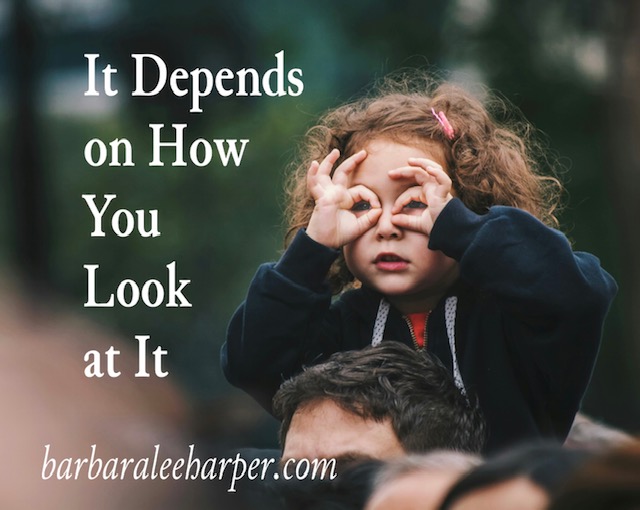
I once saw a cartoonish drawing of two men sitting on prison cots, each looking at a window while holding a paper with pictures they had evidently drawn. One had drawn a picture of the window with bars. The other had drawn a picture of the trees outside the window (1).
I don’t remember if there was a caption, but the implication was clear. Two men in the exact same space and circumstances had vastly different viewpoints. One saw the bars that kept him imprisoned. One saw past the bars to see the beauty beyond.
There’s an incident in the Bible where people had different outlooks.When God led the children of Israel out of Egypt to Canaan, He told them to send ten men to spy out the land (Numbers 13). The men spent forty days in the land. They came back with a mixed report. The land was fruitful, “flowing with milk and honey.” But the people were strong, the cities large and fortified, and there were even giants that made the men feel like grasshoppers in comparison.
God had told the people in Exodus 23:20-33 that He would send an angel to go before them and bring them to the place He prepared for them. He said He would give them victory over the people of the land “little by little” (verse 30).
Caleb quieted the people and encouraged them that they could take the land (Numbers 13:30). He and Joshua reminded the people that God was with them and would give them the victory (Numbers 14:6-10).
But the people only saw the problems. They wept. They grumbled. They blamed Moses. They blamed God. They wished they had died in the wilderness. They wanted to go back to Egypt. They wanted to stone Caleb and Joshua.
People in the same situation, with the same promises of God, saw the situation completely differently.
There are other incidents as well. In 2 Kings 6, the king of Syria sent horses and soldiers to surround the city where Elijah was staying. Elijah’s servant panicked, but Elijah said, “Do not be afraid, for those who are with us are more than those who are with them.” Then he prayed and asked God to open the servant’s eyes. “So the Lord opened the eyes of the young man, and he saw, and behold, the mountain was full of horses and chariots of fire all around Elisha.” God’s protection was there, though at first it was unseen.
When Saul’s armies quaked before the giant Goliath, David stood up for God’s honor, believed God, and defeated Goliath in the name of the Lord (1 Samuel 17). All of those trained soldiers, all people who supposedly believe in the one true God, yet none among them but a boy believed God could defeat the giant.
When we’re in the middle of major problems–and sometimes even minor ones–the problem itself looms large until it’s all we can see. Everything else is colored by that issue.
Recently I saw a quote that said something like, “You can look at God through the lens of your problem, or you can look at your problem through the lens of God” (2).
When we view God through our problem, the problem looks big, even insurmountable. But if we look at the problem in light of God’s character and truth, our perspective changes and the problem is reduced to its proper size.
I don’t know why the Lord allowed an illness that took up a large part of last month (forgive me for talking about it so much, but I am still processing it). I admit to feeling down while in the hospital, especially when it looked like there was no improvement for a few days. The whole thing seemed like a big waste of time, keeping me from doing anything more useful. But as I’ve thought about the situation in the following days, I found many things to be thankful for:
- Doctors, nurses, medicine, and treatments. Many ailments today are treatable that would have been a death sentence or had an even longer recovery period a hundred years ago.
- My husband being retired so he didn’t have to stress about taking time off from work.
- Being able to watch live-streamed church services. No, it’s not the same as being there in person, but it’s good when you can’t be there. I remember the days when that wasn’t an option: one had to wait a week or more to get a cassette tape of a service. And before that, you were just out of luck if you missed a service unless you had a friend who took good notes and would share them.
- Texts and emails helped alleviate the feeling of isolation and made me feel cared for. That isolation made me appreciate time with friends and loved ones even more.
- Even though it was the worst case of cellulitis I’ve ever had, it could have been even worse. Infections can go rogue suddenly and quickly. Our pastor emeritus caught Covid during the pandemic, was in isolation in the hospital for months, and ended up with a lung transplant. Jonah Scott had a strep infection that went toxic, causing much of his skin and tissue to be removed from his arm and side and requiring skin grafts afterward. Ciara Dierking went into the hospital almost three years ago with strep, the flu, and pneumonia which went septic. The treatments to save her life led to gangrene in all four limbs, which all had to be amputated. She had so many health challenges and nearly died, but God kept her alive, and a thriving ministry arose as she recovered. Though my infection was serious, it seems much lighter considering what these folks went through.
- God used the situation to stir up a desire to take a more active role in doing what I can to take care of my health.
Looking at trials from a different perspective doesn’t mean we minimize sorrow and loss and just “look on the bright side.” The psalms give us examples of lament in trouble that helps our own hearts today.
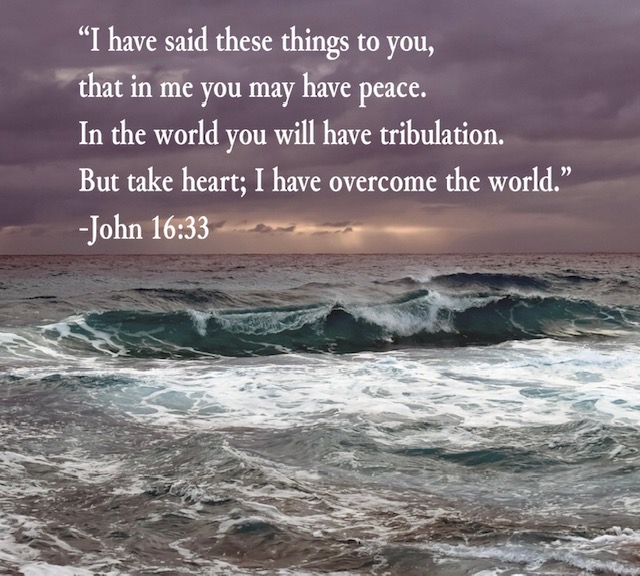
But it’s a deliberate looking for God’s hand in our troubles. Jesus said we would have tribulations in this life, but He also promised:
- to be with us: “When you pass through the waters, I will be with you; and through the rivers, they shall not overwhelm you; when you walk through fire you shall not be burned, and the flame shall not consume you” (Isaiah 43:2).
- to give us grace: “And God is able to make all grace abound to you, so that having all sufficiency in all things at all times, you may abound in every good work” (2 Corinthians 9:8).
- to use our trials to help us grow: “We rejoice in our sufferings, knowing that suffering produces endurance, and endurance produces character, and character produces hope, and hope does not put us to shame, because God’s love has been poured into our hearts through the Holy Spirit who has been given to us” (Romans 5:3-5).
- to use them to work “an exceeding and eternal weight of glory” on our behalf: “Therefore we do not lose heart. Even though our outward man is perishing, yet the inward man is being renewed day by day. For our light affliction, which is but for a moment, is working for us a far more exceeding and eternal weight of glory, while we do not look at the things which are seen, but at the things which are not seen. For the things which are seen are temporary, but the things which are not seen are eternal” (2 Corinthians 4:16-18, NKJV).
Concentration camp survivor Corrie ten Boom has said, “There is no panic in Heaven! God has no problems, only plans.” We may not see His plans. We may never know why He allows certain things in our lives. But we know He is wise, kind, good, and loving, and we can trust Him.
(I often link up with some of these bloggers.)
_____
(1) I’ve searched online to try to find the cartoon again. I’ve found some with a similar idea, but none exactly like the first one I saw.
(2) I’ve searched for this online but haven’t found it.

