
The world tells us older people are irrelevant and out-of-touch, and it’s best to avoid the appearance and effects of aging at all cost.
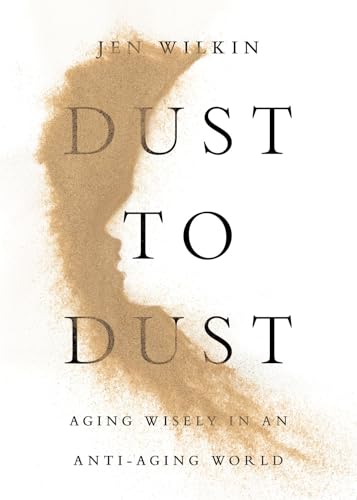
In Dust to Dust: Aging Wisely in an Anti-Aging World, Jen Wilkin says the Bible tells a different story. Except for the first few books of the Bible, where people lived hundreds of years, people had shorter life spans for much of history. Old age was seen as a gift that not many achieved. The elderly were to be treated with respect and valued for their life experience.
Even as Christians, we’re prone to view aging negatively. It’s hard not to mourn the loss of abilities and possibly influence and importance. But Jen encourages us to embrace greater dependence on the Lord and develop “eulogy virtues” rather than “resume virtues” in our last years.
Jen posits that in Eden, if Adam and Eve had not sinned, they would have continued to age without the negative effects we experience now (something I never considered before). They were told to tend the garden and have children, so it stands to reason that they, their children, and the plants would all have continued to age and develop.
But then sin and its curse entered the world. That doesn’t mean we need to look at the aging process as negative and all downhill. We can see it as a gift and view it as part of God’s purpose to prepare us to live with Him. “If you are in Christ, with an inheritance kept for you in the next life, thinking toward the day of your death can help you live each day with an eternal perspective” (p. 44).
Yet she admits aging is hard: “It’s time to state the issue squarely: Aging is an invitation into suffering and loss. Though we rightly wish to avoid them, suffering and loss are skilled teachers. . . What do they teach? Humility. Patience. Perspective. Holiness. The fruit of the Spirit” (p. 99).
One perspective is that of time and priorities. “The older we grow, the more we recognize the importance of allocating our precious time to the relationships that matter most. Shrinking possibilities bring expanding clarity. They enable us to become thoughtful curators instead of thoughtless consumers of the days on our calendar” (p. 104).
Jen frames her discussion in the form of a literary device used often in the Bible, a chiasm. She describes chasm as a “mirror-image parallelism, using repetition to trace an idea.” In Western thought, we look for the moral or the punch line or the main point at the ending of a discussion. But a chiasm puts the main point in the middle. The first and last points will be parallel, then the second and next-to-last, will be parallel, etc.
At first I thought the explanation of chiasms and trying to fit her points into this structure were going to detract from what she was trying to say. But they didn’t.
There are parallels between our first breath, birth and growth, and then our decline, last breath, and death.Then there are parallels between gaining strength as a child and losing it as an older adult; gaining abilities and possibilities of a young person, then losing them as an older person; caring for children as a young adult, and needing care as an older adult. The midpoint of the chiasm is middle age, which Jen describes as “the place of perspective.”
This book is not primarily comprised of tips for facing old age, though there are a few. And it’s not exclusively for older people. It’s mainly a biblical look at aging and how it differs from the world’s view. We need that biblical view not only for ourselves as we age, but also for how we think about loved ones who are aging.
I love the point she makes that though older people’s “physical needs may revert in many ways to those of a small child, the aged are not children. Their interior lives are shaped by years of experience and learning” (p. 66). When we were taking care of my husband’s mother, I always cringed when someone would say something about us becoming her parents and her becoming our child. No, she was still the parent, deserving of our honor and respect.
A few more quotes that stood out to me:
“I’m also paying attention to how I respond to minor adversity. Am I patient in small afflictions? If so, perhaps I will be better equipped for the bigger ones that come with age” (p. 109).
“The aging process shifts the focus of our joy to the things that matter most: becoming more Christlike and loving God and others with all we have. Yes, old age is not for the faint of heart, but it contains a richness the young don’t even know to hope for. The Lord takes away, but he also gives. We are only old once” (pp. 109-110).
“Godly wisdom views the elderly as people to love, not problems to solve. Worldly wisdom increasingly agrees that the elderly are problems before they are people” (p. 122).
“Middle age grants us a form of invisibility. And much good work can be done when we’re no longer concerned about others finding us attractive” (p. 151).
I only have two complaints about the book. I don’t know what the font size is, but it was a strain to read–which I thought was ironic since the topic was aging.
Secondly, she rightly lays out the biblical directions of families caring for their elderly and shares how that used to be the norm. Families used to live near each other instead of several states away. All that is true. But it is also hard. Since the extended family living near each other is not the usual scenario any more, that means the older ones are usually cared for by one couple: their middle-aged or older children and their spouses. Everyone I have ever talked to who cared for a parent found it difficult, even when the parent was easy to get along with. Add mental issues and combativeness, and the difficulties increase. Also, I’ve never talked to anyone who cared for elderly family members who didn’t wrestle with some degree of guilt. I wouldn’t say Jen was glib about the blessings of taking care of one’s older parents, but I wish she had dealt with the difficulties a little more and encouraged that God will give grace.
Since all of us are getting continually older, aging is a subject we should study to the glory of God rather than dreading it. I’m thankful for Jen’s help in this regard.
(I often link up with some of these bloggers.)


Aging is challenging so I don’t know if I can say I “enjoyed” this book, but I thought it had thoughtful and insightful things to say. Like you, I felt that Jen kind of overemphasized the “blessing” of caring for our elderly. I remember her writing something about she and her daughter going over each day to spend time with Grandma and how great it was. I am happy it was that way for her, but it isn’t always. Interesting about the font — I read this on my kindle so that didn’t happen there. I did like the chiasm and felt like it “worked” for the most part. Good quote “Aging is an invitation into suffering and loss.” Good review!
I wish she had gone more into some aspects, like when there is underlying trouble in a relationship even before caregiving needs arise. But she kept to her overall purpose of the biblical view of aging.
This sounds like such a good book. I’m of the age that I’m struggling with aging. I’ve put this book on m wish list.
This sounds like a great book with excellent perspective. I often wish we were more realistic and accepting of aging. I find it strange sometimes when people wish they were younger, because although I certainly wouldn’t mind the energy and health of my body at 20 years ago, I love what I’ve learned and gained. Visiting from The Crazy Little Lovebirds link party.
I’ve thought that, too–I wouldn’t want to go back to youth without what I’ve learned over the years. I do miss the health and energy, though!
Thank you for this comprehensive review Barbara, I enjoyed the points you made & agree with you re distance & for some, the family’s limited capabilities (due to their own health issues or work commitments) to give the care needed for a high dependency family member.
Most families do the very best they can whether that’s at home or finding a quality & compassionate Aged Care facility for their loved ones.
Visiting from Stephanie’s today
Blessings, Jennifer
Yes, there are lots of helps available today, thankfully. I like the idea of still being involved with a loved one’s care, even if we can’t physically take them in. When we were taking care of my mother-in-law, we felt pretty much alone.
Here in Australia the government gives Aged Care packages to keep people at home as long as possible, so that can mean Carers being allocated to the home for so many days per week to help out where needed with personal care, cleaning, medical appointments, outings, gardening etc…
Also respite care can be included.
It’s assessed by an Aged Care Assessment Team that come to the Senior’s home or the home of those who are caring for them, to see what their main needs are & how the Carer’s (who have been vetted by the government for safety) can be allocated according to the level of need & with the agreement of the Senior themselves & their family. It really is a blessing to many Seniors & their families.
I’ve been waiting to hear your thoughts on this book, because I know you have experience in the caregiver role, and it was similar to mine, I think. I remember thinking as I read about Jen’s experience with her mother and now, too, with her dad and stepmom that she’s definitely won the “parent lottery.” And, once again, I asked the Lord to search my heart and reveal to me the ways in which I was responsible for how difficult things were during my mom’s final days. It’s definitely a different experience for everyone, and, hopefully, prayerfully, we have learned from ours and will not make the same mistakes when we are in the care receiver’s place some day.