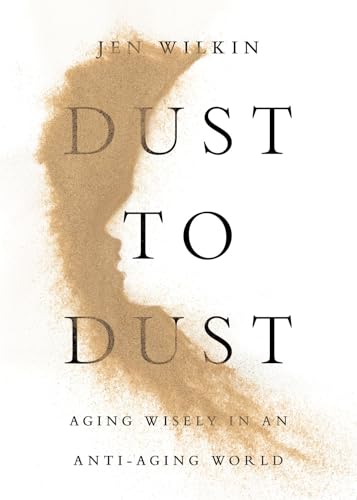
Dust to Dust: Aging Wisely in an Anti-Aging World

Dust to Dust

The world tells us older people are irrelevant and out-of-touch, and it’s best to avoid the appearance and effects of aging at all cost.

In Dust to Dust: Aging Wisely in an Anti-Aging World, Jen Wilkin says the Bible tells a different story. Except for the first few books of the Bible, where people lived hundreds of years, people had shorter life spans for much of history. Old age was seen as a gift that not many achieved. The elderly were to be treated with respect and valued for their life experience.

Even as Christians, we’re prone to view aging negatively. It’s hard not to mourn the loss of abilities and possibly influence and importance. But Jen encourages us to embrace greater dependence on the Lord and develop “eulogy virtues” rather than “resume virtues” in our last years.

Jen posits that in Eden, if Adam and Eve had not sinned, they would have continued to age without the negative effects we experience now (something I never considered before). They were told to tend the garden and have children, so it stands to reason that they, their children, and the plants would all have continued to age and develop.

But then sin and its curse entered the world. That doesn’t mean we need to look at the aging process as negative and all downhill. We can see it as a gift and view it as part of God’s purpose to prepare us to live with Him. “If you are in Christ, with an inheritance kept for you in the next life, thinking toward the day of your death can help you live each day with an eternal perspective” (p. 44).

Yet she admits aging is hard: “It’s time to state the issue squarely: Aging is an invitation into suffering and loss. Though we rightly wish to avoid them, suffering and loss are skilled teachers. . . What do they teach? Humility. Patience. Perspective. Holiness. The fruit of the Spirit” (p. 99).

One perspective is that of time and priorities. “The older we grow, the more we recognize the importance of allocating our precious time to the relationships that matter most. Shrinking possibilities bring expanding clarity. They enable us to become thoughtful curators instead of thoughtless consumers of the days on our calendar” (p. 104).

Jen frames her discussion in the form of a literary device used often in the Bible, a chiasm. She describes chasm as a “mirror-image parallelism, using repetition to trace an idea.” In Western thought, we look for the moral or the punch line or the main point at the ending of a discussion. But a chiasm puts the main point in the middle. The first and last points will be parallel, then the second and next-to-last, will be parallel, etc.

At first I thought the explanation of chiasms and trying to fit her points into this structure were going to detract from what she was trying to say. But they didn’t.

There are parallels between our first breath, birth and growth, and then our decline, last breath, and death.Then there are parallels between gaining strength as a child and losing it as an older adult; gaining abilities and possibilities of a young person, then losing them as an older person; caring for children as a young adult, and needing care as an older adult. The midpoint of the chiasm is middle age, which Jen describes as “the place of perspective.”

This book is not primarily comprised of tips for facing old age, though there are a few. And it’s not exclusively for older people. It’s mainly a biblical look at aging and how it differs from the world’s view. We need that biblical view not only for ourselves as we age, but also for how we think about loved ones who are aging.

I love the point she makes that though older people’s “physical needs may revert in many ways to those of a small child, the aged are not children. Their interior lives are shaped by years of experience and learning” (p. 66). When we were taking care of my husband’s mother, I always cringed when someone would say something about us becoming her parents and her becoming our child. No, she was still the parent, deserving of our honor and respect.

A few more quotes that stood out to me:

“I’m also paying attention to how I respond to minor adversity. Am I patient in small afflictions? If so, perhaps I will be better equipped for the bigger ones that come with age” (p. 109).

“The aging process shifts the focus of our joy to the things that matter most: becoming more Christlike and loving God and others with all we have. Yes, old age is not for the faint of heart, but it contains a richness the young don’t even know to hope for. The Lord takes away, but he also gives. We are only old once” (pp. 109-110).

“Godly wisdom views the elderly as people to love, not problems to solve. Worldly wisdom increasingly agrees that the elderly are problems before they are people” (p. 122).

“Middle age grants us a form of invisibility. And much good work can be done when we’re no longer concerned about others finding us attractive” (p. 151).

I only have two complaints about the book. I don’t know what the font size is, but it was a strain to read–which I thought was ironic since the topic was aging.

Secondly, she rightly lays out the biblical directions of families caring for their elderly and shares how that used to be the norm. Families used to live near each other instead of several states away. All that is true. But it is also hard. Since the extended family living near each other is not the usual scenario any more, that means the older ones are usually cared for by one couple: their middle-aged or older children and their spouses. Everyone I have ever talked to who cared for a parent found it difficult, even when the parent was easy to get along with. Add mental issues and combativeness, and the difficulties increase. Also, I’ve never talked to anyone who cared for elderly family members who didn’t wrestle with some degree of guilt. I wouldn’t say Jen was glib about the blessings of taking care of one’s older parents, but I wish she had dealt with the difficulties a little more and encouraged that God will give grace.

Since all of us are getting continually older, aging is a subject we should study to the glory of God rather than dreading it. I’m thankful for Jen’s help in this regard.

(I often link up with some of these bloggers.)

Ten Words to Live By

The Ten Words are the Hebrew designation for what we know as the Ten Commandments.

In Jen Wilkin’s book, Ten Words to Live By: Delighting in and Doing What God Commands, she cites a study showing that more Americans could name all the ingredients in a Big Mac than the Ten Commandments.

“When the Ten Commandments are not forgotten, they are often wrongly perceived. They suffer from a PR problem. They are seen by many as the obsolete utterances of a thunderous, grumpy God to a disobedient people, neither of whom seem relatable or likeable” (p. 12).

Even when people accept that these commandments come from a righteous God, they set them aside because they think they don’t apply since we’re under grace. “Thus, law and grace have come to be pitted against one another as enemies, when in fact, they are friends. The God of the Old Testament and the God of the New have been placed in opposition, when, in fact, they are one and the same” (p. 13). Christianity is based on relationship with God rather than rules, but “rather than threaten relationship, rules enable it” (p. 13). “Without rules, our hopes of healthy relationship vanish in short order. Jesus did not pit rules against relationship. It was he who said, ‘If you love me, you will keep my commandments” (John 14:15) (p. 14). We see this even in our earthly relationships: there are none without boundaries and preferences.

Though we rightly want to avoid legalism, the Bible also condemns the other extreme of lawlessness. “Legalism is external righteousness only, practiced to curry favor. Legalism is not love of the law, but its own form of lawlessness, twisting the law for its own ends” (p. 14).

By contrast, “Obedience to the law is the means of sanctification for the believer. . . . not out of dread to earn his favor, but out of delight because we already have it” (p. 15).

“The Ten Words show us how to live holy lives as citizens of heaven while we yet dwell on earth” (p. 17).

The Ten Words are an expression of love. When asked which commandment was the greatest, Jesus said, “ You shall love the Lord your God with all your heart, and with all your soul, and with all your mind, and with all your strength.’ The second is this, ‘You shall love your neighbor as yourself'” (Mark 12:30-31). A former pastor used to say that if our hearts were right, these two would be all we needed. But they’re not, so we need things spelled out for us. “For the commandments, “You shall not commit adultery, You shall not murder, You shall not steal, You shall not covet,” and any other commandment, are summed up in this word: “You shall love your neighbor as yourself.” Love does no wrong to a neighbor; therefore love is the fulfilling of the law” (Romans 13:9-10).

With these premises in place, Jen devotes a chapter to each of the ten commandments. She argues not for a letter-of-the-law merest obedience possible, but for an expansive obedience of the spirit of the law. She employs Jesus’s explanation that the law doesn’t cover just outward action, but our hearts.

Take, for instance, the sixth commandment: “Thou shalt not kill,” literally, “You shall not murder.” Most of us would say we’re safe from transgressing that one. But Jesus said, “You have heard that it was said to those of old, ‘You shall not murder; and whoever murders will be liable to judgment.’ But I say to you that everyone who is angry with his brother will be liable to judgment; whoever insults his brother will be liable to the council; and whoever says, ‘You fool!’ will be liable to the hell of fire” (Matthew 5:21-22).

Is Jesus adding to the law by broadening our attention from murder to anger and contempt? By no means. He is pointing out the seedling that grows into the thorny vine that chokes out life. He is appealing to us to fastidiously weed the garden of our personal holiness. He is teaching that if every person dealt with anger quickly and rightly, there would be no need for the sixth word at all (p. 94).

Jen also points out the progression of thought from anger to devaluing another.

First, I am angry with you in response to a hurt. Next, I begin to question your character with an insult. Then, I begin to question your worth as a person. As anger degrades into contempt, the personhood of another is devalued (p. 93).

But an expansive obedience “will not be content to simply be not-murderers, or not contemptuous, or not angry. We will not merely refrain from taking life—we will run toward giving it. Let us read in the sixth word’s prohibition of murder the exhortation to take every care to preserve life. Let us run to be life-protectors and esteem-givers and peacemakers” (p. 96).

Thus Jen couches each commandment in its initial setting, then examines how it applies today, then explores not just the letter, but the spirit of the law from the rest of the Bible.

I have markings on most of the pages, but here are just a few other quotes from the book:

Every transgression of one of the Ten Words begins by transgressing the first, to have no other gods before him (p. 34).

When we look to Christ, imitating him, we begin to see restored what sin has diminished. Bearing the image of God does not mean we look like him in physical terms but rather in spiritual terms—not so that others may worship us, but so that they may worship him (p. 42).

Our patterns of work and rest reveal what we believe to be true about God and ourselves. God alone requires no limits on his activity. To rest is to acknowledge that we humans are limited by design. We are created for rest just as surely as we are created for labor. An inability or unwillingness to cease from our labors is a confession of unbelief, an admission that we view ourselves as creator and sustainer of our own universes (pp. 64-65).

No one ever set out to sin against God or neighbor without first desiring something out of bounds (p. 140).

Our actions are the incarnation of our belief (p. 135).

My recent post A Better Blade for Killing Sin grew out of Jen’s comment on what Jesus said about cutting off whatever tempted us to sin. As Jesus always went to the heart,  not just the outward actions, so this admonition shows us something: even if we could cut off the lusting eye or the stealing hand, we’d still have a problem in our hearts.

We need a better blade than any formed by human hands, one aimed at ridding our hearts of disordered desires.

Praise God, we have one. The blade that slays the beast is the word of God, made living and active by the Spirit of God, dividing thoughts and intentions of the heart (Heb. 4:12). By the word of God we learn to delight our hearts in the Lord, and the outcome is that which the psalmist predicts: “Delight yourself in the LORD, and he will give you the desires of your heart” (Ps. 37:4) (p. 106).

That blade doesn’t just lop off offending members until there is nothing left. It transforms us as we delight in Him. “The antidote to the lust of the eyes is not self-inflicted blindness, but seeing as God sees (pp. 106-107).”

I wish I could share some of the core truths of each chapter, but that would make this post too long. Instead, I encourage you to read the book. It’s one that I probably need to revisit regularly. I was convicted in each chapter.

I’m counting this for the “Published in 2021” category of the Nonfiction Reading Challenge. 

(I often link up with some of these bloggers)


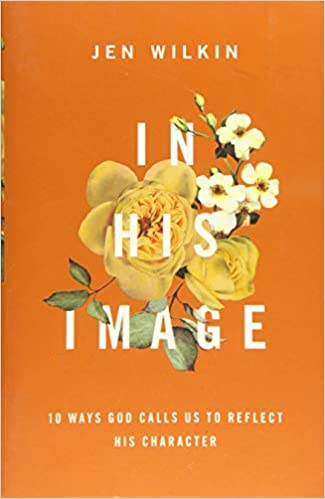
Book Review: In His Image

There are some ways in which we will never be like God. Jen Wilkin dealt with most of those in her excellent book None Like Him:10 Ways God is Different From Us (and Why That’s a Good Thing) (linked to my review).

But there are ways we are supposed to be like God. We will never become deity and we’ll never exercise these in perfection, at least until heaven. But we’re supposed to grow in them now. Jen discusses ten of these in In His Image: 10 Ways God Calls Us to Reflect His Character.: holiness, love, goodness, justice, mercy, graciousness, faithfulness, patience, truthfulness, and wisdom.

Jesus held all these traits in perfection. We’re called “to be conformed to [His] image” (Romans 8:29).

Our inclination is to discern God’s will by asking, “What should I do?” But God’s will concerns itself primarily with who we are and only secondarily with what we do. By changing the question and asking, “Who should I be?” we see that God’s will is not concealed in his Word, but is plainly revealed.

The Bible plainly answers the question “Who should I be?” with “Be like Jesus Christ, who perfectty images God in human form.” God’s will for our lives is that we conform to the image of Christ, whose incarnation shows us humanity perfectly conformed to the image of God (pp. 20-21).

In each chapter, Jen discusses what these traits look like in God, and then explains how we can best put them to practice in our own lives. The chapters end with verses and discussion questions.

I have multiple places marked in the book. But here are a few quotes that convicted me:

If we focus on our actions without addressing our hearts, we may end up merely as better behaved lovers of self.

As with the Ten Commandments, the Great Commandment begins with the vertical relationship and moves to horizontal relationships. Unless we love God with all of our heart, soul, mind, and strength, we will love ourselves and our neighbors inadequately. Right love of God is what enables right love of self and others (p. 38).

And what does right vertical relationship look like? It looks like the full deployment of our heart, soul, mind and strength—the totality of our being—in the active love of God (p. 39).

Right now, there is much that we witness or endure that is clearly not good. But under the sovereign governance of an eternally good God, we can trust that all that is not now good will ultimately be used for our good. Like Joseph we will one day, in this life or the next, look over our had pasts and acknowledge with him that what our enemies meant for evil God has used for good (Gen. 50:20) (p. 48).

Generosity is the hallmark of those who are determined to be lights in the darkness as children of their heavenly Father. It is the calling card of all who are recipients of the generous good news of salvation through Christ (p. 52).

We are familiar with the maxim that patience is a virtue, but it is a virtue rarely sought. The world’s solution to the problem of impatience is not to develop patience, but to eliminate as many situations that require it as possible (p. 110).

It is not coincidental that a lack of discernment and a neglected Bible are so often found in company (p. 144).

I wish there was a way to retain everything we read from books. Since there is not, I will have to revisit this and None Like Him again in the future. I appreciate Jen’s clear and skillful discussion of biblical concepts.

(Sharing with InstaEncouragement, Grace and Truth,
Carole’s Books You Loved, Booknificent Thursday)