
In our early married days, I worked in a fabric shop where we had a variety of customers of all ages. Among older ladies, there seemed to be two distinct types. One was very sweet, thankful for any little thing we did to assist them. The other was . . . not sweet.
I remember thinking, “I hope I am the nice kind of older lady when I get that age.”
At some point it dawned on me that if I wanted certain attributes when I got older, I needed to incorporate them while I was young.
“Old” always seems twenty to thirty years beyond my current age. But I am older, and I don’t know that I am yet the kind of older lady I want to be or should be. We’re all a work in progress, no matter how long we’ve lived.
But as I have been around the block a few times, I’ve seen some behaviors I want to avoid.
The “Know it All” Syndrome. When we’ve read the Bible and walked with the Lord for decades, hopefully we’ve acquired some wisdom along the way. But we misuse it if we try to answer most of the questions in Bible Study or Sunday School or feel we have to have the last word that sets everyone straight.
I’ve struggled with this recently. Bible teachers want participation. But I don’t want to monopolize the conversation. Yet I do want to share if I have something helpful to say. I’ve started praying before class that God would give me wisdom to know when to share and when to be silent.
The “We’ve Always Done It This Way” Syndrome. Every new generation brings with it new vocabulary, new technology, new methods. Older people can help younger ones discern between new methods and old truth and try to keep the latter from sliding into oblivion, but we shouldn’t insist that everything be done the way we always did it (or gripe when it isn’t).
The Busybody Syndrome. Busybodies can be any age. Paul is speaking of young widows when he speaks of “idlers, going about from house to house, and not only idlers, but also gossips and busybodies, saying what they should not” (1 Timothy 5:13). But older women can tend this way, too.
Many years ago, an older lady in our church at the time told one young mom of seven that she was having too many children too close together. She told another young married lady, who, with her husband, wanted to wait until he was out of school before starting a family, that she needed to get busy and start having children. You can imagine that both women were hurt and offended. I am sure that was not the older woman’s intent and that she thought she was helping others with the benefit of her accumulated wisdom. But she overstepped. Before sharing advice, we need to seek the Lord about whether it is really needed and how and when it should be shared.
Gossip Syndrome can also occur at any age or gender, but it’s something Paul specifically mentions in Titus 2 when speaking of the commendable kind of older woman. She’s not to be a “slanderer”–other translations say “gossiper” or “false accuser.” Slander can involve saying things that are untrue about someone else. Gossip can be untrue but seems to include spreading things around that may be true but aren’t anyone else’s business. The Bible has much to say about right and wrong uses of our words.
The Old Wives’ Tales Syndrome. The KJV and a few other Bible versions mention these in 1 Timothy 4:7: “But refuse profane and old wives’ fables, and exercise thyself rather unto godliness.” Other versions, like the ESV, leave out the “old wives” part and just say, “Have nothing to do with irreverent, silly myths. Rather train yourself for godliness.”
This overlaps gossip a bit, but “old wives’ tales” or fables often seem to involve health issues or warnings that aren’t based on fact. These days, they take the form of urban legends. When we were expecting our first child, someone told us not to get a cat because cats can suck a baby’s breath away. When my husband responded skeptically, the woman teared up because she was just trying to “help” us.
I see a version of this when people share dire warnings on FaceBook without fact-checking “just in case” it’s true. Some people do this so often, it’s like the old story of the “boy who cried wolf”: people don’t take the sharer seriously any more. Once again, we need to be careful of sharing falsehoods and unnecessarily scaring people. It’s usually easy these days to search online and find out the facts before we share.
The “Good Old Days” Syndrome. When we look back, our younger days can seem idyllic. We tend to forget or gloss over the negative aspects of certain eras. It’s not wrong to talk about some of the changes that have occurred over our lives or share history we’ve experienced. But we shouldn’t live in the past. We need to be alert for the good gifts God put in our present time as well.
The “I’ve Done My Time” Syndrome. I hear of women who are still teaching VBS or serving in the church kitchen well into their nineties. Good for them. 🙂 Many of us lose a certain amount of oomph over the years and can’t do all we used to. I wrote posts a few years ago on Why Older Women Don’t Serve and How Older Women Can Serve. We’re always in the Lord’s service as long as we live, but how we serve will probably change over the years. We shouldn’t have the mindset of checking out of active service. We might not be plugged into an official church ministry, but we can still minister to people by walking closely with God and being alert for opportunities to listen, giving a word of encouragement, praying, sending a note, etc.
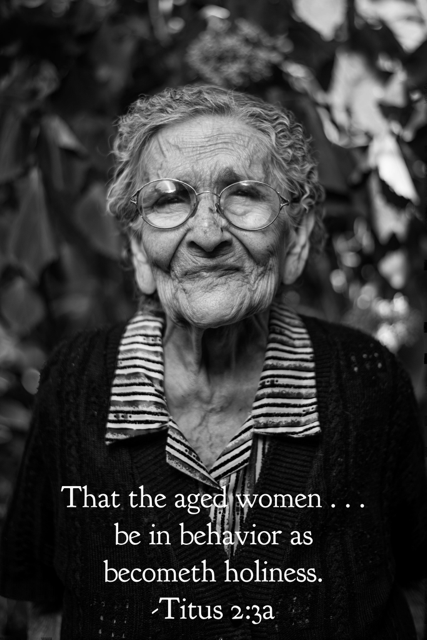
It’s good to not only look at what to avoid, but what to emulate. Godly older women are to be “reverent in behavior, not slanderers or slaves to much wine. They are to teach what is good” (Titus 2:3). They have “a reputation for good works: if she has brought up children, has shown hospitality, has washed the feet of the saints, has cared for the afflicted, and has devoted herself to every good work” (1 Timothy 5:10).
Thankfully, in every stage of life, God has placed godly women just ahead of me to observe and learn from.
Instead of gossip, slander, and fables, we share truth. Instead of showing off our accumulated knowledge, we humbly seek God’s timing to share His truth. We hold fast to truth but stay flexible about methods where we can. Instead of tearing down, we build up and encourage. Instead of being busybodies or folding inward towards self, we take kind interest in others and seek to serve however He opens doors.
May God give us grace to walk with Him and serve Him and others well at every stage of life.
Revised from the archives
(I often link up with some of these bloggers.)
 Stray Thoughts
Love this message! My Mama always said she wouldn’t be old until she reached her 100th birthday. She didn’t make it to 100 and she was always young at heart. I enjoy every season and age of my life. There is always something to learn. 🙂 Have a blessed Sunday!
I agree, there’s always something to learn and new ways in which to grow. I love your mom’s attitude!
Excellent article!
Thank you, friend.
This topic has been so much on my mind lately as I feel surrounded by older women — my mom, my mother-in-law, and a friend and former co-worker. The differences are really stark, as you allude to. Negative things I’ve noticed that I am going to consciously try to avoid are — STUBBORNNESS — one of these women refuses any suggestions for help, insisting her “grit” will get her through. NEGATIVITY — I hate to call this woman because the calls really get me down emotionally. I can feel negative at times, but when someone calls me I’ll try to at least act a little perky, for the caller’s sake if nothing else. CONTROL — attempting to control situations in others’ lives and stressing out when that doesn’t work as planned (I’ll admit that some of these things are not solely practiced by the old, but they do seem to happen with them more often than with younger people). Some of these tie in with some of yours, which are excellent. Also, having spent quite a bit of time in fabric stores, I can fully imagine several grumpy older ladies there 🙂 Thanks for a timely piece!
Thanks for these additions! Neither my mother nor my mother-in-law were controlling, but I’ve known people with moms like that. It’s especially difficult when the daughter marries but the mom doesn’t recognize the authority of the new husband in the daughter’s life.
Barbara, this is one of the best posts I’ve ever read on this subject. I think it hits closer to home for me now since I can truly be catagorized as an “older woman” . I appreciate your insight that how we will be as an older woman starts as the kind of woman we are currently. Thank you for the food for thought, my friend. xx
Thanks so much, Dianna. May God give us grace to be the kind of older women He wants us to be.
Dear Barbara, These are words fitly spoken. You are obviously working these things into your life. God is especially working on me for giving advice right now, and this is an additional encouragement. Grace and peace, Margie
>
It’s hard to know the right balance, isn’t it? God has taught us through His Word and work in our lives and wants us to share His wisdom. And we’re specifically told as older women to teach the younger in Titus 2. But it’s hard to know how and when to do that. The ones who spoke into my life most effectively did so not in classes or retreats, though those were valuable, but in everyday life. Some significant moments that helped shape my thinking as a woman were times with older women preparing a meal, working in the nursery, putting up a bulletin board. I don’t think any of them thought they were mentoring me in a formal way, but God used something each of them said, as well, as their lives and example, to instruct me.
This entire post is filled with wisdom. May the Lord help us to grow old gracefully.
Thank you, Joanne, and amen needing God’s help to grow old gracefully. .
Wonderful reminders and cautions! Thank you! ☺️
Thanks for stopping by!
Pingback: A La Carte (May 28) | BiblicalCounselor.com
this is so outstanding, wise, and true, Barbara! we can see the writing on the wall as we look deep in our hearts. thank you for this piece … I will be sharing.
Thank you, Linda. I’m preaching to myself here.
Wow, Barbara! This is an especially good post. I love, love, love this line: “At some point it dawned on me that if I wanted certain attributes when I got older, I needed to incorporate them while I was young.” Wise words and wonderful reminder today.
Thanks so much, Ashley.
I appreciate the cautionary words! And I fully realize that I’m prone to some of these behaviors so, for my family’s sake, I want to be mindful!
Me, too!
These are great words of wisdom to heed! A few of my grandmothers had a couple of these tendencies and I remember thinking that I hoped I wouldn’t be like that when I got older… and I’m trying to already practice holding my tongue and reminding myself that everyone does things differently and that differently doesn’t mean wrong.
Thanks so much, Joanne. It’s easy to slide into some of these.
Pingback: May Reflections | Stray Thoughts
This is so good, Barbara. I want to avoid those same things that you are watching out for. And like you, I am SO grateful for the older friends I’ve had over the years who have listened to me, laughed with me and led me by example in so many ways.
I don’t think I realized what a blessing they were at the time–at least, not as much as I do now.
Just today, my elder sister and I were lamenting about the younger generation no longer knowing cursive writing. So, reading your post (especially The Way We’ve Always Done It Syndrome) made me take pause, and wonder it what other areas am I acting out of “old age syndrome.” Lots of wonderful nuggets here to ponder on Brenda. I agree that God uses us no matter our age. After all, every season of life is a season that God created.
I loved these reminders to avoid ‘old age syndrome,’ but please, Lynn, don’t apply ‘the way we’ve always done it syndrome’ to cursive. We aren’t just old people clinging to the past when it comes to cursive. Neuroscience has proven the cognitive benefits of cursive, including it enhances brain development, helps with learning and retention, creativity, concentration, etc.
Pingback: Snippets from the interweb (2nd June 2024) – Building Jerusalem
I love this post, and I am an atheist. Like you, I want to be one of those kind old ladies that eschews all the bad behaviors that you’ve mentioned in this wonderful post. May we both succeed!
Thanks so much, Olivia!
I love this! Over the years, I’ve taken note of several traits of older women that I really admired and hoped to emulate in my life, as well as some more negative traits that I wanted to avoid. I see some of those on your list! Even though it doesn’t always seem possible that I could be counted as an “older” woman, I know I do fall into that category and need reminders to let the love, joy, and grace of the Lord shape my character at all times.
I know what you mean. I think of myself as “older” but not “old”–yet I am sure to younger people, I seem old. 🙂 I’ve thought of doing a positive version of this post–traits to look for and incorporate.
These “syndromes” are decidedly not reserved solely for little old ladies. A few of us “little old men” fall victim to these too. What an inspiring post, ma’am. Thank you! And I’m glad you’re most definitely the first kind.
Thanks so much for your kind words. I hope to be the nice kind of “older” lady, but I admit I have my cranky side as well.
Barbara, this is a fantastic article! I value and am encouraged by your wise words of wisdom.
Thank you so much for sharing this with Sweet Tea & Friend’s this month.