

Someone has said that if you don’t make a plan, all you have is a wish. When we want to establish spiritual disciplines or meet a need at church, we set up routines or programs.
But then sometimes those routines themselves can get in the way of meeting needs.
I see this on several levels:
We follow routine and forget purpose.
To try to be more self-disciplined, we establish habits to aid in godliness, like regular times of reading the Bible or prayer, church attendance, etc. And that’s a good thing. But we all know what it is to have days when we’re just going through the motions, when our eyes are dragging across the page. We check “Have devotions” off our list of things to do but haven’t really engaged with the text or been affected spiritually. Or we “feel spiritual” if we’ve crossed that duty off or don’t “feel spiritual” if we haven’t.
Sometimes we feel we can’t stop and ponder a passage of Scripture because we need to get through our planned reading for the day.
One book I read on Bible study strongly emphasized application. That’s good: Jesus said to be doers, not just hearers. This author recommended specific, measurable results. For instance, instead of saying “I need to pray more,” he advocated praying for a certain number of minutes, and then slowly increasing the time.
That may be a good beginning. But it seems to me that the more natural approach would be to list things to pray about–usually once we get started, the list increases. Another idea would be to study prayers of the Bible, like Colossians 1:9-14.
Likewise, if we read about loving our neighbor, we might take them a plate of cookies or shovel snow from their sidewalk and think, “There! I’ve loved my neighbor today.” But then we forget about the need to love our neighbor when he forgets to return a tool or plays loud music at midnight.
It’s not that measurable results are wrong, but they are only one aspect of applying Scripture. Sometimes measurable responses can lead to outward actions without accompanying inward change. Sometimes we need to carry the truth we learned, like loving our neighbor, with us all through the day and pray for grace to implement it when it’s difficult.
We seek formulas rather than truth.
We’ve all seen clickbait titles like How to Be a Better Wife in Three Easy Steps or Follow These Steps to Curb Your Temper. Many raised children according to the plan of the day and were surprised to find their children did not respond in the expected way.
I saw a post sharing a routine for visiting the sick. But every sick person might not have the same needs. And if they sense we’re just going through a script, they are not going to feel ministered to.
I’ve sometimes gotten good results (or so I thought) by praying a certain way in a particular situation, only to have that prayer not “work” the next time that situation arose. I finally learned God doesn’t work by formulas, because then we trust in formulas and not Him. He wants our hearts.
Our routine hinders our purpose.
One church we visited had a greeting time during the service. No one interacted with us or even looked at us until the greeting time. Then, while someone played the piano, everyone smiled, shook hands, and spoke to visitors. But as soon as the music stopped, it was like someone flipped a switch, and everyone closed up again.
Other examples: we feel like our obligation to witness is fulfilled when we go to our church’s visitation night. Or, because our church has official greeters at the door, we feel no one else needs to greet visitors. Or we don’t pick up trash on the floor because someone is paid to do that.
Once when we were visiting my husband’s parents, a couple of women from church came by to see my mother-in-law. They brought a plant and card and conversed for a few minutes. When my mother-in-law thanked them profusely, one of the women said, “Well, you were on our list today.” My mother-in-law never discussed the comment, but I felt it deflated any good feelings about the visit since it seemed to be only motivated by a list.
We try to force results.
Bible study leaders naturally want people to participate. But we had a pair of leaders who felt everyone had to say something every time. If you didn’t speak up, they were going to make you! So instead of interaction and conversation happening naturally, the quieter people felt nervous, on edge, or put on the spot.
Small group leaders want people to “go deep” in their conversations and relationships, so some have “turn to your neighbor and bare your heart on command” sessions instead of letting those opportunities arise in a more natural way.
Or would-be mentors feel they need to work through an artificial list of probing questions instead of developing a personal relationship with their mentee.
We don’t think we can change what we do.
For years, I followed the same Bible reading plan because it was what I was taught. It took years to realize that there are many ways to engage with the Bible, and changing things up helped me stay engaged and see new things in the Word.
For many years, churches in my area had Sunday evening services at 7 o’clock. Then one church changed their service time to 6. It was amazing how many conversations there were about whether that change was right or wise. Eventually, other churches did the same. These days, I am happy to see a variety of services in churches, like small groups in the afternoon or lunch together after the morning service and a short time together before everyone goes home. But forty years ago, those solutions would have been unheard of.
Some programs are useful for a while, but fizzle out after a time. It’s vain to keep them just because “that’s what we’ve always done.”
Routines have a purpose.
It’s true, sometimes we need systems and routines because we don’t always “feel like” doing what we need to. A former pastor once said that one of his best times of prayer occurred when he had to start by confessing to the Lord that he didn’t feel like praying. Sometimes just doing what we should whether we feel like it or not is the first step to feeling like it.
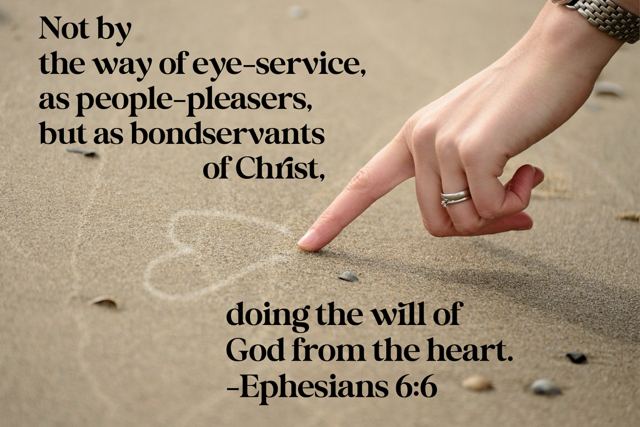
But we should seek God’s grace to serve not just out of duty, and not to check off all the designated boxes, but with a right heart. The mechanics of ministry and spiritual disciplines are tools, but not the main focus, not the end-all of our efforts.
Our ministry isn’t boxed into a particular time, place, or group of people. Our programs don’t take care of all of our obligations. There is a sense in which we should always be “on,” always ready to serve. Even if there are official greeters at church, we can greet people when we see them or help a confused visitor find the right class. Even if there is someone designated to send cards to sick Sunday School class members, we can send one, too. If God has placed on our hearts that we need to help someone else in the church, we need to pray about how to do that rather than just dismissing it because our church has a benevolence committee to take care of those things.
On the other hand, sometimes we can perfectly follow all of our routines, and our programs can seem to be going swimmingly, but we’re unaware that we’re missing something vital. The Pharisees were famous for this. All through the Bible, God reminds His people not to serve Him only with outward performance, but with their hearts.
A. W. Tozer said this in The Pursuit of God:
The simplicity which is in Christ is rarely found among us. In its stead are programs, methods, organizations and a world of nervous activities which occupy time and attention but can never satisfy the longing of the heart. The shallowness of our inner experience, the hollowness of our worship and that servile imitation of the world which marks our promotional methods all testify that we, in this day, know God only imperfectly, and the peace of God scarcely at all. If we would find God amid all the religious externals, we must first determine to find Him, and then proceed in the way of simplicity.
Routines, habits, and programs can be a great help. But they are an avenue of ministry, not an end in themselves. May God give us grace to keep our hearts engaged and our focus on others’ needs and His glory.
(Revised from the archives)
(I often link up with some of these bloggers.)
 Stray Thoughts
I like the list of things to pray about. I can see that being helpful. Have a great Sunday and week ahead.
Thanks so much–you, too!
Thank you for this powerful message. Have a blessed day! 🙂
Thank you, Melissa.
Your words remind me that being FLEXIBLE (my WOTY) is more important than sticking to a rigid routine. It would be heartbreaking to realize I missed out on a blessing from God because I didn’t follow His lead.
Flexibility is a great word and a needed concept.
Flexibility was what came to mind when I was reading this too. A former pastor used to say something like, “Blessed are the flexible, for they will bend and not break.” I like my routines but I appreciate this guidance to hold them loosely.
AMEN!!!
Your pastor’s saying is wise!
Barbara, this is a most interesting post to think on this afternoon. Routines can be a wonderful help but not if they should become rote. Another box to check off. Years ago I began praying for the Lord to breathe life into my morning devotions, for Him to open my eyes to see and ears to hear what I needed to learn and apply to my life. It truly has made such a difference. Blessings!
That’s a much needed prayer. I start my time in the Word most mornings asking God to open my eyes and help me get what He has for me.
Oh yeah, A. W. Tozer hits the nail on the head yet again. Here in the next century his words are as spot on as they were back in the day. May we be wary of any kind of shallowness or that hollowness that so easily creeps into our routines no matter where we are.
Thanks for the caution, Barbara.
I almost titled this “Form Over Function.” It’s too easy to get our practices in place and then focus on them and lose their meaning and purpose.
As always, I find such wisdom and practical help in your posts. At church we’re currently doing a preaching and devotional series that is encouraging us to identify what is distracting us from the Lord and how to deal with those distractions. I have an audio daily devotional that I listen to almost every day and it’s an excellent routine that has been so helpful to me . . . except that sometimes I get distracted and realize I’m only half-listening or my mind wanders to something unrelated during the meditation/reflection part of the devotional. And then the routine becomes the problem. Just like your first example, so that reinforced that I need to be faithful in focusing on my devotional and remembering its purpose is to help me connect with God to start my day.
Thank you! This is a good wake up! To be really listening to the Lord instead of just checking boxes. ♥️🙏🏻
We could all have a good long conversation with examples like the ones you’ve listed! Such good points. This is one reason I don’t like to “read through the Bible in a year” every year–the amount of reading needed quickly turns this into a checklist item (at least for me). I could relate too about the ladies visiting your in-laws because they were “on the list.” I have a Catholic friend who has talked to me about her conviction that she needs to do “good deeds” frequently. Every time she does something nice for me, I have to wonder if it’s on her checklist for the day, and that really takes the joy out of it 😦
Barbara, I’m not sure whether to say “Ouch!” or “Amen!” 🙂 Thank you for doing this post. I have to confess that I was raised on “routine” and that’s still how I function the best today. And that’s great for things like homemaking tasks, etc., but when it comes to our service and spiritual disciplines you are right. Being led by the Holy Spirit is the best way to go. It’s how our minds are renewed, and we are transformed to more of the image of Christ.
We were talking about idolatry in the book of Habakkuk yesterday in Sunday school, a not so subtle warning for present day believers, but it didn’t occur to me to mention our precious routines as one of our favorite idols.
I do like a routine but I typically use it more as a guide than anything rigid because I find that after awhile I get bored with routine. I don’t like to be just checking boxes in anything.
Pingback: January Reflections | Stray Thoughts
I love habits and systems and I struggle to break them when God calls for it. Great article. I’ve had to learn the hard way to be flexible with my plans.
Thank you for being part of our Grace & Truth Link-Up! Your words add so much value, and I’m thrilled to feature your post on my Pinterest board. See it here: https://www.pinterest.com/embracingtheune/grace-truth-christian-link-up-featured-posts/.
Thanks so much!