Are We Doing It for Him?

Are we doing it for God

The people wanted to know if they should keep fasting.

The children of Israel had been in exile in Babylon for seventy years. They had begun fasting in the fifth month of the year to commemorate the destruction of their temple.

But God had miraculously moved kings and events to send them back to their land. They started rebuilding the temple, but got distracted. Haggai and Zechariah encouraged them to put first things first and get the temple built.

So a group of men came to Zechariah to ask about those fasts. They were back in the land now and working on the temple. Did they need to keep fasting?

God replied with a question of His own: “Was it for me that you fasted? And when you eat and when you drink, do you not eat for yourselves and drink for yourselves?” (Zechariah 7:5-6).

As I understand, from what I have read, this was not a fast that was proclaimed by the law. It was something the Israelites started doing on their own. Had they started it for the wrong reasons? Were they feeling sorry for themselves and their plight rather than truly grieving over the sin that had caused them to be given over to their enemies?

Maybe, like the Pharisees in Jesus’ day, they fasted and prayed for show. Jesus warned, “Beware of practicing your righteousness before other people in order to be seen by them, for then you will have no reward from your Father who is in heaven” (Matthew 6:1-21).

Or perhaps they did start fasting for good and right reasons. But over seventy years, it’s easy to fall into routines and forget why and for whom we are doing them.

The following verses indicate that their ancestors had not obeyed the Lord He had told them:

‘Render true judgments, show kindness and mercy to one another, do not oppress the widow, the fatherless, the sojourner, or the poor, and let none of you devise evil against another in your heart.’ But they refused to pay attention and turned a stubborn shoulder and stopped their ears that they might not hear. They made their hearts diamond-hard lest they should hear the law and the words that the Lord of hosts had sent by his Spirit through the former prophets. (Zechariah 7:9-12).

All the religious rituals in the world will not make up for disobedience, hard-heartedness, and mistreatment of others.

The ESV Study Bible notes on this passage say, “If the people had learned the lesson that the destruction of the temple was intended to teach, and had truly repented and turned from their sins, then they could stop fasting. The temple was being rebuilt. But if they have simply been fasting for themselves all along, then their fasting was a waste of time (p. 1759).

It’s easy for us to fall into the same practices, isn’t it? Maybe we start spiritual routines like Bible reading, prayer, church attendance, and giving, with right hearts that want to grow closer to the Lord, glorify Him, and be used of Him. But in the day-to-day routines, we forget why we’re doing these things and for whom. They just become rituals without meaning.

Or we only do these things because we don’t want to appear unspiritual by not doing them.

Or we think that if we do these things, we’re okay with God, and it doesn’t matter what we do with the rest of our lives.

In Revelation 2, the Lord sent a message to the church at Ephesus. They had been doing well, patiently enduring, weeding out false prophets, and bearing up for His sake. But, He said, “I have this against you, that you have abandoned the love you had at first. Remember therefore from where you have fallen; repent” (Revelation 2:4-5). They were doing the right things, but they had forgotten their first love.

May we renew our love for Him by remembering His love for us, His character, His greatness, and all He has done for undeserving people like us. May we renew our focus to, “whether you eat or drink, or whatever you do, do all to the glory of God” (1 Corinthians 10:31).

1 Corinthians 10:31

(I often link up with some of these bloggers.)

When Habits Hinder Rather Than Help

When habits hinder

Someone has said that if you don’t make a plan, all you have is a wish. When we want to establish spiritual disciplines or meet a need at church, we set up routines or programs.

But then sometimes those routines themselves can get in the way of meeting needs.

I see this on several levels:

We follow routine and forget purpose.

To try to be more self-disciplined, we establish habits to aid in godliness, like regular times of reading the Bible or prayer, church attendance, etc. And that’s a good thing. But we all know what it is to have days when we’re just going through the motions, when our eyes are dragging across the page. We check “Have devotions” off our list of things to do but haven’t really engaged with the text or been affected spiritually. Or we “feel spiritual” if we’ve crossed that duty off or don’t “feel spiritual” if we haven’t.

Sometimes we feel we can’t stop and ponder a passage of Scripture because we need to get through our planned reading for the day.

One book I read on Bible study strongly emphasized application. That’s good: Jesus said to be doers, not just hearers. This author recommended specific, measurable results. For instance, instead of saying “I need to pray more,” he advocated praying for a certain number of minutes, and then slowly increasing the time.

That may be a good beginning. But it seems to me that the more natural approach would be to list things to pray about–usually once we get started, the list increases. Another idea would be to study prayers of the Bible, like Colossians 1:9-14.

Likewise, if we read about loving our neighbor, we might take them a plate of cookies or shovel snow from their sidewalk and think, “There! I’ve loved my neighbor today.” But then we forget about the need to love our neighbor when he forgets to return a tool or plays loud music at midnight.

It’s not that measurable results are wrong, but they are only one aspect of applying Scripture. Sometimes measurable responses can lead to outward actions without accompanying inward change. Sometimes we need to carry the truth we learned, like loving our neighbor, with us all through the day and pray for grace to implement it when it’s difficult.

We seek formulas rather than truth.

We’ve all seen clickbait titles like How to Be a Better Wife in Three Easy Steps or Follow These Steps to Curb Your Temper. Many raised children according to the plan of the day and were surprised to find their children did not respond in the expected way.

I saw a post sharing a routine for visiting the sick. But every sick person might not have the same needs. And if they sense we’re just going through a script, they are not going to feel ministered to.

I’ve sometimes gotten good results (or so I thought) by praying a certain way in a particular situation, only to have that prayer not “work” the next time that situation arose. I finally learned God doesn’t work by formulas, because then we trust in formulas and not Him. He wants our hearts.

Our routine hinders our purpose.

One church we visited had a greeting time during the service. No one interacted with us or even looked at us until the greeting time. Then, while someone played the piano, everyone smiled, shook hands, and spoke to visitors. But as soon as the music stopped, it was like someone flipped a switch, and everyone closed up again.

Other examples: we feel like our obligation to witness is fulfilled when we go to our church’s visitation night. Or, because our church has official greeters at the door, we feel no one else needs to greet visitors. Or we don’t pick up trash on the floor because someone is paid to do that.

Once when we were visiting my husband’s parents, a couple of women from church came by to see my mother-in-law. They brought a plant and card and conversed for a few minutes. When my mother-in-law thanked them profusely, one of the women said, “Well, you were on our list today.” My mother-in-law never discussed the comment, but I felt it deflated any good feelings about the visit since it seemed to be only motivated by a list.

We try to force results.

Bible study leaders naturally want people to participate. But we had a pair of leaders who felt everyone had to say something every time. If you didn’t speak up, they were going to make you! So instead of interaction and conversation happening naturally, the quieter people felt nervous, on edge, or put on the spot.

Small group leaders want people to “go deep” in their conversations and relationships, so some have “turn to your neighbor and bare your heart on command” sessions instead of letting those opportunities arise in a more natural way.

Or would-be mentors feel they need to work through an artificial list of probing questions instead of developing a personal relationship with their mentee.

We don’t think we can change what we do.

For years, I followed the same Bible reading plan because it was what I was taught. It took years to realize that there are many ways to engage with the Bible, and changing things up helped me stay engaged and see new things in the Word.

For many years, churches in my area had Sunday evening services at 7 o’clock. Then one church changed their service time to 6. It was amazing how many conversations there were about whether that change was right or wise. Eventually, other churches did the same. These days, I am happy to see a variety of services in churches, like small groups in the afternoon or lunch together after the morning service and a short time together before everyone goes home. But forty years ago, those solutions would have been unheard of.

Some programs are useful for a while, but fizzle out after a time. It’s vain to keep them just because “that’s what we’ve always done.”

Routines have a purpose.

It’s true, sometimes we need systems and routines because we don’t always “feel like” doing what we need to. A former pastor once said that one of his best times of prayer occurred when he had to start by confessing to the Lord that he didn’t feel like praying. Sometimes just doing what we should whether we feel like it or not is the first step to feeling like it.

But we should seek God’s grace to serve not just out of duty, and not to check off all the designated boxes, but with a right heart. The mechanics of ministry and spiritual disciplines are tools, but not the main focus, not the end-all of our efforts.

Our ministry isn’t boxed into a particular time, place, or group of people. Our programs don’t take care of all of our obligations. There is a sense in which we should always be “on,” always ready to serve. Even if there are official greeters at church, we can greet people when we see them or help a confused visitor find the right class. Even if there is someone designated to send cards to sick Sunday School class members, we can send one, too. If God has placed on our hearts that we need to help someone else in the church, we need to pray about how to do that rather than just dismissing it because our church has a benevolence committee to take care of those things.

On the other hand, sometimes we can perfectly follow all of our routines, and our programs can seem to be going swimmingly, but we’re unaware that we’re missing something vital. The Pharisees were famous for this. All through the Bible, God reminds His people not to serve Him only with outward performance, but with their hearts.

A. W. Tozer said this in The Pursuit of God:

The simplicity which is in Christ is rarely found among us. In its stead are programs, methods, organizations and a world of nervous activities which occupy time and attention but can never satisfy the longing of the heart. The shallowness of our inner experience, the hollowness of our worship and that servile imitation of the world which marks our promotional methods all testify that we, in this day, know God only imperfectly, and the peace of God scarcely at all. If we would find God amid all the religious externals, we must first determine to find Him, and then proceed in the way of simplicity.

Routines, habits, and programs can be a great help. But they are an avenue of ministry, not an end in themselves. May God give us grace to keep our hearts engaged and our focus on others’ needs and His glory.

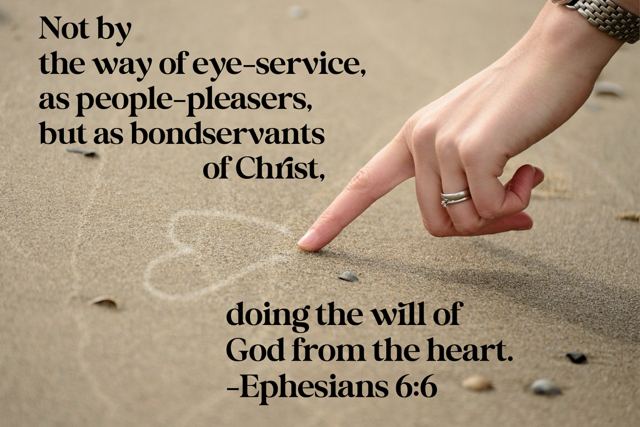
Ephesians 6:6

(Revised from the archives)

(I often link up with some of these bloggers.)

When Spiritual Routines Get Boring

I watched, amused, as my husband prepared to go to work. He checked to make sure he had his wallet, keys, backpack, and water, then he kissed me goodbye.

But then he remembered something else he needed, or something else he needed to do, before he left. He’d run through his checklist again—keys, wallet, backpack, water, wife—and remember something else he needed to get. He went through this process three times, ending each time with kissing me goodbye.

I suppose I could have gotten upset that he forgot he had already kissed me goodbye several times, that kissing me was part of the routine. Or I could have reveled in getting four kisses instead of one.

But I was amused because I have similar routines.

Some routines arise to help us remember what’s vital. When I get out of the car, I stop to check for my phone, purse, glasses and keys, saying each one aloud. This routine grew out of having locked one or more of these items in the car in the past (all of them one time when one of my then-young children closed the car door before I was ready).

I also have a checklist before I leave the house to make sure I have those same items and have turned off the oven and burners (because I have accidentally left one on for hours, though thankfully not while I was gone) and have locked all the doors (because I have come home to a forgotten unlocked door).

Routines also help us get into the right mindset. Michael Phelps had an elaborate routine before races to prepare both his mind and body. A basketball player preparing for a free throw will usually dribble the ball a few times before aiming for the hoop.

Routines also save us time and brain power by not having to think through everyday decisions. We follow more or less the same schedule with eating breakfast, brushing teeth, showering, dressing. Routines can help us avoid distractions and give more time to creative thought.

But operating on automatic pilot gets us into trouble. I don’t know how many times I’ve missed a turn while driving because I was following my usual path instead of remembering I was going somewhere different that day. Or I’ve gotten to the end of my shower and forgotten if I washed my hair.

When I read articles about establishing a regular quiet time of Bible reading and prayer, I find many authors encourage setting up a routine. If we plan a quiet time at the same time and place with the same tools every day, soon it becomes regular and we don’t have to stop and think about whether, when, or where we’re going to have devotions.

Well and good.

But I’m sure you’ve had the same experience I have of running through your quiet time as a routine and then forgetting what you read five minutes later. Or looking at the same prayer list with a bit of dismay at praying for the same things over again.

I like to start my prayer time with what we call “the Lord’s prayer” and expand from there. But when I look at those same words every morning, sometimes I am in danger of running through them thoughtlessly.

How can we help our spiritual practices not to become so routine that we move through them on autopilot?

Remember who we are interacting with. Warren Wiersbe said in With the Word “The end result of all Bible study is worship.” He meant Bible study isn’t an end in itself: it should lead us to worship of the God in its pages. But it helps to start Bible reading with worship as well, to rejoice in the fact that the God of the universe wants to talk with and hear from me. The Bible says His thoughts are precious to us, highly valuable (Psalm 119:72). Stopping to think about who He is and what a treasure His Word is helps get me in the right mind set. Sometimes I do that with thought and prayer, other times by reading or quietly singing a hymn or reading a psalm or two.

Pray. Sometimes I just stop in the middle of what I am doing and ask God to clear the cobwebs and wake me up spiritually. Sometimes I’ll read through parts of Psalm 119, which is mostly prayer, like verse 24″ “Your testimonies are my delight; they are my counselors,” or 25: “My soul clings to the dust; give me life according to your word!” Verses 36-37 are good, too: “Incline my heart to your testimonies, and not to selfish gain! Turn my eyes from looking at worthless things; and give me life in your ways.”

Change up the routine. It helps sometimes to change the order in which we do things or the translation or study method we’re using. Maybe go out on the patio or somewhere else in the house instead of our usual spot. I mentioned starting with the Lord’s prayer. But some years ago I made a list of other biblical prayers like Colossians 1:9-12 and Philippians 1:9-11, and I’ll use one of those instead.

Find study aids. If boredom comes from not understanding what we’re reading, a study Bible or simple commentary will help.

Examine our hearts. I think boredom in spiritual routines is often the result of familiarity or fatigue. But if we always feel bored when we read the Bible or pray, something deeper might be wrong. Maybe we’ve gotten our focus off the Lord or we’re harboring some sin. We need to ask Him to examine our hearts and show us anything that displeases Him. The Israelites were in worse trouble than they realized when they complained of weariness in the spiritual routines of their day.

Do it anyway. We shouldn’t let the feeling of boredom and routine stop us. Often, once we get going, we find something special in the day’s reading. One former pastor said one of his best times of prayer occurred when he started out confessing to the Lord that he didn’t feel like praying. Sometimes at the end of my quiet time, I’ve prayed, “God, you know I didn’t feel these things as fully as I have at other times. But you know I mean them.” Feelings help, but we do right whether feelings are there or not.

If over-familiarity with the Bible is a problem, these reasons to keep reading it might help.

God understands our human frailty. “For he knows our frame; he remembers that we are dust” (Psalm 103:14). He’s not looking for a stellar “performance” in our time with Him. He invites us to “with confidence draw near to the throne of grace, that we may receive mercy and find grace to help in time of need” (Hebrews 4:16).

Do you have any other tips for alleviating boredom when reading the Bible or praying?

(I often link up with some of these bloggers.)