
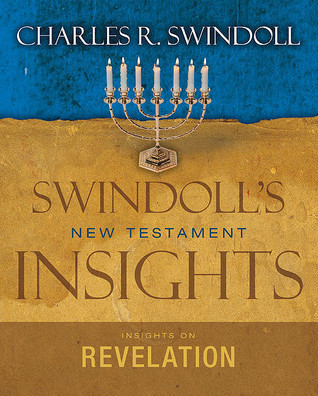
The book of Revelation can be daunting to read, with all its symbolism and strange experiences. I used Charles Swindoll’s Insights on Revelation as a companion this time through the book and found it quite helpful.
Swindoll says this book is a “mile-high” view of Revelation. He goes into more detail than a mere overview, but mainly hits the high points.
The Greek word for “Revelation” is apokalypsis, form which we get our word apocalypse. Today, apocalypse conveys the meaning of a massive, end-of-the-world-type battle. Though Revelation tells of the final, victorious battle between good and evil, the word actually means an unveiling. This is an unveiling of the future, but even more so, and unveiling of the true King.
Revelation was written by the apostle John, brother of James. He was an old man now, living in exile on the island of Patmos, when he was caught up to heaven and told to write what he saw.
First he is told to write seven letters to then-existing local churches. Swindoll calls these a type of performance review. Each church is told what they did right, what they’re doing wrong, and how God wants them to respond. The message to each church has much to say to us today as well.
Then John sees several visions of things to come, including the reign of the Antichrist during seven years of what we call the Tribulation, leading to the final judgments of mankind, the resurrection of all from the dead, and the crowning of Jesus Christ as the King of the universe, with all those who believed on Him through the ages coming to live with Him in His kingdom.
Revelation pronounces a blessing on those who read and obey it: “The one who reads this is blessed, and those who hear the words of this prophecy and keep what is written in it are blessed, because the time is near!” (Revelation 1:3, HCSB). The blessing is repeated near the end of the book: “And behold, I am coming soon. Blessed is the one who keeps the words of the prophecy of this book” (Revelation 22:7, ESV).
Swindoll emphasizes that we may not understand everything in the book–even John didn’t understand everything he wrote. But there is still much we can glean and be blessed by. He says careful observation of what the text says, paying attention to the context within Revelation, and bringing in what we know from other parts of the Bible help us understand it better. He says, “The book of Revelation wasn’t written to confuse, frighten, or entertain. Rather, it was given to believers to read, understand, and apply.”
There are groups of people with very strong opinions on some questions in Revelation: whether there will be a “Rapture” of the church, a catching away of Christians; when that will occur (before, in the middle of, or after the tribulation–seven years of trouble); whether there will be a literal millennium–a thousand year reign of Christ on Earth; or whether everything in the book is symbolic. I felt, even before this book, that these things are not worth arguing over or breaking fellowship over.
In fact, the study of Revelation can often devolve into trying to prove one’s version of these things. But a focus on these things can obscure or even miss the point. “The purpose of Revelation is to change us, not simply to inform us.” The book of Revelation gives us hope for the future, inspires us to live holy lives in light of what’s coming, and “moves us to worship God, who will ultimately triumph over evil.”
After each section, Swindoll share practical applications we can draw from the text for our lives here and now.
Some of the judgments God pours out on the unbelieving and rebellious in the end times are some of the most awful things we’ll read in the Bible. But the good news is, God has made a way to escape those judgments by believing on Jesus Christ as Lord and Savior now. The last chapter of the book contains an invitation: “The Spirit and the Bride say, ‘Come.’ And let the one who hears say, ‘Come.’ And let the one who is thirsty come; let the one who desires take the water of life without price” (Revelation 22:17).


This is interesting because I just finished Jen Wilkin’s Revelation book/study. I feel like the more I read about Revelation the more confused I become. How much is literally going to happen? What is symbolic? Or has all this happened already? It doesn’t help that very intelligent people over the centuries have disagreed about all this too. But I do find it interesting to read different “takes” and I just pray that God will reveal to me what he wants me to take from all this. Good review!
It helps me to keep the key things in mind that are true no matter what we believe about the controversial parts of the book. Revelation contains both a warning and an invitation to unbelievers. And believers are given hope that someday all wrong will be set right and there will be no more sin, death, or pain. And we’ll be in heaven with the Lord!
Peter says that knowing the things of this earth will one day be burned up ought to inspire us to live “lives of holiness and godliness” (2 Peter 3:10-13).
Plus, seeing Jesus crowned King of kings and Lord of lords in Revelation reminds me that’s the point of our lives here. I can get so caught up in the everyday cares and concerns of life that I forget the big picture.
Thank you for sharing your candid thoughts Ms. Barbara. Yes, The Revelation of Jesus Christ can be daunting to read and understand. Appreciate your and Pastor Swindoll’s insights.
I love Swindoll! We’re currrently using his material for our adult SS class. I just finished Jen Wilkin’s study on Revelation, and I am tempted to go back and relisten to all the videos. SO MUCH TO ABSORB! TT
[image: –Join me at Living Our Days]
Join me at Living Our Days https://michelemorin.net “The way we live our days is, of course, the way we live our lives.” (Annie Dillard)https://linktr.ee/MicheleDMorin
Such a good review, Barbara. I agree with you that there are things that are not worth arguing about or breaking fellowship with someone over because their ideas may be different than our own. The book of Revelation is a revealing of Christ and brings comfort to those who are His disciples.
I’m so glad that some have studied and taken on the task of explaining the book of Revelation. So much symbolism there. I can’t imagine what was going through John’s mind when he saw those visions. I think that this book would be helpful for anyone trying to understand that book of the Bible.
What a timely review, Barbara! Roomie and I have spent a good bit of time this summer over our own observation of the text and connecting the symbolism in Revelation with other Old Testament prophetic texts.
Pingback: August Reflections | Stray Thoughts