
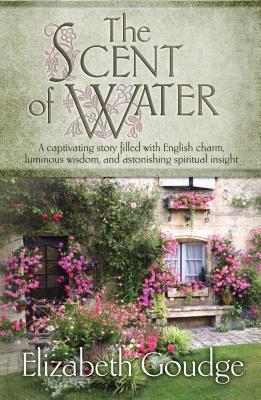
The Scent of Water by Elizabeth Goudge takes its title from Job 14:7-9, KJV: “For there is hope of a tree, if it be cut down, that it will sprout again, and that the tender branch thereof will not cease. Though the root thereof wax old in the earth, and the stock thereof die in the ground; Yet through the scent of water it will bud, and bring forth boughs like a plant.”
The novel shares the story of several people in a small English village in the late 1950s, but especially Mary Lindsay. She’s a woman in her fifties in London who began as a teacher, then went into government services, then became something like an administrator for a ministry. She receives word that an aunt for whom she was named has died and left Mary her house in the country and a small legacy. At first Mary plans to go down to Appleshaw, get the house in order, and sell it.
But then she remembers visiting Aunt Mary when she was about eight. Aunt Mary had showed her a collection of “little things,” miniatures, that young Mary had been enchanted with. Aunt Mary had offered to give them to her, but in the busyness of a London home with other siblings, she was afraid they’d get lost or broken.
Mary wonders now whether the “little things” are still there. She uncharacteristically decides to quit her job in London and take possession of Aunt Mary’s home in the countryside.
As Mary starts to get the house in shape, she meets other villagers. There are children next door who regard her garden as theirs and are quite hostile, until Mary makes friends with them. There’s a blind veteran, Paul Randall, with his discontent, grumbly wife. There’s the vicar with his anxious, easily frightened sister. And a dear older, feeble couple with a wayward son.
Part of Mary’s reasons for coming to the quiet of the country is to process her feelings for her aunt and her fiance, who had been killed at war a week before the wedding. She felt like perhaps she hadn’t really loved him as she should have since she didn’t grieve as deeply as she had seen others do. And she wanted to get to know her mysterious Aunt Mary, whom she had only seen that one time as a child. Fortunately, she finds Aunt Mary’s diary.
“The scent of water” is mentioned many times through the book as different characters experience renewal and new life in various ways.
Some of the quotes that stood out to me:
I had not known before that love is obedience. You want to love, and you can’t, and you hate yourself because you can’t, and all the time love is not some marvelous thing that you feel but some hard thing that you do. And this in a way is easier because with God’s help you can command your will when you can’t command your feelings. With us, feelings seem to be important, but He doesn’t appear to agree with us.
Suffering had had an effect with which she was familiar. The refusal of self-pity and despair had turned it from lead to fire, burning up the subterfuges and dishonesties below the surface of the inherited veneer of manners and thought that most men and women think are their true selves, and the veneer with them.
Mary sat up late that night with the diary. She had been reading it slowly and steadily, passing with Cousin Mary through the first few years at Appleshaw, years of alternate illness and respite, so much at one with her cousin that she seemed to be learning with her how to accept the first with hope and the second with wonder and gratitude. Cousin Mary hoped her journey through periods of dark and light was like that of a Swiss train toiling up the mountainside, in and out of tunnels but always a little farther up the hill at each emergence. But she could only hope that this was so. She did not feel it.
No desert is so dusty as not to have an oasis here and there.
I liked this quote about a writer who gave Mary some of his work to critique.
He had found in her what he had never had, a sympathetic but intelligent critic. She could wield the pruning knife mercilessly yet at the same time she watered the roots.
I think most writers would appreciate that kind of feedback.
However, there were a couple of things that puzzled me. One was that Mary finds herself falling for a married man. She never acts on her feelings or lets anyone know. He’s a writer and finds in her a meeting of the minds unlike what he has with anyone else. But that being understood and appreciated seems to make him more determined to make his relationship with his discontent wife right.
Another was this exchange with a child who had taken a couple of the “little things” from Mary’s house:
“Then you don’t think I’m awfully wicked?” whispered Edith. “You don’t think I’ll go to hell?”
Mary laughed. “No, I don’t. It’s like this, Edith. Why you do a thing is more important than what you do. And so stealing because you love is really better than not stealing because you don’t. Not that I am advocating stealing exactly. This question of good and evil is very complicated. Life has been very difficult for us all since Eve ate the apple.”
Mary was not a believer at this point, so she can be forgiven for not having her theology quite right. But it seemed an odd thing for the author to include.
I was surprised to see a handful of “damns” in the book.
In an earlier book I read by this author, The Dean’s Watch, it seemed to take her a long time to actually get into the story. In this book, she seemed to jump right in, so that was helpful. Still, it’s kind of a slow-moving, character-driven rather than action-packed novel. But I liked the theme of renewal and how it worked out in the lives of its characters.


The first time I read The Scent of Water, I was struck by the three phrases that marked Mary’s journey into belief in Christ. Elizabeth Goudge is one of my favorite British authors.
I’m kind of just discovering her this year. I liked those three phrases, too.
I’m glad you introduced me to Elizabeth Goudge since I’m now enjoying “The Dean’s Watch” after reading your review. This sounds good too. She has such nice passages to quote (like the ones you highlight here). I too am surprised by some of the things you mentioned in this one. I did notice this morning while reading “Dean” that the part I read had a huge emphasis on love. Not wrong, but perhaps not giving the whole story in isolation??
She’s good at working a theme throughout her books. Love did seem to be the major theme in The Dean’s Watch. Renewal seemed to be the theme in this one.
I’ve heard a lot lately about Elizabeth Goudge. I need to find one of her books to read. Thanks for the review.
Pingback: September Reflections | Stray Thoughts
Thanks for sharing your review with the Historical Fiction Reading Challenge
Pingback: Why Do Christians Dread Death? | Stray Thoughts