
I had not intended to go on an Elizabeth Goudge rabbit trail. But someone recommended her novel, The Dean’s Watch, to me. I enjoyed that and went on to read The Scent of Water, then the first of the Elliot family trilogy, The Bird in the Tree.
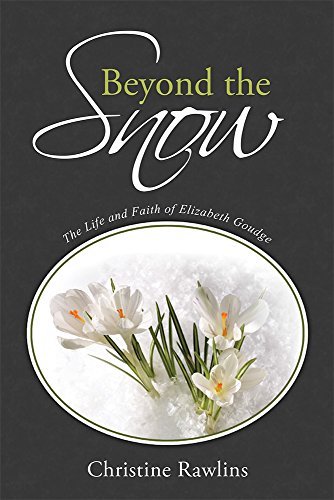
Though Elizabeth’s writings are definitely from a Christian worldview, there were some odd things in her writing I couldn’t quite place. I wanted to learn more about her and where she was coming from. Somehow I came across Beyond the Snow: The Life and Faith of Elizabeth Goudge by Christine Rawlins.
Rawlins’ title is a play on Elizabeth’s autobiography, The Joy of the Snow, which primarily is about happy times even though she experienced “loneliness, war, childlessness, mental illness, and breakdown.” Elizabeth considered herself “fortunate” and even “spoilt,” and a “determined optimism and thankfulness was a part of her Christian faith,” so she downplayed her troubles in life. But she did not downplay dark times in her novels. She felt “a vital part of the soul’s journey as she saw it was to counter the adversary by focusing on the light above.”
For whatever her life contained, whatever she had to cope with or to live without, she strove to find light in the darkness, and to create comfort and hope for others from her own despair: sharing her winter experiences with her readers, but always taking them beyond the snow, into a place of potential joy (p. 14).
For some reason, any biographical information I have found about Elizabeth begins with the houses and cities she lived in. That’s a bit frustrating when I want to know about her, not where she lived. Yet many of her books are set in the places where she used to live, and even the houses in some of her books are based on houses she lived in.
Elizabeth was born in 1900 in England. She was the daughter of an Anglican theologian who mainly taught. Her mother was injured in a bicycle accident while pregnant with Elizabeth and was something of an invalid most of her adult life. Elizabeth suffered a nervous breakdown after trying to fulfill the social obligations of her father’s position as well as take care of her mother. When her father died, she and her mother moved to a small home.
She had gone to an art college, which she enjoyed, but didn’t learn any means to support herself. She had developed a bad stutter as a girl, which she later outgrew; but it prevented her from teaching or nursing. Plus she wasn’t physically strong enough for nursing.
She wrote some plays which were performed, but a publisher she submitted them to told her to go write a novel. Her first book was not a success, but subsequent ones were. She eventually wrote eighteen novels, eight children’s books, four nonfiction books, and several magazine articles, as well as contributing to a number of anthologies. Her children’s book, The Little White Horse, earned her the Carnegie medal, and Green Dolphin Country was made into a movie titled Green Dolphin Street.
Many of her books have themes of suffering, sacrifice, and love, in the sense that love isn’t just a feeling but is often costly.
From the first, Elizabeth’s novels were always a rather curious mixture-of everyday modern life; happy endings; characters wrestling with problems; a strong sense of place; and often, a thread of history impacting on succeeding generations. Add to these, an awareness of other worlds; a dash of myth, magic and fairytale; and increasingly, a powerful thread of her Christian faith holding the whole thing together (p. 252).
She uses a lot of symbolism in her books as well. By modern standards of more subtle symbolism, she can sometimes seem a little heavy-handed with it.
She had some odd ideas about God as she grew up. Thankfully, she was able to discuss them with her father, who set her thinking back on the right course. But at some point she became enamored of Christian mysticism. I’m finding that’s a bigger subject than I’ve had time to look at in much depth, but it seems to have an emphasis on experiencing God rather than dogma and rules, and viewing Scripture symbolically. While we do need to go beyond dogma to know God personally, and while some Scripture is symbolic, I think this emphasis on the experiential can lend itself to not being theologically precise, which I think accounts for some of the oddness in Elizabeth’s work.
She was also “interested in ESP and saw this as one of the many ways of God revealing himself” (p. 636). I can’t recall this coming out in the few books of her that I have read.
Rawlins doesn’t say how she became interested in Elizabeth’s work, but she’s extremely knowledgeable about it. She kind of synthesizes Elizabeth’s writing, sharing something about one of her houses from her autobiography and then the fictional account of the house in one of her novels, and then doing the same with themes, her often-used symbols, etc. Though I found some of this interesting when I was familiar with the books she mentioned, the stringing together of long quotes grew a little tedious at times. The paper copy of the book runs over 700 pages.
Rawlins also includes a lot of references to “thinkers” of Elizabeth’s day–perhaps to justify her thoughts, or couch them within the times. But I could have done without so much of that.
Though I would have preferred a more condensed version of Goudge’s life that was better put-together, I did learn more about her and her thinking. I wouldn’t take my theology from her writing. But I think she can be read with discernment with overarching Christian themes in view while setting aside the more mystical qualities.

