
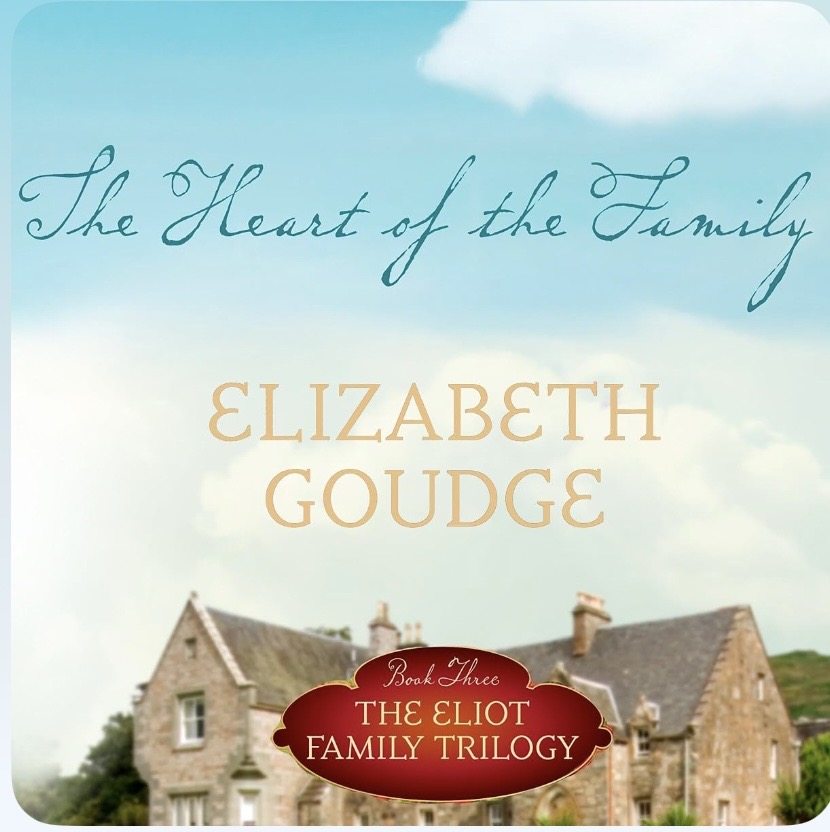
The Heart of the Family is the final book in the fictional Elliot family trilogy by Elizabeth Goudge. The setting jumps ahead in time several years from the last book, The Pilgrim’s Inn. Family matriarch Lucilla Elliot is in her nineties and slowing down. Grandson David has married Sally and has two children with one on the way in the years after WWII.
David is a well-known actor and has just finished a tour of America. His secretary decides to stay on in the US. Another man, Sebastian Weber, is recommended to David by a mutual friend.
Sebastian is Austrian, lost his family in the war, and spent time in a concentration camp. Though he accepts a job with David and travels to England to work for him, in his heart of hearts, he hates him. He saw David in a performance of King Lear that he described as a cathartic experience. He likes David, the actor. But he dislikes David, the man. He feels David has everything he does not: looks, talent, wealth, a loving wife and family.
David, for his part, doesn’t like himself very much, either. He is filled with self-loathing over a couple of issues: his part in bombing raids during the war, and his almost succumbing to temptation while in America.
Back in England at the family home, Damrosehay, Sebastian sees different and surprising sides of David. He’s charmed by David’s wife and daughter. And the rest of the family takes him in as one of themselves as well. He and Lucilla connect in ways helpful to them both, though Lucilla is surprised to find Sebastian is the age of her grandsons. He seems much older.
The overarching main story of the book centers on these two men, getting to the bottom of their issues and their relationship with each other. But there are other plot threads as well: David’s nephew, Ben, loves a girl and wants a profession that his parents don’t approve of; Sally has had hard labor with her first two pregnancies and wrestles with fear over her upcoming delivery; the grandchildren and great-grandchildren are in various stages of growing up; Lucilla knows her life is winding down.
There’s a lot of repetition about the houses, family history, and towns from the previous books. This book was published in 1953, five years after The Pilgrim’s Inn and thirteen years after the first book in the series, The Bird in the Tree. Maybe Goudge thought people would forget some details in-between?
This book, like the others of Goudge that I have read, is character-driven rather than plot-driven. In fact, there’s not much action at all. A lot of the book shares what’s going on in people’s heads or conversations about what’s going on in their heads. Much of it was interesting, but would have been better if condensed.
Also, like the other books, there are clear Christian truths and themes, such as this: “Pain and death are owed for sin. Christ paid the debt, and He is the debt, for it was His own life that He put down in payment” (p. 107, Kindle version). But there are oddities as well. Lucilla feels that, in her old age, she has a certain amount of clairvoyance into what others are thinking. Plus she feels her favorite son, Maurice, David’s father, who died in WWI, is somehow with or near her, “almost . . . as though his adult soul was carrying her childish one to a new birth, as once through nine long months her body had carried his” (p. 21). One late night she feels she sees her sons on her crucifix, “with no shock or horror, but a profound and grave satisfaction. For the salvation of the world. And she was the mother of such sons. It was a matter of immense yet humble pride to her, as it must be to Mary, whose prayer also was lifted above time. . . All mothers were one mother in the motherhood of Mary” (p. 283). Whatever that means. Then there’s this misrepresentation: “Men always thought that women forgot about the pain of childbirth. Even Christ had thought that they did. And no woman ever undeceived them” (p. 216)–as if Christ were mistaken in what He thought or said. All three books talk about children who play in the old garden that apparently some people can see and some can’t.
I enjoyed the storylines, but some of these odd, “mystical” things keep me from fully loving Goudge’s writing.
Some of the other quotes that stood out to me:
“Most extraordinary!” . . . Doubtless it was the favorite exclamation of many old people, for the state was full of surprises, not the least of them being that one’s body could be so incredibly antique while deep inside one felt so young (p. 18).
She believed that the very old and the very young are less fond of caresses than their admirers imagine (p. 26).
Nowadays she took nothing for granted. Her slow relinquishment of earthly life had taught her that nothing was truly hers but the love of God (p. 28).
She loved beauty and she was creative, but her creativeness found its joy in the shaping of everyday life to a form of comeliness, so that it became not just something that one put up with, but something that was enjoyable and lovely in itself (p. 119).
It was always better for the frustrated to be slow in the uptake, Lucilla thought. A certain amount of stupidity was nicely insulating (p. 121).
One thinks, I was so sure of my own decency, yet I could do this thing. I thought myself so safely grounded in fidelity, or whatever the particular virtue may be upon which one prides oneself, that no temptation could shake me, yet I went down like a rootless tree. The shock shatters one’s self-complacency, and that, I suppose, gives the light its chance (p. 129).
It had pleased her to walk through her days for a long time with serene melancholy, wearing her martyr’s crown of lilies and roses with an exquisite sad grace that suited her dark pale beauty to perfection, or she would not have worn it so. It had in truth been a martyr’s crown for a little while, for it had been a real death that she had died, but she had admired herself for her self-denial, and had not removed the crown when it had become entirely outmoded (p. 133).
God help me, he thought, to what thoughts am I giving free passage in this place of refreshment? (p. 167).
You can’t make sense unless you have [sense] (p. 202).
Half-knowledge is the breeding ground for error (p. 270).
I listened to the audiobook, which was mostly read nicely, but with some of the same caveats I mentioned last time. I also checked out the Kindle version from Libby to read some passages in more depth.
With this book, I think I am done with Goudge for a while. (Incidentally, I’ve always thought of her last name as we say “gouge.” But the audiobook narrator pronounces it like “goo-jaw.”) It was an interesting experience to read several books by one author as well as her biography over a few months. I hadn’t intended to immerse myself in her writings, but it was a good way to get to know an unfamiliar author.

