Theo of Golden

Theo of Golden

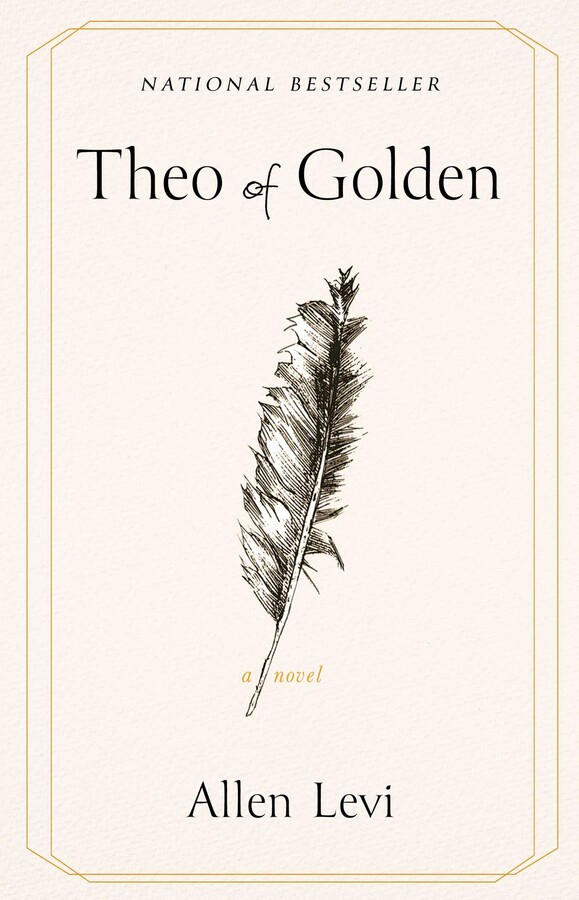
In Allen Levi’s debut novel, Theo of Golden, Theo is a man in his 80s, originally from Portugal, who comes to visit to the small town of Golden, Georgia. He only gives his name as Theo, saying his last name is difficult to pronounce. When asked what brings him to town, he vaguely says he has some properties to attend to.

He enters a local coffee shop one day to find its walls lined with nicely-drawn portraits. When he asks about them, he learns they were made by a local artist and the subjects were all local people. Theo studies them intently. Then he decided to buy them, one at a time, and give them to the subjects in them. He gets a little help finding the right names and addresses and writes an elegant letter asking the subject to meet him at a public place, the town fountain. There he gives them the portrait of themselves, asks for their story, and tells what he sees in their portrait.

Theo is warned that some people might react negatively to such a request for a meeting with a stranger. But for the most part, the meetings go well and the recipients feel honored–not just to receive a portrait of themselves, but to hear Theo’s assessment. Most approach the meetings with curiosity, some with skepticism.

Along the way, we learn bits and pieces of Theo’s backstory. He’s cultured, well-traveled, and apparently has a seemingly endless supply of money. He has known tragedy that still haunts him.

We also learn about the townspeople. Though Golden, Georgia is very different from Jan Karon’s Mitford, NC, I get the same kind of feeling from them. There are some good-hearted, salt-of-the-earth types as well as quirky characters and a few villains.

Some of my favorite quotes:

How is it, Theo wondered, that a piece of paper – a letter, a photo, a ticket stub, a sketch, a painting – is suddenly transformed by placing it in four bits of wood beneath a pane of glass? What does it mean that we place permanent boundaries around transient moments? What does it say of humankind that we take such trouble to freeze specific memories, that we devote such energy to capturing and preserving the “minute particulars” of our lives?

It’s hard enough to define what art is, much less ‘good art.’ I wonder if there is such a thing. Maybe there are just good responses. But I guess if a work of art makes us see something familiar in a new way or makes us feel something we ought to have felt all along or shows us our place in the world more clearly, maybe then it qualifies as ‘good.’ If it makes us better somehow, maybe that’s what gives it value.

It was better to see one thing well than many poorly.

Music was a microcosm. It was portraiture in sound.

It is another of life’s great mysteries that sadness and joy can coexist.

Beauty, throughout my life, has always seemed to hint at something more.

When I first heard of Theo of Golden, I didn’t think the premise sounded very interesting. But I saw so many people just raving about this book, I decided to look into it. As I read, I thought it was . . . nice. At first I was afraid it was an “angel in disguise” story, but I was glad to see Theo was very human. He was a good example of putting interest in others before himself, showing kindness and generosity, seeing below the surface. Yet, I still didn’t quite see what all the fuss was about.

Then a little past the 80% mark, there was a gut-punch of a plot twist. As we learn who Theo really is in later pages, that changes everything about some of the relationships in the story.

Sometimes after I finish a book, I’ll look back at the first pages in light of what I know from the ending. I was astonished to find all sorts of little clues about what would come later. Some scenes were so much more poignant now. I decided to get the audiobook and listen through the whole book. I am so glad I did. It’s nicely read by David Morse. One thing I like about audiobooks is that I don’t usually think in the accents of the characters as I read, but hearing them greatly enhances the story.

One remarkable thing about this book is that the author did not write it with publication in mind. He’s had a checkered career as a lawyer, judge, musician, and songwriter. He wanted to challenge himself to see if he could write a complete novel. When he showed it to a few friends, they urged him to publish it.

Since he was almost 70, he didn’t want to go through the two-year process of traditional publishing. He asked his niece to look into self-publishing and handle that aspect of it. And that led to another remarkable happening: the book became a bestseller, largely by word of mouth. (A good article about its publishing journey is here, but it’s behind a paywall). Later, it was acquired by Simon and Schuster.

Some articles and interviews with Levi about the book:

The author did not want to publish the book as Christian fiction, but his faith informs his writing. There are some concise but clear references to the gospel and allusions to Bible passages. One of my favorite scenes is when a homeless woman with some possible mental issues tried to bring her bicycle into an upscale church. Some in the congregation called 911. Others were “curious and even amused that an actual sinner had entered the elegant premises of James, the saint. The biblically literate among them might have expected a finger to start writing on the wall.” The church’s name was St. James–interesting since the book of James has verses about not showing favoritism to the rich. After Theo and an older woman diffuse the situation, “One could almost hear the sound of stones dropping to the ground.”

There’s a theme of gold running through the book. Not only is the town named golden, but gold is pointed out in sign lettering, people’s clothes, a chalice, a river, jewelry, even leaves. It shows up so often that I am sure it’s meant to symbolize something, but I don’t know what. Maybe the image of God in flawed people, maybe looking for the good in them and in circumstances.

There’s also a theme of gifts. Theo tells people their portraits are a gift for which they don’t don’t have to do anything–a picture of grace. But gifts of various types, including kindness, are mentioned throughout the book.

There are a few language issues in the book, mostly from one or two characters. There are also some information dumps, a lot of unnecessary detail on certain points.

But overall, though the book was a slow burn at first, ultimately I ended up loving it.

(Sharing with Between the Bookends)

Review: The Tiny Crown

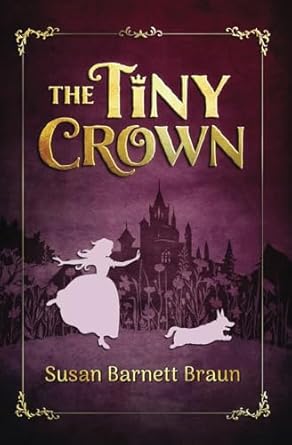
The Tiny Crown by Susan Barnett Braun

In The Tiny Crown by Susan Barnett Braun, Lucinda is a sixteen-year-old high school student who is discontent with her mundane life. One teacher seems out to get her. She wants the cute guy to ask her to the homecoming dance, but she’s afraid the nerdy guy will ask first.

Lucinda loves England and dreams of traveling to “the land of hope and glory” one day. She’s obsessed with royals. What could be more fun than being a princess or having a handsome prince fall in love with you?

She knows her family could never afford to go to England. But, to her surprise, one morning her mother announces that she got bargain tickets for them to do just that!

Lucinda enjoys sight-seeing with her family. When visiting Buckingham palace, she spies a corgi and runs after it–only to find herself passing through the wall into another realm.

While Lucinda finally gets a taste of the life of her dreams, she may discover that royalty isn’t all it’s cracked up to be.

Susan is a long-time blog friend at Girls in White Dresses. She first wrote this book on Kindle’s Vella, which allowed authors to post their books a chapter at a time. Vella is defunct now, but this book is available as an ebook or paperback.

I had read of Susan’s visit to England a while back on her blog, and it was fun to see some of those details show up in this book.

Susan tells more about the book here. The main audience for the book is teens and young adults, but I enjoy a good twist on the Cinderella story. Susan says most of her early readers have been adult women. Susan writes, “The book isn’t overtly Christian, but it has a definite Christian worldview” and “You will probably enjoy ‘The Tiny Crown’ if you 1)can remember some of the angst you experienced as a teen, or 2)would enjoy a little trip to some of London’s most famous spots, or 3)like reading about medieval times and living in a castle, or 4)would enjoy a foray into fantasy, while realizing at the same time that some wishes are best left unrealized.”

I very much enjoyed Lucinda’s journey.

Review: Miramar Bay

Miramar Bay by Davis Bunn

When I started listening to The Christmas Hummingbird by Davis Bunn, I didn’t realize that it was the eighth novel in a series. The first few books in the series were free for Audible subscribers, so I decided to try them out.

In the first novel, Miramar Bay, Connor Larkin is an actor known for his “bad boy” good looks and for dying onscreen (97 times so far). His current gig is a fake “reality” show featuring his relationship with a Hollywood starlet. But now the studio has written an on-air wedding into the script, and Connor bolts. He had visited Miramar, on California’s central coastline, some years before, and it seemed a quiet place to hide out and think.

Connor steps into a Miramar restaurant playing Sinatra music and is drawn in. He had originally wanted to be a musician playing this type of music, but his early acting roles led him another direction. He finds himself applying for a waiter’s job at the restaurant.

Sylvie Cassick had put all her money and hopes into the restaurant and named it Castaways. Her father had been an artist, a kind man but an impractical dreamer. When her mother left them, Sylvie took on the role of trying to keep things in order and the bills paid. She had not heard from her mother in years, and her father passed away, so she’s on her own. Her staff has become dear friends. But everything hangs by a thread: one major problem or repair could cost her everything.

And then the unthinkable happens when illegal drugs are found in her fish order.

As Conner and Sylvie get to know each other, they bond over music. But when Sylvie learns who Connor really is, she can’t get over the fact that he lied to her.

Miramar is known as a place of second chances. Will Connor and Sylvie find theirs as they each face their separate crises?

Some of the characters in the later book were here, too: the sheriff, the head waitress, and a few others.

I looked online to see if Miramar is a real place, and it is: you can read more here.

I loved the small-town, close-knit community Bunn created. The characters seemed real and relatable. The plot kept me invested and interested.

As with the Christmas book, there’s not much mention of anything of a spiritual nature in this book, though everything else I’ve read from Bunn has been Christian fiction. One character visits a chapel a couple of times and prays for help. Perhaps Bunn meant this as a crossover into the general market, which would then draw readers back to his many other books. This is a good, clean read, but it was a little sad to me that the author, who knows real peace can only be found in Christ, had Connor find his peace in a community.

The only other thing some readers might find objectionable is a fair amount of alcohol consumption. One example: Sylvie’s friends “make” her drink brandy to brace herself before sharing bad news. I know this is an area where good people can differ, but to me alcohol seemed to be mentioned a lot.

I listened to the audiobook nicely read by Graham Winton. If you’re familiar with the Adventures in Odyssey radio program by Focus on the Family, Graham’s voice sounds a lot like the actor who portrays character Jason Whitaker there–so much so, that I had to look up that actor. But that actor’s name is Townsend Coleman.

(Sharing with Bookish Bliss Quarterly Link-Up)

The Other Bennet Sister

If you are a Pride and Prejudice fan, you might remember middle sister Mary Bennet as being bookish and quiet. In fact, the only significant scene of hers I can recall is when she’s playing the piano at the Bingley ball (the one where all the Bennet family comes across as ridiculous in front of Mr. Darcy) to the point that her father has to pull her away with “You’ve entertained us enough for now.”

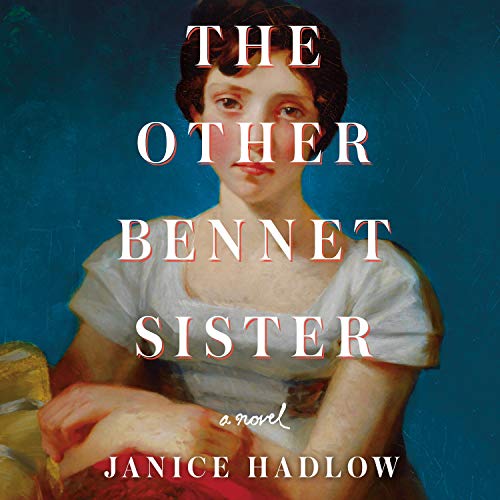
Janice Hadlow has crafted a novel from Mary’s point of view: The Other Bennet Sister. Hadlow delves more deeply into Mary’s character and what might have been after P&P ended.

The Bennets had five daughters. Mr. Bennets property is entailed, meaning it will go to a male cousin upon Mr. Bennet’s death rather than a Bennet daughter.

Even though the Bennets are landed gentry, there’s not enough money for any of the girls to have large enough dowries to attract the “right” kind of husband. But most of the girls are pretty enough to attract attention, and their ambitious mother is determined to place them where they can be seen and admired.

Mary, however, is plain. In Mrs. Bennet’s book, that’s almost a sin. At the very least, Mary’s plainness is a great disappointment to her mother. Mrs. Bennet is one of the most annoying characters in literature, and one of my least favorite. Mary’s mother not only has little use for Mary, she constantly berates her daughter. “She had learned from Mrs. Bennet that without beauty, no real and lasting happiness was attainable. It never occurred to her to question what she had been taught.” Mrs. Bennet didn’t even want Mary to get needed glasses because they would further hamper her ability to get a husband.

Since Mary doesn’t have the looks or personality to be “pleasing,” and she loves to learn, she sets herself to study in her father’s library. Perhaps at some point she can discuss books with him. But he demands absolute silence in the library—except when Lizzie, his favorite, is there.

Mary tries other venues, like music, in which to stake her significance, with poor results.

Mary is also in the very middle of the five sisters. The older two are close, as are the younger two, leaving Mary with no one. Lizzie and Jane are not unkind, but they don’t draw Mary in, either.

Since Mary feels invisible, she looks invisible as well, wearing very plain dresses with no color or frill.

The first part of the book covers the events of P&P, but from Mary’s point of view.

Then the book jumps ahead a couple of years. Mr. Bennet had died, and all the Bennet daughters are married except Mary. Mary and her mother go to live with Jane and Mr. Bingley. But the days there are dreary for Mary, with her mother’s constant harping and Caroline Bingley’s sniping remarks. Mary goes to visit Elizabeth and Mr. Darcy for a while, then Charlotte (Elizabeth’s close friend) and Mr. Collins, the obsequious cousin who inherited the Bennet family home. Charlotte and Mary have several talks about life as a plain woman.

Single women did not have many options in those days. Spinsters were pitied and often poor, earning money as governesses or music teachers. Mary is not interested in either profession, but living with one of her sisters is not ideal, either.

Finally Mary goes to London to stay with her aunt and uncle, the Gardiners—the same aunt and uncle Lizzie stayed with in P&P. Things start to turn a corner as Mrs. Gardiner gently draws Mary out and convinces her that it is not drawing undue attention to herself to dress nicely. And the Gardiner’s friend, Mr. Hayward, convinces Mary’s very rational mind that poetry and feeling are valuable.

I loved a lot of Mrs. Gardiner’s advice, some of which had a double meaning.

Sometimes the very best stuff can seem quite plain, until one examines it closely. It is only then that one sees its true quality.

I see plainly enough that you don’t like to make a fuss about dress—that you dislike having attention drawn to you. But there are times when the best way to ensure you are not remarkable is to conform to the expectations of those around you.

There is a middle way between an obsession with one’s appearance and an absolute denial of its importance.

It’s hard to persuade anyone, especially a man, that your regard is worth having if you have none for yourself.

In our house, no-one is obliged to sparkle. Which, I find, makes it far more likely that they might.

There were several things I liked about this novel. One is Mary’s slow “blossoming,” often with one step forward and two back as she makes mistakes.

I thought the author did an admirable job keeping the personality of each of Austen’s main characters close to what they were in P&P. Even though Hadlow’s style is different from Austen’s, the book still had a cozy Regency feel to it.

I had two minor complaints, though. One is that, especially in the beginning of the book, there was a lot more “telling” than “showing.” That improved after the story got into new material after the P&P timeline.

The other complaint is that sometimes there was too much explanation. The narrative would belabor a point long after the reader understood.

Those two aspects made the story drag just a little in places, but not enough to ruin the book.

Overall, I really enjoyed this story. I wanted to speed ahead to see how things worked out for Mary, but then I didn’t want it to end. Some parts of the book had me in tears.

I listened to the audiobook wonderfully narrated by Carla Mendonca.

Thanks to Lois for putting this book on my radar.

Book Review: Villette

Villette was the last book written by Charlotte Bronte (another was published posthumously but was actually her first book). I had only recently heard of Villette, but since Charlotte penned one of my top three novels, Jane Eyre, I thought I’d give it a try.

Villette is a semi-autobiographical novel based on parts of Charlotte’s life. She and her sister, Emily, had taught for a time in a boarding school in Brussels, Belgium. They both went back to England when their aunt died, and Charlotte returned to the boarding house alone. Villette is a fictional town in France, but based upon Brussels. By the time Charlotte started writing this novel, she was the only remaining sibling of the original five in her family, and she well captures that feeling of being all alone in the world.

The story’s heroine is Lucy Snowe. After some unexplained tragedy in her family, Lucy was left totally alone and needing to make her own way in the world. She heard that some French families hired English-speaking governesses for their children, so she took what money she had and went to France though she knew almost no French and no one in the country. She met a young English girl, Ginevra, on the ship, who went to a French boarding school. After getting lost in Villette, Lucy found herself on the doorstep of the same boarding school run by a Madame Beck. Lucy begged for a job doing anything at the school. She was hired to take care of Madame Beck’s children, but eventually she was asked to teach English at the school.

Lucy on the outside seemed like a quiet, almost mousy person (someone called her a shadow), but inside her feelings ran deep. Charlotte named her Snowe on purpose (she was originally going to go with Frost) to portray how she seemed to other people.

In addition to the ups and downs at the school and encounters with the spoiled Ginevra, Lucy came across her godmother and his son in town, who, unknown to her, had moved to Villette. The son was a teenager at the beginning of the book but became a doctor. Later Lucy encountered a father and daughter she had also met at the beginning, and had several run-ins with an abrasive fellow teacher, M. Paul Emanuel.

One article I read said “Everyone loves Paul Emanuel.” I did not. He constantly criticized Lucy and tended to dominate, not letting her leave for lunch when he wanted to talk to her, locking her up in the attic to learn lines for a school play he was directing. Later he is shown to have several redeeming qualities, but I never got over the initial dislike.

Since France was primarily a Catholic country Lucy stood out as one of the few Protestants. M. Emanuel and a priest took it upon themselves to try to convert her, but Lucy stood firm. Lucy had no use for Catholicism (” the CHURCH strove to bring up her children robust in body, feeble in soul, fat, ruddy, hale, joyous, ignorant, unthinking, unquestioning”), but came to believe that “there are good Romanists.” She and M. Emanuel eventually came to an understanding that they both trusted in “God, be merciful to me, a sinner,” and they left each other’s religious affiliations alone after that. The priest, however, thwarted some of her interests later.

Though there are several aspects to the story, it’s primarily a psychological drama of sorts with Lucy’s highs and lows, known mostly just to herself. There are comic moments in Lucy’s asides to herself, especially in her conversations with Ginevra. But Lucy gets so low at one point, when she is left alone at the school during a long break with a mentally disabled student and then falls ill, that she has a breakdown. One passage that’s characteristic is Lucy’s encouraging of herself:

Courage, Lucy Snowe! With self-denial and economy now, and steady exertion by-and-by, an object in life need not fail you. Venture not to complain that such an object is too selfish, too limited, and lacks interest; be content to labour for independence until you have proved, by winning that prize, your right to look higher. But afterwards, is there nothing more for me in life—no true home—nothing to be dearer to me than myself, and by its paramount preciousness, to draw from me better things than I care to culture for myself only? Nothing, at whose feet I can willingly lay down the whole burden of human egotism, and gloriously take up the nobler charge of labouring and living for others? I suppose, Lucy Snowe, the orb of your life is not to be so rounded: for you, the crescent-phase must suffice. Very good. I see a huge mass of my fellow-creatures in no better circumstances. I see that a great many men, and more women, hold their span of life on conditions of denial and privation. I find no reason why I should be of the few favoured. I believe in some blending of hope and sunshine sweetening the worst lots. I believe that this life is not all; neither the beginning nor the end. I believe while I tremble; I trust while I weep.

Some article I read herald the novel’s “feminism” and Lucy’s independence, but here she shows a longing for a “true home,” someone “dearer to me than myself.” I read that she wanted to write a sad and unfulfilled ending, but her father (and I think perhaps others) urged a conventional happier one. The ending is a little ambiguous, so readers can interpret it whichever way they like.

There are several parallels between Villette and Jane Eyre. Both protagonists are women alone; neither would be considered beautiful; each has a rather unconventional romance with an unlikely suitor. There is even a bit of gothic mystery in both: Jane’s Mr. Rochester is found to have a mad wife locked up in an unused part of the house; Villette’s boarding school has a legend of a dead nun who haunts the place, which Lucy encounters a couple of times (though later a logical explanation is found for the appearances).

One downside to Villette is that much of the conversation is written in French with no translation. That posed a problem for me to listen to the audiobook since I know almost no French. Thankfully I found an annotated copy of the novel at the library with translations and other notes, but it was disjointing to have to look up passages later after reading them.

I listened to the audiobook wonderfully read by Davina Porter. Though I enjoyed the novel, Jane Eyre is still my favorite Bronte work.

(Sharing with Carole’s Books You Loved, Semicolon‘s Saturday Review of Books, Literary Musing Monday)


Book Review: The Austen Escape

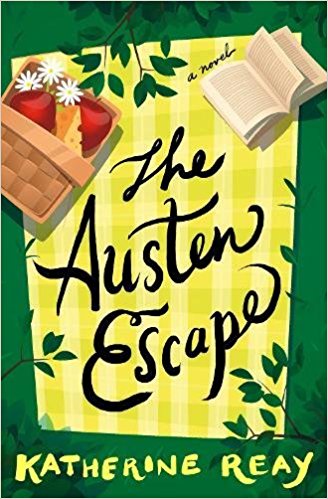
Austen Escape The Austen Escape by Katherine Reay finds lifelong friends going on vacation to a manor in Bath, England, for a Jane Austen-themed experience. Mary Davies, from whose point of view the story is told, is an engineer, not a Romantic. In fact, all her mother’s Austen books were given to her friend, Isabel Dwyer, who is lively, vivacious, and well-versed in all things Austen. Isabel has some sharp edges, though, and the two friends have been somewhat on the outs for a time. But Isabel begs/drags/insists that Mary go, and as so often happen, Mary concedes.

While at this Austen experience, guests are to choose a character from one of Austen’s books to portray and to dress in Regency outfits provided by the manor. There are a few rough spots until Isabel has some sort of mental issue, forgets who she is, and believes she really is the character she’s portraying.  She’s actually much easier to get along with, though, and some things come out that help Mary put together some of the issues that they’ve had. On the other hand, other issues concerning the guy Mary is interested in come out as well, leaving her feeling betrayed.

My thoughts:

The lost memory issue is mentioned on the back of the book, and I wondered how the author was going to pull that off when it seems likely someone in that condition would be taken to the hospital immediately. But the explanation for why they stay on at the manor seemed plausible. I also had a hard time figuring Isabel out when some times she seemed like Mary’s best-ever friend, and other times she seemed condescending and even haughty. I thought perhaps the back-and-forth was going to be a precursor or related to whatever caused the memory loss. That did not turn out to be the case, at least not directly, but it was explained eventually.

I have read all of Reay’s books and enjoyed them to varying degrees, but I have to confess, this is not a favorite. The premise sounded fun – how great would it be to actually go on an Austen-themed vacation like this?! And all of Reay’s books have a plethora of literary allusions, fun for any reader of classics. Obviously the ones this time were all connected to Austen books.

Two themes in the book have to do with various ways people “escape,” and with vision – lack of seeing things clearly, etc.

But the writing this time just seemed — maybe a little uneven to me. I don’t know quite how to put my finger on it. I didn’t “get” a key factor until the discussion questions after the book, which was probably my own fault.

And then, Reay’s first book was definitely in the Christian or at least inspirational fiction category, but it seems her later books get further away from that category. I don’t recall anything relating at all to Christianity or faith in this book, though it’s possible it’s there and I have forgotten it. But if it’s there, it’s small. Maybe this is meant as a general fiction or romance, I am not sure. There was a comment between Mary and her boyfriend about her chest that totally didn’t need to be there – though it was mild compared to secular standards. And there was a fair bit of alcohol consumption – I know there are Christians with varying degrees of conviction about this issue, and I know alcohol was consumed in the Austen books, but it just seemed like that element was detrimental to me personally.

But all in all it’s an enjoyable story, especially as things come together in the end, and as the discussion questions pulled more of the story together for me.

(Sharing with Semicolon‘s Saturday Review of Books, Carole’s Books You Loved)

Book Review: 20,000 Leagues Under the Sea

20,000 LeaguesJules Verne’s 20,000 Leagues Under the Sea opens in 1866 when reports come in front various countries of sightings of…something in various waters, giving rise to assorted speculations. It is described as “a long object, spindle-shaped, occasionally phosphorescent, and infinitely larger and more rapid in its movements than a whale.” In a couple of instances it damaged nearby vessels, leaving a large hole in one ship. These kinds of accidents and the unexplained disappearance of several ships lead to the general sentiment that the creature must be found and destroyed. An expedition is arranged from New York aboard the Abraham Lincoln, and Pierre Aronnax of France, Professor of Natural History at the Museum of Paris and author of Mysteries of the Great Submarine Grounds, is currently in NY and invited to come along. He accepts, along with his servant, Conseil.

After a number of days of searching, they do encounter the creature. Ned Land, a Canadian expert harpooner, had also been invited on this expedition, and when he tries to harpoon the thing, his harpoon bounces off. The thing then sprays an enormous amount of water at the ship, causing, among other things, Professor Aronnax to fall into the depths.

His faithful servant Conseil goes in after him, and they find Ned Land on top of something solid – and metallic. The Abraham Lincoln’s rudder has been broken, so they can’t count on it to come after them. When whatever they are on starts to submerge, they pound on the outside. A hatch opens, and they are taken in.

After a couple of days locked in a dark room, visited by a couple of men who at first seem not to understand them, finally the master of the vessel, a Captain Nemo, introduces himself, tells them they are at liberty to roam the vessel, but he cannot let them go, and furthermore, there would be times when he asked them to remain in their cabins until they received notice they could leave again. He had “broken all the ties of humanity,” and was “done with society entirely, for reasons which I alone have the right of appreciating. I do not, therefore, obey its laws, and I desire you never to allude to them before me again!” They had no choice but to accept.

The professor finds plenty to occupy himself. Nemo takes him on a tour of his ship, the Nautilus, explains how it is fueled, how he built it, etc. A window opens up sometimes to show the surroundings, and Aronnax is excited to observe, record, even to go on some underwater excursions and explore. Conseil is happy to be wherever his master is, but Ned Land chafes at the confinement.

At times Nemo comes across as intelligent, gracious, refined, and generous. But there are other times he seems a little unhinged. When a crisis occurs, the three visitors become convinced they need to leave. But how can they?

My thoughts:

I never knew much about this book besides being familiar with the names of Nemo and the Nautilus, and the round copper helmets of their diving suits seemed to be a staple of underwater sci-fi when I was growing up. So it was interesting to finally learn the story. There were just a couple of places where it got tedious, when measurements or  long citations of plants and animals seen were listed. But there was also plenty of drama and suspense.

I bought the audiobook on sale some time ago and I had forgotten that, when reading a book that has been translated from the original, it’s good to get some information on which translation is considered the best. According to Wikipedia, the first English translation by Lewis Mercier “cut nearly a quarter of Verne’s original text and made hundreds of translation errors, sometimes dramatically changing the meaning of Verne’s original intent.” The description doesn’t say what translation this is, but the comments indicate this is not one of the better ones. So if I ever read it again, I’ll seek out another, but I did enjoy the story.

I was amazed at the misconceptions about it, though. For one, some list it as juvenile fiction, though it was not written that way. Schmoop attributes that to some of the poor translations and its having been made into a Disney movie. One source said it was about Nemo seeking revenge on a sea creature, but that’s one incident in the book and not the main plot at all.

Other interesting facts: The 20,000 leagues in the title refers to distance traveled, not depths plumbed. A little more of Nemo’s background is revealed in a later Verne book, The Mysterious Island. Verne’s publisher made several changes to the book (it wasn’t indicated whether this was with or without Verne’s approval), like changing Nemo’s nationality.

I’m thankful to the Back to the Classics challenge for spurring me to read a book I might not otherwise have picked up.

(Sharing with Semicolon‘s Saturday Review of Books, Literary Musing Monday, Carol’s Books You Loved)

Laudable Linkage

I found quite a bit of good reading the last couple of weeks. Hope something here piques your interest:

Grace Incognito. “What if the point isn’t sprinting across the finish line in record time, but knowing God in every halting, baby step along the way?”

Grace-paced Living in a Burnout Culture. The “Mrs. Grace” illustrations were probably the best I’ve seen showing what life lived with an overflow of God’s grace to us is looks like.

What Should Be One of My Chief Aims at Church?

3 Ways Understanding Jesus’s Cultural Context Helps Me.

Here’s How I’m Fighting the Lies of Self-pity.

19 Spurgeon Quotes for Coping With Stress and Anxiety.

When the Doctor Says to Terminate.

Children and Sleep-overs: What Parents Need to Know.

Master Your Time: 5 Daily Scheduling Methods to Bring More Focus to Your Day, HT to Challies.

The Things All Women Do That You Don’t Know About, HT to Lisa. Sad, but true. (Warning: a bit of bad language).

Here’s What Goodwill Actually Does With Your Donated Clothing.

5 Reasons You Need Fiction, HT to Lisa.

Did you know they were making a new live-action version of Beauty and the Beast? With Dan Stevens (Matthew on Downton Abbey) as the Beast? Here are some photos from it, HT to Carrie. This is one of my favorite fairy tales and the Disney film one of my favorite Disney movies. I hope they do this well and don’t toss in anything objectionable. Looks good so far.

And finally, my oldest son posted this video called “Unsatisfying,” and right at first I thought it was frustrating, but before long I was laughing. Some of the little touches, like the squeaky windmill, are great and the soundtrack, though I love the piece (Samuel Barber’s Adagio for Strings), is perfect.

Happy Saturday!

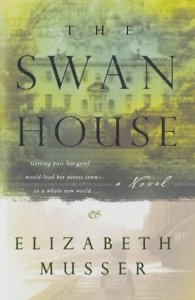
Book Review: The Swan House

Swan HouseI picked up The Swan House by Elizabeth Musser when it came through as a Kindle deal because I liked her Words Unspoken so much (in fact, it was one of my top ten books from 2010.)

This story is told from the vantage point of 16-year-old Mary Swan Middleton, daughter of a wealthy Atlanta family in the 1960s. Tragedy strikes early in the book as her mother dies in an airplane accident along with a number of other Atlantans. The accident wounds her family and community deeply.

There are a number of threads in this book which Elizabeth weaves together nicely:

– Mary’s family and community dealing with their grief

– Mary’s (or Swan, as she’s called most often, or Swannee) quest to determine what happened to some missing paintings, one of them her mother’s, which were lost before they were to be debuted at the High Museum of Art

– Her black maid, Ella Mae, inviting her to come to her church to help with the weekly food distribution to the needy as a way to take her mind off her grief, where her eyes are opened to a whole different world and where she meets Miss Abigail, a white lady who has made it her mission to live and minister in the area.

– Her getting to know and becoming interested in a black teenage boy named Carl.

– The volatile racial tensions 0f the 1960s South and burgeoning civil rights movement

– Mary’s discovering clues that what was thought to be her mother’s artistic temperament might have been something deeper, something worse.

– Mary’s school life and activities, best friend Rachel, and budding interest in a boy named Robbie

– Mary’s spiritual development and crisis of faith.

In a sense it’s a coming-of-age story, but it’s so much more than that. It’s a book of rich depths. One of its themes is that there is often more going on behind the surface of a person’s life that we’re aware of.

Some of my favorite quotes from the book:

We were transported by that music in a ethereal way that later we would try to explain and couldn’t. But it was the first time I really felt what I had long understood: that something could be extremely beautiful and intensely painful at the same time.

She thought every church should be…a place where you could go without no makeup or fancy dress to hide behind and you could jus’ hug yore friends and cry and tell the Lawd how bad you’d messed up and ask Him to forgive ya and let ya git up and keep goin’.

It’s been through the hard times that I been able to he’p someone else. It’s been through believin’ that the Lawd somehow gonna git me through that the others done wanted to hear about my Jesus.

Guess I ain’t got no business tellin’ the good Lawd that He put me in the wrong place. He done shown me ’nuff times that He knows exactly what He is doing.

I mentioned in Why Read Christian Fiction that you would expect to find Christian conversations in Christian fiction but that some authors make it more subtle or only mention Christian truths in an offhand way so as not to be accused of being too heavy-handed with it. While some stories would call for subtlety, I am glad Elizabeth felt the freedom to have her characters have full-fledged conversations about what it means to really be a Christian and how Christianity should impact a life.

Elizabeth is a native Atlantan, and I enjoyed her afterword where she explained that many points of the story came from real life (even the airplane crash was a real one that impacted the Atlanta community). We lived just outside Atlanta for four years, and even though we didn’t go into the city that much, I felt like I was not only revisiting it but getting to know it better while reading this book.

I also enjoyed reading a little more about Elizabeth after reading this book. She and her family are missionaries in France, and she writes in a refurbished tool shed. She tells some of her writing journey here and photos of her writing place are here. I was exciting to see on Goodreads that this book “was named one of Amazon’s Top Christian Books of the Year and one of Georgia’s Top Ten Novels of the Past 100 Years.”

I enjoyed Words Unspoken so much, I am not sure why I waited so long to read another of Elizabeth’s books. But now that I have, I am looking forward to reading more of them.

(This review will also be linked to Semicolon‘s Saturday Review of Books.)

Why Read? Why Read Fiction? Why Read Christian Fiction?

photo 1(1)

I have been reading Christian fiction for some 35 years or so, and for the most part have loved it. It has ministered to me in many ways. I always wince a bit when I hear someone “slam” it. Especially when they say “All Christian fiction is…” whatever it is they don’t like about it. My snarky(and probably fleshly) inward response is “You haven’t read all of it.” 🙂

I’m probably not going to convince anyone who is dead set against it, and that’s fine. We can still be friends. 🙂 But I wanted to share why I find it valuable, and to do that, it seems to me I need to start with reasons to read anything in the first place, and then reasons to read fiction, and then Christian fiction.

Why Read?

God chose to communicate to us through words. He created the world by speaking. His Son is called “the Word.” The Bible contains a number of different genres (poetry, history, letters, narrative, forensics).

To gain information

To learn – about other people’s experiences, other points of view, any of the many things we don’t know yet or know as much as there is to know

To understand how things work

To understand how others feel and develop empathy.

To gain perspective

To gain wisdom

To broaden horizons. There are places you’ll likely never go, experiences you’ll likely never have, except by reading about them. On the other hand, something you read may spark an interest in a new venture.

To understand your own culture better

To understand other cultures

To strengthen your views

To know you are not alone in your views.

To test your own beliefs against others

To understand others’ views

To improve reasoning skills

To find others who express thoughts you’ve had but couldn’t quite put into words

To improve concentration and focus

To improve vocabulary and communication skills

To relax

To be amused

To be challenged

To profitably pass time

To be surprised

To stave off boredom

To be inspired

To become a more well-rounded person

To become more creative

To immerse oneself in a subject. Randy Alcorn wrote at the end of Courageous that they wanted to write a full book after the movie partly so that people could spend 10 hours in a book thinking over the topics involved rather than just 2 hours of a film.

For enjoyment and pleasure

To understand cultural references so that when someone quotes Dickens or Frost or Shakespeare you have some idea who they’re talking about. If someone mentions “Two roads diverged….,” knowing the poem and its subject enriches your understanding of what the person is referring to.

To have a point of contact with one’s fellow man or woman. A friend’s son was planning to go into a vocational job working with his hands and struggled with literature classes. She felt that her son’s time and mental powers would be better employed just reading and studying the Bible. But even the apostle Paul quoted poets and took time to understand other people’s culture as a way of understanding them as a people and having a point of reference from which to share the gospel (Titus 1:11-13, Acts 17:21-23).

To inspire “noble action.”

“All literature, all philosophy, all history, all abounds with incentives to noble action which would be buried in black darkness were the light of the written word not flashed upon them.” – Cicero, Pro Archia

“I believe stories can broaden our empathy, helping us to love. They tell us we’re not alone. But they can also give us something to live up to, whetting our appetite for virtues we don’t yet have.” James D. Witmer, Stories That Lead By Example

To think. I found it interesting that a daughter of a friend teaching English and American culture in a Communist country said that parents there did not read books to their children for pleasure.

“Books are weapons in the war of ideas.” – U.S. Government Printing Office, Office of War Information, S. Broder (artist) 1942 World War II Poster. In totalitarian societies, books that disagree with national policy are banned.

“The books that help you most are those which make you think the most. The hardest way of learning is that of easy reading; but a great book that comes from a great thinker is a ship of thought, deep freighted with truth and beauty.” Theodore Parker (1810 – 1860) (seen at Carrie’s)

To glean from the minds of great thinkers.

“The reading of all good books is indeed like a conversation with the noblest men of past centuries who were the authors of them, nay a carefully studied conversation, in which they reveal to us none but the best of their thoughts.” Rene Descartes (1596 – 1650) (seen at Carrie’s).

To comprehend right and wrong

“The great fairy tales and fantasy stories capture the meaning of morality through vivid depictions of the struggle between good and evil, where characters must make difficult choices between right and wrong, or heroes and villains contest the very fate of imaginary worlds.” Vigen Guroian, Tending the Heart of Virtue

To gain power. Thanks to Janet for this one. She shared that

“In his autobiography, Frederick Douglass writes that his owner forbade his wife to teach a slave to read on the grounds that it would ‘forever unfit him to be a slave.’ ‘I now understood what had been to me a most perplexing difficulty — to wit, the white man’s power to enslave the black man,’ writes Douglass. ‘It was a grand achievement, and I prized it highly. From that moment I understood the pathway from slavery to freedom… I set out with high hope, and a fixed purpose, at whatever cost of trouble, to learn how to read.’”

Why Read Fiction?

You may agree with all the reasons listed so far for reading, but you want to read what’s “real” and have no room for fiction in your life. Here are some things to think about regarding reading fiction. I believe all of the above reasons apply to fiction as well as non-fiction, but here are some that apply primarily to fiction:

God employed fiction in the Bible (Nathan to David, parables in the NT, story of the bramble in the OT, plus many others). We have to be careful not to fictionalize or label as myth what the Bible indicates as fact – as someone once said of Bible interpretation, “Where common sense makes good sense don’t seek any other sense.” Some people want to categorize much of the Old Testament as myth, and that is going way too far for too many reasons to go into here. But God does make use of stories.

God created imagination and stories employ it.

A story might provide conviction and instruction when we see ourselves in the story (Nathan to David in the story about a lamb, Aesop’s fables). A lecture or direct confrontation is not always the best approach. In It Takes a Pirate to Raise a Child by Daniel B. Coupland, he tells of a time when he was trying to get across to his young son why the way he was acting towards his sisters was wrong. The son did not comprehend or agree with what his father was saying until he said, “You’re acting like Edmund” in The Lion, the Witch, and the Wardrobe by C. S. Lewis. Then he “got it” and not only realized where he was wrong, but “The reference to Edmund hit my son in a very deep place in his heart, which only stories can reach.”

Fiction fleshes out truth. Sometimes during a sermon I am following along and understanding but find myself wondering what that truth looks like in real life. A story or illustration helps us know how to apply truth or helps us understand the truth better.

Fiction appeals to our minds. Somehow most of us are wired to tune in to a story. I read one preacher who lamented that his listeners got drowsy while he exposited Scripture but perked up when he told a story. That doesn’t necessarily mean they are unspiritual and shallow. I have often fought sleepiness during a message I really wanted to hear but then found myself wide awake when the preacher began to tell a story. That’s not to say preachers should tell more stories than preach the Bible – we do need to discipline ourselves to hear sound doctrine. But it is not always due to laziness that are minds are attracted to stories.

Here are what greater minds than mine have said about fiction:

“The appeal of stories is universal, and all of us are incessant storytellers during the course of a typical day.” Justin Taylor, How Stories Work

“Good literature erects bridges between different peoples, and by having us enjoy, suffer, or feel surprise, unites us beneath the languages, beliefs, habits, customs, and prejudices that separate us. When the great white whale buries Captain Ahab in the sea, the hearts of readers take fright in exactly the same way in Tokyo, Lima, or Timbuctu.” ~Mario Vargas Llosa, Seen at Semicolon

“Reading is to the mind what exercise is to the body. As by the one, health is preserved, strengthened and invigorated; by the other, virtue (which is the health of the mind) is kept alive, cherished and confirmed. But as exercise becomes tedious and painful when we make use of it only as the means of health, so reading is apt to grow uneasy and burdensome, when we apply ourselves to it only for our improvement in virtue. For this reason, the virtue which we gather from a fable, or an allegory, is like the health we get by hunting; as we are engaged in an agreeable pursuit that draws us on with pleasure, and makes us insensible of the fatigues that accompany it.” -Joseph Addison and Richard Steele, The Tatler No. 147

“Stories give children the opportunity to think about morals, lessons, and conflict resolution. With practice, children begin to search for the moral at the end of the story, and some will even structure their own stories around a specific message. Children who listen and tell many stories begin to recognize trends in human behavior. Their perspectives expand, and they become more critical, observant thinkers. They begin to consider in broader terms what it means to be helpful, mean, practical, hopeful, spiteful or considerate. Creating characters – which teaches that multiple perspectives exist at every moment – gives children invaluable tool for understanding others and for finding their way in the world.” (page 13)  Show Me a Story: 40 Craft Projects and Activities to Spark Children’s Storytelling, HT to Carrie.

“Some Christians view fiction as the opposite of truth.  But sometimes it opens eyes to the truth more effectively than nonfiction.” – Randy Alcorn.

“It is only a novel… or, in short, only some work in which the greatest powers of the mind are displayed, in which the most thorough knowledge of human nature, the happiest delineation of its varieties, the liveliest effusions of wit and humour, are conveyed to the world in the best-chosen language” ― Jane Austen, Northanger Abbey

“Fairy Tales are more than true; not because they tell us that dragons exist, but because they tell us that dragons can be beaten.” – G.K. Chesterton

“It might be expected that such a book would unfit us for the harshness of reality and send us back into our daily lives unsettled and discontent. I do not find that it does so….Story, paradoxically enough, strengthens our relish for real life. This excursion into the preposterous [speaking here of The Wind in the Willows] sends us back with renewed pleasure to the actual” –C. S. Lewis, On Stories and Other Essays on Literature, p. 14

Since it is so likely [children] will meet cruel enemies, let them at least have heard of brave knights and heroic courage.C. S. Lewis, On Stories and Other Essays on Literature, p. 39

“The value of myth is that it takes all the things we know and restores to them the rich significance which has been hidden by the ‘veil of familiarity.’ The child enjoys his cold meat (otherwise dull to him) by pretending it is buffalo, just killed with his own bow and arrow. And the child is wise. The real meat comes back to him more savory for having been dipped in a story…If you are tired of the real landscape, look at it in a mirror. By putting bread, gold, horse, apple, or the very roads into a myth, we do not retreat from reality: we rediscover it. As long as the story lingers in our mind, the real things are more themselves. This book [LOTR] applies the treatment not only to bread and apple but to good and evil, to our endless perils, our anguish, and our joys. By dipping them in myth we see them more clearly.” – C. S. Lewis, On Stories and Other Essays on Literature, p. 90
Fairy Tales

Why Read Christian Fiction?

In addition to all of the above reasons for reading, which I believe can be applied to Christian fiction as well, here are some reasons particular to Christian fiction:

The missing element. Even the best of secular stories tends to leave God out of the picture and have the characters acting on their own initiative. Christian fiction shows how a Christian might act in dependence on God in some of these scenarios.

To see how Christians act in everyday life. I’ve mentioned here before that my mother was not, as far as I know, a Christian as I was growing up. In her later years she had some questions and concerns about it, but she did not want to discuss it. It was too sensitive, too personal for her to open up about it. I began sending her some of the Christian fiction I was reading. Not only did she enjoy the stories (Terri Blackstock and Dee Henderson were a couple of her favorites), but it helped her to see what Christianity in action looked like (we lived 1,000 miles away, so though we talked and wrote, we didn’t have that everyday life contact back when there was no texting or Facebook to keep in touch every day).

To display the gospel. I don’t think every Christian story has to include the plan of salvation or show a conversion, but if the gospel affects every aspect of our lives, that would be displayed in the stories in some way. I went into this further in an earlier post titled The Gospel and Christian Fiction. To repeat one thought from that post, while not every Christian story needs to explain the whole gospel, what it does share needs to be accurate. Because some have accused Christian fiction of being too “preachy” (more on that later), the pendulum has swung the other way lately, and some authors have tried to make their message a little more subtle. That can be fine: some stories would call for the book’s message to be a little more explicit, some call for more subtlety. But in some cases subtlety has generated obscurity or even misleading statements. I would not have sent those kinds to my mom so as not to confuse her, though a mature Christian might benefit from them.

To learn spiritual truth.

To be helped in your own life by another’s example. Just one instance of this in my life: for several years of our married life, my husband had to travel quite a bit, and I was often discouraged about it. During one of those periods I was reading Janette Oke’s A Quiet Strength, and the young wife in the story was experiencing something similar with her husband having to be away much of the time to work. Even though our ages, life situations, time in history, and number of years married was different, I was still encouraged by what she found that encouraged herself.

It’s clean – or should be. There is a growing trend to use bad language or sexual scenes to be more “realistic,” but I think explicitness in either vein is detrimental. I wrote about these elements in The Language of Christians and Sexuality in Christian Fiction, so I won’t reproduce those thoughts here.

Charges against Christian fiction:

Here are some complaints about Christian fiction that I have heard or read:

“It is predictable.” The person who is not a Christian becomes one or the problem a Christian has is solved or the lesson learned. But isn’t there a measure of predictability in every genre? Usually the guy and the girl get together in a romance, the detective figures out the mystery and “whodunnit,” the good guys win in the Western, the doctor helps save the patient, etc. (unless it is a series, and then a few lost cases are thrown in for realism). We expect a certain ending with most of the books we read, and the fun is in seeing how it is done and what unexpected twists and turns arise on the journey.

“It’s too preachy” or it is more of a sermon in the guise of a story. I’ve only found that occasionally. Of course authors, Christian or secular, usually do have some kind of truth they are trying to convey, but usually they try not to be blatant about it. Sometimes they are accused of being blatant when they are not: in C. S. Lewis’s book On Stories, he quotes Dorothy L. Sayers as saying, about the assumption that she wrote to “do good”: “My object was to tell that story to the best of my ability, within the medium at my disposal — in short, to make as good a work of art as I could. For a work of art that is not good and true in art is not good and true in any other respect” (p. 93). An author’s worldview is going to seep out into his story in some way. Lewis said that the Narnia stories were not intended as an allegory. They started with a couple of pictures in his mind, one of a faun, and some “supposings,” and developed from there.

I mentioned earlier that Christian fiction will show the everyday activity of Christians, so obviously there will possibly be prayer, reading and discussing Biblical truths, going to church, etc., in the story. But those elements should be woven in as naturally as possible and not just tossed in to label a character as Christian. One of the best at this is Jan Karon in her Mitford books, which are not even marketed as Christian fiction but convey a definite element of faith.

“The characters are too perfect.” I have rarely found this to be the case in the Christian fiction I have read. Most writers strive to make their characters realistically flawed.

“It’s poorly written.” I have only a handful of times found a Christian fiction book that I thought was truly terrible. There are some Christian novels that are mediocre, but, again, that could be said of any genre. I have found plenty of Christian fiction that has kept me glued to the page, instructed or inspired me, and some that had me looking up at the ceiling thinking, “I wish I could write like that.”

“As soon as someone becomes a Christian in the book, all of their problems are solved and they live happily ever after.” Again, I have rarely found that to be the case in the Christian fiction I have read, especially in recent years.

I think some of these charges might have been more true of some of the earliest Christian fiction, but most authors I have read over the last 25+ years have striven to make their characters and plots and realistic as possible.

If someone truly feels convicted that they should not read Christian fiction, of course one shouldn’t violate conscience. I have mentioned missionary Isobel Kuhn many times. For a time she came to a place of laying aside fiction because one time, after finishing a very exciting novel, she tried to read her Bible and couldn’t engage with what she was reading. She felt the Lord was telling her that trying to read the Bible after a novel was like trying to eat dinner after ice cream. She felt the fiction was stunting her taste for the Bible (I don’t know what kind of fiction it was). To that I would say, as parents the world over have, don’t eat your dessert before your main course. 🙂 Make sure to put Bible reading before any other reading. Probably that same kind of thing would happen if trying to read the Bible just after an exciting ball game or social gathering or play: it takes a bit of time to “change gears.” But I wouldn’t argue with someone who felt this way: sometimes God does call us to put aside things that aren’t harmful in themselves in order to give first place to the best things. Later on when Isobel’s husband became a superintendent for their mission and had to travel frequently, and she was left alone in lonely mountain villages for long periods of time, she did come back to the classics for moments of respite and company. She felt like she was visiting with old friends, and because she was familiar with them, she didn’t have the temptation to neglect duties to stay glued to the book to see what happened.

I am not saying Christians should only read Christian books – not at all. One good post I’ve seen on that subject is Three Reasons to Diversify Your Reading.

I am also not endorsing all Christian fiction. Just as I wince when someone says they think it is all bad, I would also wince to hear someone say it is all good. We need to use discernment in everything we read. I have found some Christian fiction that I did feel was either poorly written or was off-base in something it said, but those have been the minority.

Conventional blogging wisdom would suggest that I divide this up into several posts – but personally I like having it all in one place even though it makes for too long a post. I hope you don’t mind. I also have a few more quotes I was going to share about books and reading, but I think I will save those for another time.

I’d love to hear your thoughts about reading fiction and Christian fiction.

“Every great story tells in some part The Great Story. Each truth revealed helps us make sense of our world. And through each tragedy, comedy, and fairy tale, the Truth is woven through the fabric of our being.” – Julie Silander, Threads

(Sharing with Booknificent Thursday)