
I recently saw a meme which said that our relationship with God is not about Him pointing out our sin, but about exchanging our hearts with Jesus.
I had to think about that a while.
I’m not sure what the writer meant by exchanging hearts with Jesus. Maybe she was alluding to Ezekiel 36:26, where God says He will remove our heart of stone and give us a heart of flesh.
But what particularly struck me was the downplaying, even the rejection, of the need for God to point out our sin. The thought reminded me of a song that was popular when I was a kid. The singer prays at night during a lonely time. She doesn’t want God to correct, challenge, or chasten her. She just wants Him to listen.
Our relationship with God is more than dealing with sin, of course. But dealing with sin is certainly part of it. Even the allusion to needing a new heart is an indication that all is not right with ours.
No one enjoys having their wrongdoings pointed out. Yet God pointing out our sin is not a negative aspect of our relationship with Him. It’s a blessing. It’s sin that comes between us, hinders our prayers, and clouds our fellowship. When God convicts us of sin, it’s a sign of His love and an opportunity to confess to Him and be forgiven. Proverbs 28:13 says, “Whoever conceals his transgressions will not prosper, but he who confesses and forsakes them will obtain mercy.”
We might think of it a little like this. Suppose a young boy who is old enough to know better kicks a ball around in the house and breaks a window, hits his little sister, skips school, and is found smoking with his friends—and then asks his parents for the latest video game. Most parents would say, “We have some other things to talk about first.”
The parents correct the child not just because he’s not living up to their standards or embarrassing them in front of the neighbors, but for his own good. A child who is never corrected by his parents will never learn to say no to himself or rein himself in. He’ll most likely have trouble in school, in his job, and in relationships because he’s never been taught to do anything but have his own way.
We don’t like to be shown that we’re doing something wrong. Everyone having their own “truth” these days makes it even harder to pin down an authoritative right and wrong.
But what about when we are wrong?
If you’re going the wrong direction, wouldn’t you want someone to tell you before you go too far out of your way?
If you are training to be an accountant, wouldn’t you want to work out the mistakes in your calculations so you don’t cost yourself or your client great sums of money?
If you’re a brain surgeon, wouldn’t you want the best training and practice so you’re not a hazard to your patients?
Correction is a fact of everyday life. We’re in a constant state of growth. Learning better ways to do things and treat people involves examining our thoughts, motives, speech, and actions, ferreting out what’s bad, and learning improved ways to think, feel, speak, and act.
The need for correction is even more vital spiritually.
Sin is what originally separates us from God. Isaiah 59:2: “Your iniquities have made a separation between you and your God, and your sins have hidden his face from you so that he does not hear.”
Jesus died on the cross to take care of our sin. 1 John 3:5: “You know that he appeared in order to take away sins, and in him there is no sin.” Galatians 2:21b: “If righteousness were through the law, then Christ died for no purpose.”
Well, you might say, I am a believer. The Bible says “There is therefore now no condemnation for those who are in Christ Jesus (Romans 8:1). So I don’t have to worry about sin any more.
No, that’s not true. I John 1:6-10 says—to Christians—
If we say we have fellowship with him while we walk in darkness, we lie and do not practice the truth. But if we walk in the light, as he is in the light, we have fellowship with one another, and the blood of Jesus his Son cleanses us from all sin. If we say we have no sin, we deceive ourselves, and the truth is not in us. If we confess our sins, he is faithful and just to forgive us our sins and to cleanse us from all unrighteousness. If we say we have not sinned, we make him a liar, and his word is not in us.
Our sins are forgiven and we’re not under condemnation. But we still have an old nature. After we’re saved, we fight against sin because we have a new nature that wants to please our Father. As we grow in Him, He convicts us of things that are wrong so we might confess them and put them aside. Sin doesn’t sever our relationship, but it does affect it.
Usually after several years of being a Christian, we’ll be convicted about things we never thought of when we were first saved. That’s a blessing: if God dealt with everything in our lives at once, we’d be overwhelmed. As parents, the things we deal with our children at age fifteen will be different, and likely more advanced, than what we dealt with at age five.
Being convicted of our sin does more than prompt us to confess and forsake the sin. It also humbles us and reminds us how much we need to be in God’s Word and to rely on Him for our daily walk.
A. W. Tozer said, “We must allow the Word of God to correct us the same way we allow it to encourage us.” “All Scripture is breathed out by God and profitable for teaching, for reproof, for correction, and for training in righteousness, that the man of God may be complete, equipped for every good work’ (2 Timothy 3:16-17). Multitudes of verses in proverbs tell us that wise people receive corrections, but fools don’t listen.
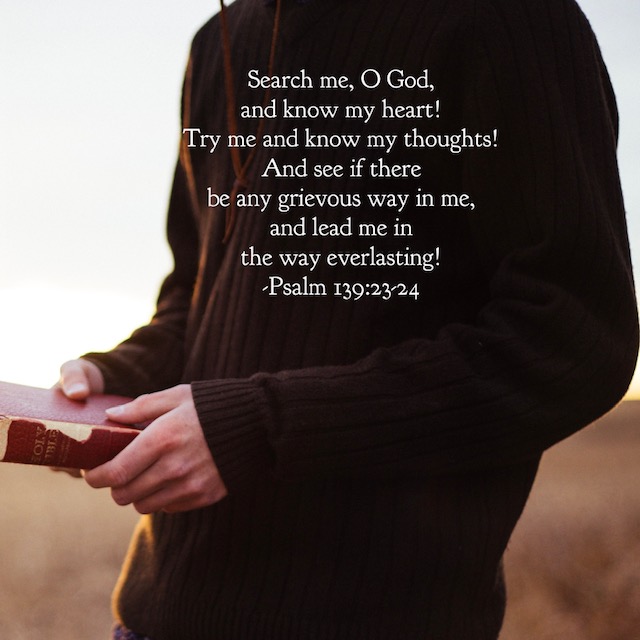
Like the psalmist, we need to regularly invite God to “Search me, O God, and know my heart! Try me and know my thoughts! And see if there be any grievous way in me, and lead me in the way everlasting” (Psalm 139:23-24). “Examine me, O LORD, and prove me; Try my mind and my heart” (Psalm 26:2). Paul tells us to examine ourselves before taking communion.
God “disciplines us for our good, that we may share his holiness. For the moment all discipline seems painful rather than pleasant, but later it yields the peaceful fruit of righteousness to those who have been trained by it” (Hebrews 12:10b-11).
We don’t approach a stern judge who is ready to bang his gavel. We come to one who sympathizes with us in grace. “Since then we have a great high priest who has passed through the heavens, Jesus, the Son of God, let us hold fast our confession. For we do not have a high priest who is unable to sympathize with our weaknesses, but one who in every respect has been tempted as we are, yet without sin. Let us then with confidence draw near to the throne of grace, that we may receive mercy and find grace to help in time of need” (Hebrews 4:14-16).
So don’t search the Bible or pray only for assurance and affirmation. Let God’s Word and Spirit do their sanctifying work of searching you and correcting you. The process may not be pleasant, but His cleansing ultimately brings great peace and joy.
(I often link up with some of these bloggers.)
 Stray Thoughts