

He Knows My Name

He knows my name

I was named for two aunts. My mother’s sister was Barbara Ann, and my father’s youngest sister was Lora Lee. So I became Barbara Lee. I supposed I could have ended up with Lora Ann, or a name from another aunt, Faye Elisabeth, whose name was the same as my grandmother’s.

From time to time as I grew up, interest arose in name meanings. My friends were always tickled to discover that my first name, Barbara, means “stranger.” I’d hear good-natured comments the speakers thought were witty, like, “Yeah, you’re the strangest friend I have.”

When I was taking a class in some New Testament epistles in college, the teacher said something like, “I don’t know if we have any Barbaras in here . . . ” (at which point everyone who knew me looked at me), “but the name Barbara comes from the word barbarian.” He said “barbarian” arose from how Greeks described foreigners, whose language sounded like “bar bar” to them.

I loved my aunts and didn’t mind my name. I don’t think my parents had name meanings in mind when they named me. But after I became a Christian I was encouraged to discover the concept of being a stranger in the Bible.

In Ephesians 2, Paul writes that we were “strangers to the covenants of promise, having no hope and without God in the world. But now in Christ Jesus you who once were far off have been brought near by the blood of Christ. For he himself is our peace . . .” Through the cross, He reconciled us to Himself, so when we believe on Jesus Christ, we “are no longer strangers and aliens.” The Getty’s hymn, “Jesus, Joy of the Highest Heaven,” puts it this way:

Jesus, laid in a lowly manger,
Facing a world of dangers,
Come to turn me a stranger
Into a child of God.

Isaac Watts’ hymn, “My Shepherd Will Supply My Need,” captures this beautifully in the last stanza.

The sure pro­vi­sions of my God
Attend me all my days;
O may Thy house be mine abode,
And all my work be praise!
There would I find a set­tled rest,
While oth­ers go and come;
No more a stran­ger, nor a guest,
But like a child at home.

When we were at home in a world that doesn’t know God, we were strangers to Him. But once we became His children, then we also became strangers to the world. Hebrews 11 says the people listed there “all died in faith, not having received the things promised, but having seen them and greeted them from afar, and having acknowledged that they were strangers and exiles on the earth” (verse 13). This world is not the ultimate home of believers. We seek to do good and enjoy God’s gifts and shine as lights for Him here, but ultimately, we “desire a better country, that is, a heavenly one” (verse 16). C. S. Lewis put it this way in The Problem of Pain: “Our Father refreshes us on the journey with some pleasant inns, but will not encourage us to mistake them for home.”

As strangers here, 1 Peter 2:11 urges us “to abstain from the passions of the flesh, which wage war against your soul.” This urging follows the verses that say believers are “a chosen race, a royal priesthood, a holy nation, a people for his own possession, that you may proclaim the excellencies of him who called you out of darkness into his marvelous light. Once you were not a people, but now you are God’s people; once you had not received mercy, but now you have received mercy.” Because we have become God’s people through faith, we live and act differently from what we used to.

Deuteronomy 10:18-19 really elevated my name in my eyes: “He executes justice for the fatherless and the widow, and loves the sojourner [stranger], giving him food and clothing. Love the sojourner [stranger], therefore, for you were sojourners in the land of Egypt.”

In Bible times, name meanings were special. People were given names according to character traits they either had, or that parents hoped they would have.

God often changed a person’s name in the Bible after a significant encounter with God. Thus Abram (“exalted father”) became Abraham (“father of many nations”). Jacob (“planter or deceiver”) became Israel (“prince with God”). Simon (“hearing”) became Peter (“rock”).

Revelation 2:17 contains an interesting situation: “To the one who conquers I will give some of the hidden manna, and I will give him a white stone, with a new name written on the stone that no one knows except the one who receives it.”

This is the only place where such a white stone is mentioned in the Bible. Some sources say ancient jurors cast white stones for a “not guilty” verdict or a black stone for “guilty.”

Some say the stone hearkens back to the breastplate the high priest wore which contains twelve jewels with the twelve tribes of Israel inscribed upon them. The high priest brought the names of the tribes before God as he ministered. So Jesus bears our names before the Father.

GotQuestions.org poses this as the best theory:

The best theory regarding the meaning of the white stone probably has to do with the ancient Roman custom of awarding white stones to the victors of athletic games. The winner of a contest was awarded a white stone with his name inscribed on it. This served as his “ticket” to a special awards banquet. According to this view, Jesus promises the overcomers entrance to the eternal victory celebration in heaven. The “new name” most likely refers to the Holy Spirit’s work of conforming believers to the holiness of Christ.

Jesus said of a good shepherd “The sheep hear his voice, and he calls his own sheep by name and leads them out’ (John 10:3). Then He said, “I am the good shepherd. I know my own and my own know me” (verse 14). 

Imagine–the God of the universe, who made and knows millions (billions? trillions?) of people, knows our name. Those who know Him will receive a new name in heaven known only between Him and them.

I don’t know what my new name will be. But I am immeasurably thankful to be known and loved by God.
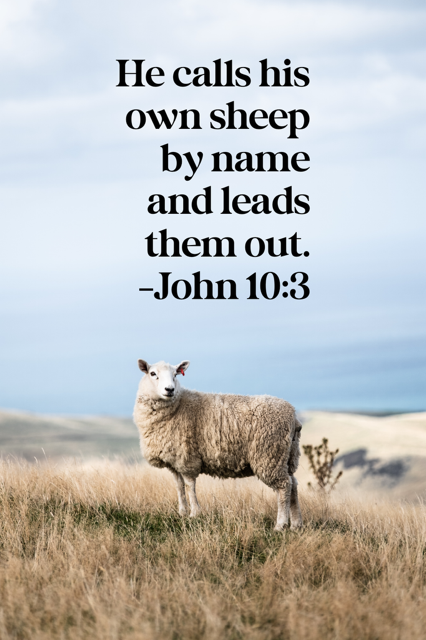
He calls his own sheep by name and leads them out. John 10:3.

He calls his own sheep by name and leads them out (John 10:3).

(I often link up with some of these bloggers.)

While we wait

No one enjoys waiting. Even if we’d prefer to put off something we’re not looking forward to, at some point we just want to get it over with. Sometimes waiting enhances the enjoyment of whatever we’re waiting for until it finally comes — cookies baking, marriage, an anticipated outing. Some waits are particular nerve-wracking and even traumatic: a response from a job application or a medical test. Waiting can make us feel impatient, unsettled, and strained.

Wait can be an active as well as a passive verb. A waiter serves others actively. One of the best ways to deal with waiting is to get busy about something else. If we’re serving others or accomplishing some task, we’re not only using our time profitably, but we’re also distracting our thoughts from our wait.

A couple of weeks ago I was reading in 1 Peter and was arrested by verse 7 in chapter 3: “The end of all things is at hand; therefore be self-controlled and sober-minded for the sake of your prayers.” I’m thankful that all my Christian life, I have been under teaching that emphasizes reading whole chapters and whole books of the Bible rather than isolated verses. I made a list that day of all the things Peter went on to tell people to do and think about until “the end of all things” actually comes. Then today, looking back through all of 1 Peter, I realized “the end of all things” hearkens back to the “living hope” we were born again to “through the resurrection of Jesus Christ from the dead, to an inheritance that is imperishable, undefiled, and unfading, kept in heaven for you, who by God’s power are being guarded through faith for a salvation ready to be revealed in the last time” (1:3-5).

Until that time, God has given us plenty to do – not just as a distraction, as busywork, but as that which must be done.

This isn’t a full exposition of 1 Peter, but here are some things I noticed we’re to do while we wait for that inheritance at the end of all things:

Remember:

Remember who you are in Christ if you are a believer: “You are a chosen race, a royal priesthood, a holy nation, a people for his own possession” (2:9).

Remember why you were called: “that you may proclaim the excellencies of him who called you out of darkness into his marvelous light” (2:9-10). “You yourselves like living stones are being built up as a spiritual house, to be a holy priesthood, to offer spiritual sacrifices acceptable to God through Jesus Christ” (2:5).

Remember your pilgrim status (1:17). 1 Peter 2:11 in the ESV calls us sojourners and exiles; the KJV says strangers and pilgrims.This world is not all there is. It’s not our final destination. We’re “just traveling through,” as the song says. We seek “a better country, that is, a heavenly one,” one God has prepared for them (Hebrews 11:16).

Adjust your thinking and actions:

Feed on God’s Word like babies take in milk (2:2-3). “The word of the Lord remains forever” though all else fails (1:24-25).

Endure tests and trials in a way that honors the Lord (1:6-9; 3:13-17; 4:1-2). He allows them to test and refine us or for other reasons. Remember how Christ suffered unjustly, without threatening, sinning, or reviling, “entrusting himself to him who judges justly” (2:19-25; 3:18). Don’t be surprised at suffering, but glorify God in it and rejoice. “Let those who suffer according to God’s will entrust their souls to a faithful Creator while doing good” (4:12-19). Know that you are not alone: others are suffering, too (5:9).And after you have suffered a little while, the God of all grace, who has called you to his eternal glory in Christ, will himself restore, confirm, strengthen, and establish you. To him be the dominion forever and ever. Amen” (5:10-11).

Be holy (1:14-16, 22; 3:10-12, 16-17; 4:3-5). Remember you were delivered from the “passions of your former ignorance” (1:14) and redeemed “with the precious blood of Christ (1:18-20, 23; 2:4-8). “Put away all malice and all deceit and hypocrisy and envy and all slander” (2:1). “As sojourners and exiles . . . abstain from the passions of the flesh, which wage war against your soul. Keep your conduct among the Gentiles honorable, so that when they speak against you as evildoers, they may see your good deeds and glorify God on the day of visitation” (2:11-12).

Be sober minded and alert (1:13, 17; 4:7; 5:8). That doesn’t mean you can never laugh or rest. But the tenor of our lives isn’t that of goof-offs. “Be sober-minded; be watchful. Your adversary the devil prowls around like a roaring lion, seeking someone to devour. Resist him, firm in your faith” (5:8-9a).

Hope (1:13). “Set your hope fully on the grace that will be brought to you at the revelation of Jesus Christ.” Biblical hope isn’t iffy: it’s a confident expectation.

Have a humble mind (3:8; 5:5-6).

Casting all your anxieties on him, because he cares for you. (5:7).

Rejoice in the inheritance waiting for you (1:6). “Though you have not seen him, you love him. Though you do not now see him, you believe in him and rejoice with joy that is inexpressible and filled with glory” (1:8).

Interact with others in these ways:

Love others above everything else, sincerely, earnestly, and continually, from a pure heart,  (1:22; 3:8-9; 4:8).

Submit to God-given authorities (2:13-18; 5:5) unless they tell you to violate the commands of God (Acts 4:18-20).

Honor each other in marriage, the wife submitting to her husband and working on “the hidden person of the heart with the imperishable beauty of a gentle and quiet spirit” rather that giving undue attention to outward beauty, the husband honoring and protecting his wife (3:1-7).

Don’t retaliate. “Do not repay evil for evil or reviling for reviling, but on the contrary, bless, for to this you were called, that you may obtain a blessing” (3:9; 2:19-25).

Be ready to answer. “In your hearts honor Christ the Lord as holy, always being prepared to make a defense to anyone who asks you for a reason for the hope that is in you; yet do it with gentleness and respect (3:15).

Show hospitality to one another without grumbling (4:7).

Use the gifts God gave you (4:10-11) “to serve one another, as good stewards of God’s varied grace,” by His strength, for His glory. Especially shepherds (5:1-5)

“This is the true grace of God. Stand firm in it” (1 Peter 5:12b).

All of this instruction is given to believers in Christ. Others passages warn unbelievers not to be so caught up with life’s pleasures and problems that they neglect to think about their need of a Savior now and in eternity and urge them to believe on Christ while there is still time. “For Christ also suffered once for sins, the righteous for the unrighteous, that he might bring us to God” (1 Peter 3:18). “You were ransomed from the futile ways inherited from your forefathers, not with perishable things such as silver or gold, but with the precious blood of Christ, like that of a lamb without blemish or spot. He was foreknown before the foundation of the world but was made manifest in the last times for the sake of you who through him are believers in God, who raised him from the dead and gave him glory, so that your faith and hope are in God” (1 Peter 1:18-21).

___

(Sharing with Inspire Me Monday, Literary Musing Monday,
Let’s Have Coffee, Share a Link Wednesday, Grace and Truth)