

Laudable Linkage

Laudable Linkage

I found quite a few thought-provoking reads this week:

How Do I Leave My Sin at the Foot of the Cross? “Whatever it is, even when you’ve consciously given it to Jesus, you wake up the next morning and it’s back. Or it reappears because you gave in to temptation during moments of stress or exhaustion, even though you thought you’d fully surrendered the struggle to the Lord. What then? When you feel caught somewhere between the guilt that clings to you and the truth of Scripture, what does it actually mean to leave a sin struggle at the foot of the cross?”

If You Never Become a Mother: Truths to Anchor Your Hope. “They have learned to rest in truth––the kind that gently offers them a reminder that their value is not tied to motherhood nor do their lives lack meaning, beauty, or purpose. They’re merely grounded in a different kind of fullness.”

William Carey and the Power of a Second Chance. “Sometimes, life does require a ‘do-over.’ A second chance at a project, person, or path in life. Again, these can be frustrating, humiliating, and discouraging, but necessary. William Carey found himself in such a situation.”

Graduate, Step Up to More than the Podium. “When I graduated, I had to rethink what graduation means. I’d come to see it as a finish line, but I needed to see it as a launching pad. The graduate (whether from kindergarten or college) is stepping up from one level of formation, education, and aptitude to another. You may be graduating with a diploma or degree in engineering or nursing, but when you step up to the podium, you shouldn’t neglect to move forward in your Christian walk as well.”

She Forgot Our Names, But Not the Rock of Ages, HT to Challies. “My grandmom’s story taught me about the power of music for remembering and reproducing truth. The songs that Grandmom learned as a barefoot girl in a little mountain church stayed with her – for eight decades. They stayed with her when almost everything else was being forgotten.”

The Woman Who Saved Capitol Hill Baptist Church, HT to Challies. “She did not need a formal leadership role in the church to know that every member has the responsibility to protect a church’s life and doctrine. A sign of a church’s health is not simply how well the church’s leaders know their Bibles but how well the members do.”

The One Life Dream That Makes a Girl Blush, HT to Challies. “But the souls that move in bodies in and around my home? They are a legacy and an investment that I do not ever regret giving it all for. When I’m weary and feeling empty, when my life goals feel lifetimes away and my body isn’t the one I hoped I’d have, I can promise you that I wouldn’t give them up for a thousand trips around the world, a perfect waistline, or a name linked to fame.”

Reading Widely and Well. “The lack of reading and ensuing limited vocabularies lead to a limited ability to interpret rightly and wrestle well with ambiguity. I find students more likely to categorize an author immediately as friend or foe. They quickly determine whether they are supposed to blindly agree with, or set themselves in opposition to, a given text, often as a result of the author’s known or assumed political or religious persuasion. This approach doesn’t require close reading skills; it just requires quick judgment.”

You Don’t Need AI. You Can Just Tell Your Kids Stories. HT to Challies. “In my experience, the biggest challenge to telling bedtime stories is the difficulty of making up a plot and dialogue and characters. This is where A.I. is offering to save you time and effort. Don’t buy it. You can do this.”
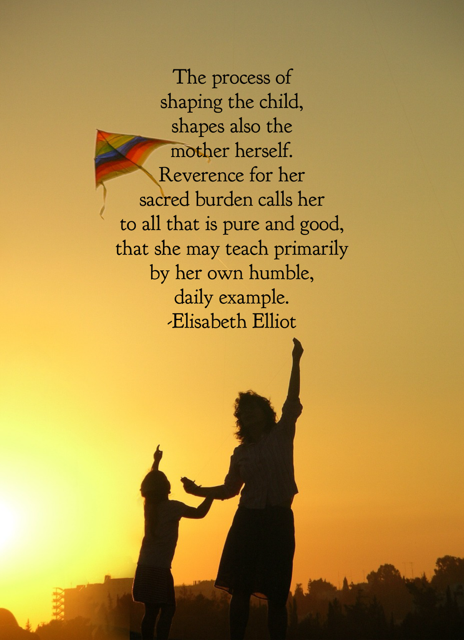
Elisabeth Elliot quote about mothers

The process of shaping the child, shapes also the mother herself. Reverence for her sacred burden calls her to all that is pure and good, that she may teach primarily by her own humble, daily example. Elisabeth Elliot
31 Days of Missionary Stories: William Carey: “Attempt great things for God. Expect great things from God.”

CareyNo series like this would be complete without mention of William Carey, who is known as the “Father of Modern Missions.” In reading of his life, one cannot help but be struck by the providence of God in preparing and directing him and the perseverance of William Carey in the face of seemingly insurmountable odds.

He was born near Northampton, England in 1761 to a poor weaver. When he was six, his father was appointed a clerk for the Church of England. William loved to read, and in that day most books were only owned by rich people and clergymen; so with his father’s new appointment came many opportunities to borrow books. William was fascinated by tales of explorers and other lands. He was also very quick with languages. He taught himself Latin from an old book of his uncle’s that he found along with an old dusty Latin grammar book his father had found. Later on as a teenager, after finding a book of Greek, he found someone to teach it to him, and quickly picked it up as well.

William completed the schooling available to him at the age of 12 (only those who could afford to continued their formal education beyond that; William’s family could not.) William loved the outdoors and went to work on a farm; however, he got a painful rash on his hands and face whenever he was out in the sun. He tried to continue the work for two years, but finally had to give it up. It is likely that if he had continued on in that labor, he would have remained a poor farmer all his life. Instead, his father apprenticed him to a shoemaker. William was able to work with a book propped up nearby and continued to learn. The other apprentice was a “dissenter” — one who disagreed with much in the Church of England. They had some lively arguments, but in the end William became a dissenter, too, eventually becoming one of their preachers. After a few years, a congregation called him to be their pastor.

William was also able to teach school. His geography lessons spurred not only his love of learning, but his compassion for people in other lands who did not know Christ. His interest grew into a passion which compelled him to action.

Churches didn’t send out missionaries in the late 1700s — at least not Dissenting English churches. Many felt that the “Great Commission” was given to 11 disciples in the New Testament and wasn’t applicable in modern times. At a minister’s meeting, William tried to share his burden and vision for reaching the lost in other lands. He was told by an older pastor, “Young man, sit down! If God wants to convert the heathen, He will do it without consulting you — or me!” He was soundly rebuked as a “miserable enthusiast.” This drove William to study to see if the minister was right, but he became more convinced than ever that they had a responsibility to the heathen. The more he studied about other countries, the more he felt burdened for souls lost in darkness: the more He studied Scripture, the more he saw evidence that the church was indeed called to spread the gospel.

Since the subject caused such dissension in public meetings, he began to talk with other pastors individually. He was urged to write a pamphlet and eventually was able to so, only the “pamphlet” turned into an eighty-seven-page book with a forty-two-word title. It became known as the Enquiry. In it, William addressed some common misconceptions:

Objection: How do we know that this command is still valid? Not even divine injunctions abide forever. They have their periods and pass, like the Levitical law.

Reply: Nay, divine injunctions abide till they have fulfilled their function. Who can think this command exhausted, with the majority of mankind not yet acquainted with Christ’s name?

Objection: But Christ’s command could scarcely have been absolute, seeing they never heard of vast parts of the globe — the South Seas, for example — nor could these be reached. Neither can we think it absolute today, with very large regions still unknown and unopened.

Reply: As they (the apostles) were responsible for going according to their strength into all their accessible world, we are in duty bound to speed into our much enlarged world. Indeed, we ought to be keen to go everywhere for Christ, till all closed doors are open.

Other sections of the book listed the history of missions in the world, the facts as they knew them about the world at the time (including the fact that an estimated 76% or 557 million souls were lost), practical considerations, and the duty of every Christian (to pray, to plod, and to plan).

Soon after his book was published, there was a ministers’ meeting. William brought his book and gave copies to those who were interested. At his opportunity to preach, he chose the text from Isaiah 54:2: “Enlarge the place of thy tent, and let them stretch forth the curtains of thine habitations: spare not, lengthen thy cords, and strengthen thy stakes.” He urged the obligation of missions, concluding with the phrase famous to us now, “Brothers, attempt great things for God. Expect great things from God.” Some of the ministers were shaken. Yet later on, in the business meeting, there were no resolutions and no discussion about missions. When the meeting was adjourned, “William leaped to his feet. ‘Is nothing going to be done again?’” He compared them to the ten scouts of Moses. One man moved to reopen for business, and a majority agreed. Within minutes they passed a resolution: “Resolved, that a plan be prepared against the next ministers meeting at Kettering, for forming a Baptist Society for propagating the gospel among the Heathens.”

Opposition still abounded.  Some felt the church could not afford such a thing. Only two dozen of the congregations in their Association approved.

In the next months, William was led to offer himself as their first appointee. His wife flatly refused to go (though she eventually relented, a depression that began when her first baby died continued to grow. She was mentally unstable a good portion of her adult life.) His father was bitterly opposed. The East India Company feared missionaries would interfere with their trade and opposed them; in fact, William could have been arrested and deported except that a Dutch settlement in India took him in.

Though he had many hearers, there were no converts for seven long years. The first convert was bitterly persecuted, but his family and others to turned to Christ instead of away from Him.

William’s facility with languages led to translating the gospel into several. Other missionaries eventually followed, with churches and a school established. Thanks to one man’s perseverance and God’s grace to him, many were saved and a great work was done that not only impacted Carey’s world for God, but continues to have influence on believers today.

William Carey was a shining example of his own motto, “Attempt great things for God. Expect great things from God,” but near the end of his life, when another missionary came to visit him and discuss his work, William said, “You have been speaking about William Carey. When I am gone, say nothing about William Carey — speak only about William Carey’s Savior.”

William died on June 9, 1834. The epitaph on his tombstone reads:

“A wretched, poor, and helpless worm
on Thy kind arms I fall.”

(Some information taken from William Carey, Father of Modern Missions by Sam Wellman.)

(You can see a list of other posts in the 31 Days of Missionary Stories here.)

(This will also be linked to Semicolon‘s Saturday Review of Books.)