Friday’s Fave Five

Welcome to Friday’s Fave Five, hosted by Susanne at Living to Tell the Story, in which we can share five of our favorite things from the last week. This has been a wonderful exercise in looking for and appreciating the good things God blesses us with. Click on the button to learn more, then go to Susanne’s to read others’ faves and link up your own.

I missed last week due to a quick out of town trip. Here are a few of my faves from the past couple of weeks:

1. More presents. I had mentioned my dear hubby snagged a good deal on an HP TouchPad for my birthday: he went on to buy me this case for it…trimmed in pink!

I used it when we went away last weekend to keep the TouchPad from getting banged up in the suitcase.

He also got me a dock thingy (dontcha love my technological expertise? 🙂 ) in which the TouchPad rests nearly upright while still charging the battery. I’ve got it on the kitchen counter and I’m loving the “Shuffle” mode to play the CDs I loaded onto it. That feature is way-old news for those of you with iPods and such, but this is the first time I’ve used it. It’s like listening to a radio without commercials! And it’s bringing up songs I hadn’t listened to in a while. Love it!

2. Coolness. The temperatures have been really pleasant this week, such a relief from the heat but not too chilly yet. Some leaves are even starting to change — I don’t know if we’re in for an early fall. Traditionally we’ll usually have some more hot days before fall fully arrives. But this has been a lovely week temperature-wise.

3. Wraps. I had one for lunch last week and one at a restaurant a while back while traveling. They make for a refreshing, not too heavy meal. At home I usually have one with instant ramen noodle cup-of-soups — maybe not the healthiest thing on the planet, but every now and then it really hits the spot.

4. Nice people at counters. The lady at the hotel counter where we stayed last weekend was just the perfect blend of niceness — friendly but not overly so, pleasant but not syrupy sweet. It really is refreshing to have someone like that help you rather than someone who acts like they’d rather be somewhere else or could care less if you’re there.

5. A day off. We don’t “celebrate” Labor Day per se, but we do like the day off. No major plans, just puttered around the house, took a really nice nap to the sound of gently falling rain, and got barbecue from a local restaurant. A nice day after a super-busy weekend.

There — I worked in all of the faves I had jotted down without going over five. 🙂

But here is a little bonus I saw in a Victorian Trading Company catalog: I don’t wear boots and these are too expensive, but they are so cute:

Happy Friday!

Rambles…

I don’t know if anyone reads this type of post, but I’m just rambling about what’s going on in our lives lately…

Last weekend we spent a few days at our old house in SC to get it ready to put on the market. We hadn’t put it on the market yet because the market was so sluggish we felt we’d lose money on it and because about half a dozen houses were up for sale on our street (which might make a potential buyer wonder what’s wrong with the area). Jim’s company has been helping with the old house payments as part of his relocation package, but that’s coming to an end before long, so we need to get the ball rolling. If we can’t sell it in a reasonable time frame, we’ll look into renting it. Jim already looked into a leasing company, which would help since we’re in another state, but I’d really rather be out from under the responsibility completely.

Jim took off a few days and went down on Thursday; Jesse and I went after school got out on Friday. I don’t think I had been back to the house since Jeremy moved a year ago. Jason and Mittu did some work on it while they lived there, and Jim and Jesse took a few excursions over the summer to paint and do minor repairs. So it was good to see those.I certainly don’t miss those stairs, though.

My main order of business was cleaning: mopping all the rooms that didn’t have carpet, wiping out cabinets, dusting windowsills, vacuuming, cleaning up the stove and counters, making runs to W-Mart, etc. It looks a lot better, but it’s discouraging, because the more you do the more you see needs to be done, but at some point you just run out of time and energy. But we got it to the place where the realtor could take decent pictures.

We also took everything we had left in the attic (Jim and Jesse, actually, did that) and a heap of things Jason and Mittu had left and sorted through what to keep, trash, or donate. I finally let go of a number of toys I had held on to for grandkids some day. Funny how I had more of a hard time letting go of some of the toys than the kids did. But I tried to look at it realistically. When mine were little, my mother-in-law kept a box of toys for the kids to play with at her house, and they were all old, faded, labels torn off, etc., and the kids just weren’t motivated to play with them even though they “worked.” So I tried to look at things through that lens, and it wasn’t necessarily easier to let them go emotionally, but it did help me to be more practical.

I also had one box of the kids’ work from our four years of home schooling and a couple from elementary school years. It was fun to sort through those. Though there is a part of me that wants to hang on to all of that, I decided not to keep rote stuff like spelling tests and math exercises and workbook sheets, but rather just the things that showed some of their personality and creativity. I’m looking forward to going through the papers I kept more carefully.

Jesse got to go for a few hours to a youth activity our old church was having. He tries to touch base with friends whenever we’re there, and he missed a couple he really wanted to see, but I’m glad he got to do that, at least.

While Jim was there alone he just slept at the house — we have one couch and love seat still there. But when Jesse and I came down we all stayed at a hotel. Jim went back to the house early Sat. morning to get started, while Jesse and I finished getting ready and packed up. I had two dresses on hangers in the closet and laid them on the end of the bed so I’d be sure to see them — and somehow I missed them, even though I took another pass through the room to make sure we had everything. 🙄 I drive myself crazy with double and triple checking things, and still miss or forget things. Sigh. Thankfully the hotel found them and sent them to us, though it cost about the price of one of the dresses to do so!

We ended up getting back here about 11 p.m. Saturday night, exhausted. I had thought we might stay for the Sunday morning service at our old church, but Jim wanted to get back. I was dragging through Sunday, and though I don’t usually like to get meals out for Sunday dinner, I asked if we could this time. We brought home Papa Murphy’s pizza. I did get a good nap in the afternoon.

Our Labor Day was just a low key day. Jim and Jesse unloaded some of the stuff we brought back, cleaned out the cars, I did laundry and such, Jim and I took a nap in the afternoon. We had some much needed rain — no thunderstorms or heavy pouring, just gentle steady rain that was very pleasant to fall asleep to.

I’m still working on the best way to schedule my time since school started back, mainly struggling with where to fit the exercise in. I like to do it before showering, but during the school year I usually shower first thing. So I’ve been trying different things — still haven’t found an ideal situation, but I’m still keeping up with it. I don’t want to lose what ability I’ve worked up to, even though some days I exercise through gritted teeth because I don’t want to do it. But usually by the time I’m done I’m glad I did.

That’s probably way more than enough rambling for one day!

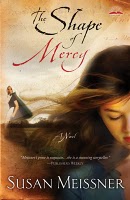
Book Review: The Shape of Mercy

I read Susan Meissner’s Lady in Waiting last year and subsequently wanted to read more of her books. So I recently picked up The Shape of Mercy which was published in 2008, and I remembered several bloggers mentioning it and liking it, so I decided to give it a try.

In The Shape of Mercy, Lauren Durough comes from a family of wealth and privilege, but wants to forge her own path, her own destiny. She defies tradition by going to a different college than expected and living in the dorms, and she takes a further step by looking for a job to take care of living expenses rather than depend on her father’s stipend. That leads her to an eighty-three year old well-to-do retired librarian, Abigail, who is looking for someone to transcribe a diary that was written by one of her ancestors, named Mercy, who had been arrested and convicted during the Salem witch trials.

Lauren learns that misjudgment and jumping to conclusions did not die in 1692, but she is especially startled to learn the extent those elements rule her own heart.

Overall I thought this was a marvelous, multi-layered book. Susan brilliantly wove together the diary entries with the contemporary story, and I was drawn in to Lauren’s growth and realizations about herself as well as her curiosity about Abigail’s life. There were times when I didn’t want to put the book down, times I was almost in tears for different characters.

This would be one of those five-star, two thumbs up reviews except for just a couple of things.

Major Spoiler Alert:

It doesn’t bother me so much that one character commits suicide — I think such a thing is always a tragedy, but I can accept it as part of the plot because such does happen in the real world. What does bother me, though, is that is is regarded by the other characters as something heroic, sacrificial, and done out of love when biblically it is never regarded that way. “Thou shalt not kill” certainly applies to one’s own life as well as others. There is a difference between taking a bullet for someone and aiming that bullet at yourself. Suicide is the ultimate taking of your own life into your own hands and the ultimate lack of faith in God to handle one’s life circumstances as He sees fit. There were Bible people who wanted to die, but they left the actual process to the Lord. I don’t want to turn this into a treatise on suicide, but felt I must explain why the response in this book disturbed me.

Secondly, at one point the author refers to “that bit of the divine still smoldering in us.” If she means that we’re made in God’s image and some of that can still be seen even though we’re marred by the fall of man and our own personal sin, I can agree with that. If she means some spark of divinity resides in every human being, I can’t agree with that.

But other than those two elements, I really enjoyed the book and I do plan on reading more of Meissner.

Something neat I just found earlier today is a blog where Meissner continued the stories of some of the characters as blog posts here. I poked around just a bit today and I am looking forward to reading a bit more.

(This review will also be linked to Semicolon‘s Saturday Review of Books.)

Book Review: Peace Like a River

I had seen many bloggers refer to Peace Like a River by Leif Enger years ago, and I put the title on my TBR list, but only got to it the last couple of weeks: my family wanted ideas for my birthday, and I scanned my list of TBR titles and suggested this one and a couple of others.

The story is told by eleven-year-old Reuben Land, who almost didn’t survive his birth as a severely asthmatic child but was brought back after twelve minutes without breathing by his father calmly saying, “Reuben Land, in the name of the living God I am telling you to breathe.”

Thus begins a series of miracles at the hands of Reuben’s father. After many of them Reuben says, “Make of that what you will.” Honestly, I don’t know what to make of that, and that may be why I hadn’t sought out this title earlier, but figuring out the author’s theology of such isn’t really necessary to enjoying the story. Reuben narrates the book as a witness: “Someone to declare, Here’s what I saw. Here’s how it went. Make of it what you will.”

In Reuben’s eleventh year, his brother Davy kills two bullies, somewhat but not entirely in self-defense, and escapes jail when he seems sure to be convicted (not much of a serious spoiler there as the back of the book refers to Reuben’s “outlaw older brother who has been controversially charged with murder.”) There follows a strange dichotomy of heart for some of the characters and for me as a reader as well: you find yourself hoping Davy is okay, yet knowing that he has to face justice, and grieving that he seems to have no regrets or repentance. After a time Reuben, his nine-year-old sister Swede, and their father go after Davy to try to find him, only to discover after a time that the FBI is following them. Throughout it all the character of each unfolds through the events, especially that of Reuben’s father.

Leif Enger is a wonderful storyteller. The book feels as if you’re sitting across from him in rockers on the front porch, listening to him tell a story. One reviewer’s blurb on the back of the book says “his novel moves in a current that can be poetic and slow or as tumultuous as whitewater rapids,” an apt description. He’s no mean poet as well, as through Swede he shares segments of an epic Western poem (though it didn’t seem like this could come from the hand of a nine-year-old girl, precocious as she was). I also liked that the chapter titles were significant: this was the first book in a long time in which I paid attention to the titles and at the end of each chapter looked back and thought about the title designations. And at the end of the book, when I turned it over and looked again at the front cover, I realized with a start who the shadowy horseback rider was, and nearly came to tears.

Some of Enger’s phrases stood out to me as well: a description of a particular women who “resembled an opportunity missed by Rembrandt”: “Fair is whatever God wants to do”; a reference to something people say “as if they’ve been educated from greeting cards.”

There were humorous parts as well: in one incident when Reuben and another girl end up in the church kitchen during a long service and start to make pancakes, the smell floats up to the sanctuary, influencing one man to “prophesy” about heavenly smells at the Lord’s banquet table.

I probably should say for some readers that though there is a description of a charismatic service, I am not charismatic and not promoting that kind of thing, but I am not going to dissect all of that. One doesn’t have to agree with every little point in a book to benefit from it.

I did enjoy the book and it had me pondering for a while afterward. In a search earlier today I came across this interview which shed more light both on the author and the book. I am definitely planning to put his next one, So Brave, Young, and Handsome on my TBR list.

(This review will also be linked to Semicolon‘s Saturday Review of Books.)

The Week In Words

”"

Welcome to The Week In Words, where we share quotes from the last week’s reading. If something you read this past week  inspired you, caused you to laugh, cry, think, dream, or just resonated with you in some way, please share it with us, attributing it to its source, which can be a book, newspaper, blog, Facebook — anything that you read. More information is here.

From a friend’s Facebook:

“God’s solution is sometimes different. He does not always lift people out of the situation. He does not pluck them out of the darkness. He becomes the light in the darkness, the peace in the midst of the conflict….” Patricia St. John

Reminds me of a plaque I had some years ago that said something like, “Sometimes God stills the storm, and sometimes He stills His child in the midst of the storm.”

From Lisa‘s Twitter feed:

God’s self-exaltation is not because he’s incomplete without praise, but because we’re not complete without it. ~ John Piper

I mentioned some time back a professor bringing up a rhetorical question without really answering it and it causing me some problems for years. It was on this topic, and this quote helps immensely. I had come to that conclusion before, that God’s wanting our praise had more to do with our need of it than his desire for it, but I love the way Piper put it.

From another friend’s Facebook:

“Failure…the opportunity to start over again with more knowledge than you had before.”

One of the most valuable sermons I ever heard, one that has stuck with me for decades, was one in college having to do with failure. I wasn’t failing, but I was struggling more than I ever had and felt like I was failing, and of course have had many individual failures throughout life. It was such a blessing to know failure was not an end in itself.

And finally, from this blog which I discovered while searching for something else:

“We ought to give thanks for all fortune: If it is ‘good’ because it is good, if ‘bad’ because it works in us patience, humility and the contempt of this world and the hope of our eternal country.” ~ C.S. Lewis

If you’ve read anything that particularly spoke to you that you’d like to share, please either list it in the comments below or write a post on your blog and then put the link to that post (not your general blog link) in Mr. Linky below. I do ask that only family-friendly quotes be included.

I hope you’ll visit some of the other participants as well and glean some great thoughts to ponder. And don’t forget to leave a comment here, even if you don’t have any quotes to share! 🙂

Laudable Linkage

I was so sorry to have missed the Friday’s Fave Five yesterday! There were some things that *had* to get done yesterday, so I figured I’d better do those first…and it is a good thing I did! Instead of writing a very late FFF post, I decided just to wait til next week.

But I wanted to share a few interesting links from this week’s web perusal and one very special video.

Thoughts on Proverbs 27:2, HT to Diane.

A Holy Moment realizing the weight of online words.

Are You Frustrated With Your Local Church?

Retreat Planning Ideas, HT to Lizzie.

I Spy Something Lovely.

A Mother Hears Her Daughter’s Heart Beat One Last Time. A transplant patient who received the heart of a teen-ager offers to let the girl’s mother hear her heart beat. Very touching, very moving story, for both moms. Get the tissues out.

Book Review: Goforth of China

Goforth of China by Rosalind Goforth is a book I have read many times, and I recently felt an urge to revisit it. It has taken me a while to talk about it, though, because I have so many places marked in it, it would be impossible to share all of them.

Jonathan Goforth grew up as the seventh of eleven children on a farm in Canada. Though an excellent farmer, he felt the call of God to go to China as a missionary after hearing someone speak on Taiwan. Jonathan’s mother was an excellent seamstress, but Jonathan was marked for teasing by his more urban classmates at college due to having home-made clothes and being somewhat naive and unpretentious. His fellow dorm mates went so far as to take new fabric he had bought to have new clothes made, cut a hole in it, put it over Jonathan’s head, and made him run up and down a hallway through a number of other laughing students. He felt afterward that this kind of behavior should be reported, but was told by the college authorities that it was just a harmless prank. It hurt him, not so much that this had been done to him, but that it had happened at a Christian college. Rosalind writes, “That night he knelt with Bible before him and struggled through the greatest humiliation and the first great disappointment of his life. The dreams he had been indulging in but a few days before had vanished, and before him, for a time at least, lay a lone road. Henceforth he was to break an independent trail. It is not hard to see God’s hand in this, forcing him out as it did into an independence of action which so characterized his whole after life” (pp. 31-32). By the time he graduated, he had the honor and support of the whole school, and many came to apologize for their actions that year. One particular student prayer meeting at a much-needed time helped make a definite change in his ability to use the Chinese language (told here).

College not only honed his intellect and forged his character, but it also was saw the beginnings of ministry as he reached out in various ways to lost people. He was a missionary long before he left the shores of his home country. He met his wife, Rosalind, as a fellow mission worker. Once when Jonathan left his Bible on a chair, Rosalind picked up his Bible. Finding markings throughout and the book itself falling apart, she thought to herself, “That is the man I would like to marry” (p. 49).

The Goforths headed to China at a time when the Chinese were greatly suspicious of “foreign devils.” Some of the stories circulated about the foreigners (such as the one that their medicine was so effective because it had the eyes and hearts of children in it, leading the people to fear the foreigners would kidnap their children) seem so ridiculous to read now and to think that anyone actually believed them, but suspicion was a great hindrance to their efforts to reach the Chinese. In an effort to counteract this, they held frequent tours of their home to let the Chinese see whatever they wanted to see (and sometimes the Chinese saw whatever they wanted to see by touching a dampened fingertip to the paper windows, making a peephole!) The result of one such incident I shared earlier near the end of this post.

The Goforths not only had to deal with everyday frustrations, but also major, heartbreaking trials. Four times in their ministry they lost nearly all their possessions, once by fire, once by flood, once during the Boxer rebellion (a harrowing time with a miraculous deliverance in itself), and lastly while on furlough when a new inexperienced missionary moved some of their belongings into an unlocked “leaking, thatched cowshed” (p. 211). After the last time, “when, in the privacy of their own room, the ‘weaker vessel’ broke down and wept bitter, rebellious tears, Goforth sought to comfort her by saying, ‘My dear, after all, they’re only things and the Word says, ‘Take joyfully the spoiling of your goods!’ Cheer up, we’ll get along somehow.'” He wasn’t being calloused: he had a generally faith-filled, buoyant spirit, while his wife had…one rather more like my own. The worst loss of all, though, that even shook Goforth himself was the loss of several children.

Despite and sometimes even through the trials they endured, God used them to bring many to Himself. Describing one of their evangelistic meetings, Rosalind said, “Oh, friends, who wrote in those days pitying us, would that you could have experienced, as we did day by day,…the keenest joy a human being can I believe experience, [seeing] men and women transformed by the message of God’s love in Christ” (p. 168).

Besides Goforth’s spirit mentioned above, one of his other major characteristics was his firmness of doctrine. Modernism was creeping into the church and eventually into its seminaries and missions, undermining its foundation, and Goforth saw firsthand the devastation it could wield on a person’s faith. He wasn’t afraid to speak out where he saw wrong, even if it wasn’t well-received and even (especially) when it infiltrated the church.

It was during such a time on furlough when some were even closing their pulpits to him that this was written, blessing my women’s-ministry-loving  heart: “Many times as he went throughout the churches he remarked on the blessed and powerful influence of the Women’s Missionary Society. When inclined to be depressed at the general deadness of the church, cheer and comfort would often come from the warmth of receptions given by the women” (p. 340).

God greatly used the Goforths not only in various countries in their own time, but ever since then as well through Rosalind’s writings. A few years ago Lifeline Ministries reproduced the original unabridged version of Goforth of China, and I was so glad to get it. Some years back Bethany House produced an abridged version titled Jonathan Goforth (which sadly doesn’t appear to be in print any more, but used copies can be found, or perhaps you can find it in a church or Christian school library). I’m afraid I’ve misrepresented that version in the past by complaining that the point of view switched from third to first person, but as I reread the original version, I saw Mrs. Goforth did that herself: overall she acted as narrator telling their story, but in some parts she slipped into the first person as she described particular incidents, especially those involving herself directly. It’s not as hard to follow, though, in the original: maybe some of the transitions didn’t make it to the abridged version. In many ways the abridged version is easier to read: the unabridged lists a great many names and places that wouldn’t mean as much to people not living at the time of the writing. My particular copy of the reproduction of the original has what appears to be some ink level problems: on some pages the print is very light, but on others it is very heavy, almost bleeding through the page. Hopefully they fixed that in subsequent printings.

Mrs. Goforth also wrote Miracles Lives of China (which I haven’t read), How I Know God Answers Prayer, and Climbing, one of my all-time favorite books. Jonathan wrote By My Spirit, telling of the revivals God sent to China. Another book which I haven’t read but which I think is geared toward children is Jonathan Goforth: An Open Door in China by Geoff and Janet Benge, part of the Christian Heroes: Then & Now series.

In an earlier post about why I love missionary biographies, I said, “There are heroes of our spiritual heritage who inspire us in love and dedication to God and to greater faith in remembering that the God they served and loved and Who provided for and used them is the very same God we love and serve today and Who will provide for us and use us.” The Goforths are such heroes, though they might balk at such a designation. Reading about them not only inspires faith but encourages us to follow in their footsteps of dedication. I hope you’ll read more about them.

(This review will also be linked to Semicolon‘s Saturday Review of Books.)