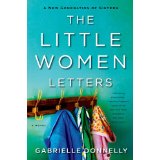
 In The Little Women Letters by Gabrielle Donnelly, a descendant of Jo March discovers some of her letters the attic. The modern Atwater family has three sisters who are similar in some ways to the March sisters, and Lulu, the one most like Jo, is the one to discover the letters. She’s at a crossroads in her life but doesn’t know which way to go and is getting heartily tired of questions and advice about career paths she should take. Over time she finds comfort in the similarities between herself and her great-great grandmother Jo. Meanwhile older, sensible sister Emma is preparing to be married and younger, vivacious sister Sophie is trying various acting roles.
The Atwater family isn’t meant to be an exact modern representation of the March family, but there are similarities, and some plot lines that follow incidents in Alcott’s book.
But there are differences as well…
The March girls had their spats, but they were teens and younger and learned to handle their differences better as they matured. The Atwater girls are all grown and out of their childhood home yet fight constantly and are quick to take offense. They were relating to other other better by the end of the book, but I got so sick of their bickering. The March girls seemed normal; the Atwater girls excessive.
Then, there is a wholesomeness to Little Women, which is missing from this book. This one has a smattering of “damns,” “hells,” and God’s name thrown around as an expression of disgust and exasperation (which I hate). I knew to expect that in a secular novel (and I am sure it is tame compared to a lot of what is out there), but I don’t have to like it. There is a quite vulgar sentence from a drunk man in a section where Lulu is working in a pub: we didn’t need to have that in order to get the idea of what kind of man he was and what Lulu faced while working there.
The counterpart to wise Marmee is feminist Fee, a free spirit who was married barefoot on the beach by a shaman. In a scene that hearkens back to Meg’s spending more than she should have buying fabric that she then has to ask her more well-to-do friend to buy back from her, Emma falls in love with a pair of designer shoes that cost as much as the refrigerator she and her boyfriend have been saving for, and in a moment of weakness lets herself be talked into buying them for her wedding. When she tells her mother about it, Fee says that because “the woman works far harder around the home than the man does,” she entitled to treat herself now and then (pp. 120-121). 🙄
I think it also jarred me a little that the book was set in England. Not that I am prejudiced against the British, but Little Women was very much an American book, set in a staunch New England family. I would have felt just as jarred if the modern family was distinctly Southern or western, even though it’s perfectly plausible that the March descendants would be scattered far beyond New England. And I don’t usually have trouble “getting” either dramas or comedies set in England, but I wonder if the setting had to do with my not understanding some of the humor — though the father’s having an imaginary wife struck me as very odd rather than humorous.
There were aspects I did like to the author’s writing. A couple of times she skillfully led me along thinking the plot was going to go one way and then it surprised me. She conveyed Lulu’s feeling of not fitting in anywhere (much like Jo’s) very well. By the end of the book I was more sympathetic to the characters and I liked how the book ended.
But overall, though the premise was wonderful, I am afraid the book fell far short of my expectations.
(This review will also be linked to Semicolon‘s Saturday Review of Books.)











 Stray Thoughts